

Choosing the wrong welding process costs real money. Whether you’re running a high-volume fabrication shop or taking on custom structural work, the process you select shapes your throughput, your weld quality, and your cleanup time. MIG welding (Gas Metal Arc Welding, or GMAW) has earned its place as the dominant process in fabrication shops worldwide, and for good reason. MIG is versatile across joint types, materials, and thicknesses, and its semi-automatic wire feeding makes it a natural fit for everything from one-off parts to fully automated production lines. This article breaks down exactly why.
Table of Contents
- Versatility across materials and settings
- Productivity and clean welds: Fewer passes, less cleanup
- Support for automation and robotics
- Better control through transfer mode selection
- Parameter optimization boosts weld quality
- Expert perspective: When (and why) MIG isn’t always the answer
- Upgrade your welding game with industry-leading tools
- Frequently asked questions
Key Takeaways
| Point | Details |
|---|---|
| Versatile applications | MIG welding works with a wide range of materials, joint types, and shop setups. |
| Boosted productivity | Continuous wire feed and cleaner beads help reduce overall welding and cleanup time. |
| Enables automation | MIG is the go-to process for automated welding and robotics thanks to its repeatability. |
| Process control | Selecting the right transfer mode maximizes weld quality and reduces defects. |
| Parameter tuning | Optimizing voltage, current, and other parameters can measurably improve weld strength. |
Versatility across materials and settings
With the challenge of process selection in mind, let’s start with MIG’s most recognized strength: its ability to handle a wide range of metals and joint configurations without swapping machines.
MIG welding handles mild steel, stainless steel, aluminum, and even some nickel alloys. You can run it on thin gauge sheet metal, thick structural plate, and everything in between. Joint types are equally flexible: butt joints, T-joints, lap joints, and fillet welds are all well within MIG’s range. For a fabrication shop that moves between light gauge automotive panels and heavy structural frames in the same week, that flexibility is a genuine operational advantage.
The controlled wire feeding system is a big part of why MIG delivers such consistent results across these varied applications. Because the electrode wire feeds continuously at a set rate, the arc length and heat input stay predictable. This reduces operator-to-operator variation and keeps your quality consistent even when different welders are running the same job. If you’re considering a multiprocess welding setup, MIG’s adaptability means it covers the majority of your shop’s daily workload from a single machine.
“MIG is versatile across many joint types, materials, and thicknesses, and it supports automation/robotic use because of its semi-/fully-automatic nature and controlled wire feeding.” — Schuette Metals
Reducing the number of machines you need on the floor also shortens changeover times. Instead of reconfiguring a stick setup or swapping to TIG for a different material, you adjust wire type and gas mix and keep moving.
Productivity and clean welds: Fewer passes, less cleanup
Once versatility is established, the next crucial advantage is shop productivity and minimizing rework. And this is where MIG really separates itself from stick and flux-core in controlled environments.
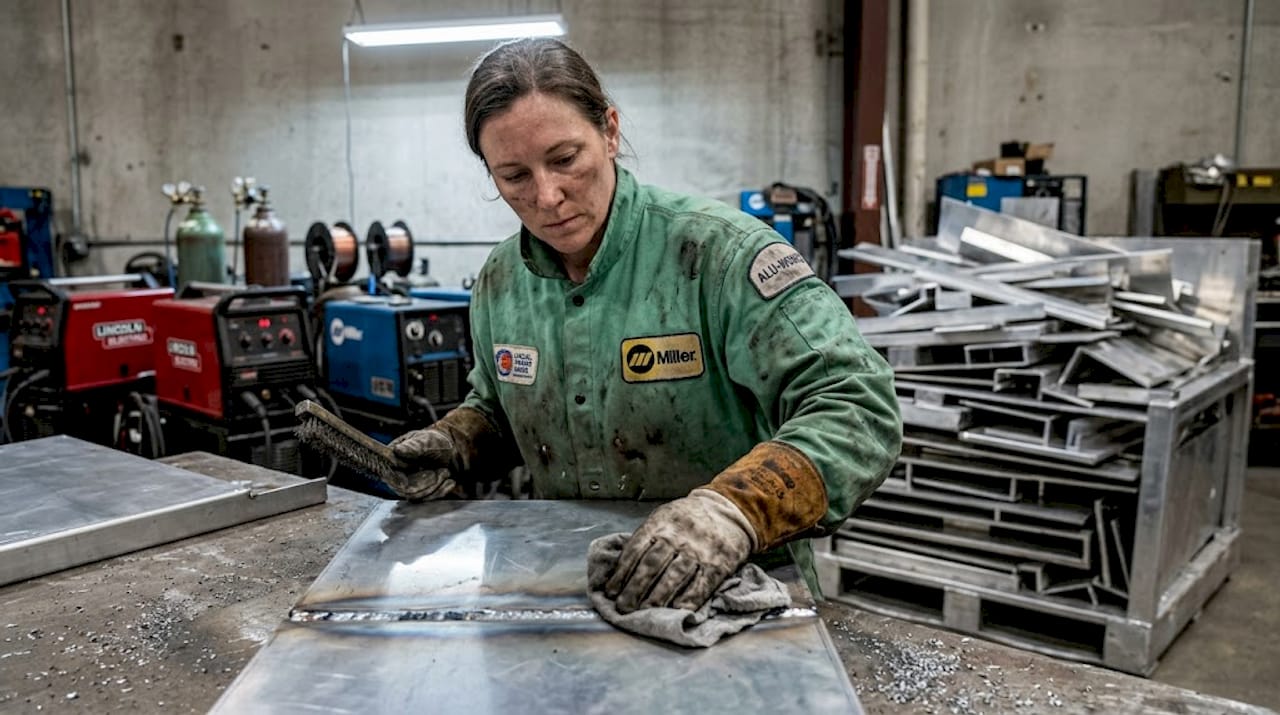
MIG’s biggest operational advantage is typically cleaner beads and speed in controlled, sheltered environments. The continuous wire feed means you’re not stopping to replace electrodes, and the shielding gas produces a much cleaner bead than flux-based processes. Less slag, less spatter, less grinding. On a high-volume job, that time adds up fast.
Here’s a practical breakdown of where MIG saves you time compared to stick and flux-core:
- No slag removal. MIG’s gas shielding leaves no slag layer to chip off after each pass.
- Minimal spatter with correct settings. Proper wire and gas selection keeps spatter low, reducing grinding time between passes.
- Faster travel speeds. MIG allows higher travel speeds than TIG, especially on thicker material.
- Fewer interruptions. Continuous wire feed means you’re welding, not stopping to swap electrodes every few inches.
- Single-pass capability on thinner material. On sheet metal and light structural work, MIG often completes joints in one pass where stick might require multiple.
Pro Tip: Matching your wire type and shielding gas to the base metal is the single fastest way to reduce post-weld cleanup. For mild steel, ER70S-6 wire paired with a 75/25 argon/CO2 mix produces a smooth, low-spatter bead. Switching to pure CO2 increases spatter noticeably, even with identical machine settings.
For shops focused on clean bead techniques, investing in a quality MIG machine with precise voltage and wire speed control pays for itself quickly in reduced labor on cleanup and rework.
Support for automation and robotics
To scale these productivity advantages further, MIG’s fit for automation and robotics is worth examining in detail. No other common arc welding process integrates as naturally into automated production lines.
Repeatable weld quality is the core requirement in automated manufacturing. A robotic welder needs to produce the same result on part 1 and part 10,000. MIG’s semi-automatic MIG welding architecture, with its consistent wire feed rate and stable arc, is exactly what robotic systems need to maintain that repeatability. TIG requires a skilled hand to manage filler rod addition manually, making full automation difficult. Stick is simply not practical for robotic use.
| Process | Automation suitability | Speed | Consistency | Setup complexity |
|---|---|---|---|---|
| MIG (GMAW) | Excellent | High | High | Low to medium |
| TIG (GTAW) | Limited | Low | Very high | High |
| Stick (SMAW) | Poor | Low | Variable | Low |
| Flux-core (FCAW) | Good | High | Medium | Medium |
Common MIG automation applications include:
- Automotive body and frame assembly
- High-volume structural fabrication
- Appliance and HVAC manufacturing
- Robotics and machinery assembly lines
- Pressure vessel and pipe spool fabrication
Companies that invest in streamlined manufacturing processes consistently point to MIG automation as a key driver of throughput improvement. The ability to run lights-out welding on repetitive parts is a real competitive advantage for fabrication shops competing on price and delivery time.
Pro Tip: For robotic MIG applications, consistent gas flow is non-negotiable. Even small fluctuations in shielding gas delivery cause porosity and inconsistent fusion. Use a quality regulator with a flow meter, and check your gas lines for leaks before every production run.
Better control through transfer mode selection
For those aiming to master MIG’s potential, control over the transfer mode is the next level advantage. Most welders know MIG as a single process, but it actually operates in four distinct metal transfer modes, each suited to different applications.
MIG process performance depends heavily on the transfer mode, which changes heat input, penetration, spatter, and positional capability. Here’s how each mode works and when to use it:
- Short-circuit transfer. The wire physically contacts the puddle and short-circuits repeatedly. Low heat input, good for thin material and out-of-position work. Best for sheet metal under 3/16 inch.
- Globular transfer. Large droplets transfer across the arc. Higher spatter, limited positional use, but works at higher deposition rates on flat or horizontal joints.
- Spray transfer. Fine droplets spray across a stable arc. Very clean, high deposition, excellent fusion on thicker material. Flat and horizontal positions only, requires higher voltage and argon-rich gas.
- Pulsed transfer. Alternates between high and low current pulses. Combines spray transfer’s clean bead with short-circuit’s lower heat input. Excellent for aluminum, stainless, and out-of-position work on thicker material.
| Transfer mode | Heat input | Positions | Spatter level | Best application |
|---|---|---|---|---|
| Short-circuit | Low | All | Low | Thin material, root passes |
| Globular | Medium | Flat/horizontal | High | Thick plate, less critical joints |
| Spray | High | Flat/horizontal | Very low | Thick structural, high deposition |
| Pulsed | Low to medium | All | Very low | Aluminum, stainless, out-of-position |
When you choose MIG wire and gas mix, you’re also selecting which transfer modes are available to you. A 75/25 argon/CO2 mix supports short-circuit and pulsed transfer well. Spray transfer requires 90% or higher argon content. Understanding this relationship gives you on-the-fly adaptability when a challenging workpiece demands a different approach.
Parameter optimization boosts weld quality
Beyond basic process choice, fine-tuning parameters brings MIG’s weld strength into focus. This is where the difference between a competent welder and an expert welder becomes measurable.
Welding parameters measurably affect MIG weld strength and quality, and studies using DOE (Design of Experiments) and Taguchi methods have quantified exactly how much. Research testing current, voltage, wire feed speed, and shielding gas flow found that optimizing these variables produced significant improvements in tensile strength compared to default settings. The Taguchi method, which systematically tests parameter combinations to find the optimal set, is increasingly used in production environments to dial in weld procedures.
The most critical parameters and their direct effects:
- Current (amperage). Controls penetration depth and deposition rate. Too low causes lack of fusion; too high causes burn-through on thin material.
- Voltage. Controls arc length and bead profile. Higher voltage flattens and widens the bead; lower voltage produces a more convex, narrower bead.
- Wire feed speed. Directly tied to current in most MIG machines. Faster feed increases heat input and deposition.
- Shielding gas flow rate. Too low allows atmospheric contamination; too high creates turbulence that can draw in air. Typical range is 20 to 35 cubic feet per hour depending on nozzle size and environment.
- Travel speed. Faster travel reduces heat input and bead width. Slower travel increases penetration and can cause burn-through on thin material.
| Parameter | Effect on weld | Typical range (mild steel) |
|---|---|---|
| Current | Penetration, deposition rate | 100 to 250A |
| Voltage | Bead width, arc stability | 18 to 26V |
| Wire feed speed | Heat input, deposition | 200 to 450 in/min |
| Gas flow rate | Shielding quality | 20 to 35 CFH |
| Travel speed | Heat input, bead profile | 10 to 20 in/min |
For shops running best practice MIG welding procedures, documenting your optimal parameter sets for each base metal and joint type is one of the highest-return investments you can make. It eliminates the guesswork when a new welder runs a familiar job and keeps your quality consistent across shifts.
Expert perspective: When (and why) MIG isn’t always the answer
Here’s the part most articles skip. MIG welding is genuinely excellent, but treating it as a universal solution is how shops end up with burn-through on thin stainless, porosity on outdoor structural jobs, and frustrated welders fighting a process that’s wrong for the work.
The honest reality is that outdoor wind tolerance favors other processes over MIG when portability and field conditions are the primary concern. MIG’s shielding gas is easily disrupted by wind, even at relatively low speeds. On a construction site or outdoor structural job, stick or flux-core will outperform MIG every time because they don’t depend on a gas envelope to protect the weld puddle.
TIG welding is the better choice when surface finish and metallurgical precision matter more than speed. Thin stainless, aluminum tube, and aerospace-grade work all benefit from TIG’s precise heat control and clean bead appearance. If your shop does a lot of ornamental or food-grade fabrication, TIG is not a luxury, it’s a requirement.
Transfer mode selection is a practical pro-level lever: if your MIG setup repeatedly struggles with burn-through, spatter, or lack of fusion on thin or poorly fit-up joints, the problem is often process mismatch, not operator error. Switching to a more appropriate transfer mode, or matching your gas mix correctly, can directly change heat input and fusion behavior. But sometimes the right answer is switching processes entirely.
Watch for these red flags that MIG may not be optimal for the job:
- Consistent burn-through on material under 16 gauge despite dialing down parameters
- Uncontrollable spatter that persists even with correct gas and wire selection
- Porosity that appears repeatedly in outdoor or drafty environments
- Base metal contamination (mill scale, rust, paint) that can’t be fully cleaned before welding
- Joint fit-up that’s too inconsistent for MIG’s narrower tolerance for gaps
The best fabrication shops treat process selection as a skill, not a default. Knowing when to put down the MIG gun and pick up a stick electrode or TIG torch is what separates shops that produce quality work from shops that fight their equipment all day. Check out TIG and stick alternatives when the job calls for a different approach.
Upgrade your welding game with industry-leading tools
Armed with a clear picture of MIG’s strengths and its limits, the next step is making sure your equipment can actually deliver on those advantages.
A MIG welder that can’t hold stable voltage or maintain consistent wire feed speed will undercut every technique and parameter optimization you apply. At Simpleweld.com, we carry the machines and consumables that let you put this knowledge to work. The Miller Multimatic 215 is a top choice for shops that need MIG, TIG, and stick capability in one reliable unit, covering the full range of processes discussed in this article. For shops focused on MIG production work, the Lincoln POWER MIG 210 delivers the arc stability and parameter control that makes clean beads and fast travel speeds achievable consistently. Browse the full range of professional welding tools to find the right fit for your shop’s specific workload.
Frequently asked questions
What are the main advantages of MIG welding over stick welding?
MIG’s biggest operational advantage is cleaner beads and faster welding speed in controlled environments, with no slag removal required after each pass. This translates directly to less cleanup time and higher throughput on production work.
How does automation in MIG welding improve shop productivity?
MIG’s semi-automatic wire feeding and consistent arc characteristics make it the most practical process for robotic welding systems, enabling repeatable weld quality and higher production rates with reduced manual labor.
Which parameters most affect MIG weld quality?
Current and voltage are most significant, with wire feed speed, shielding gas type, and travel speed also playing major roles in determining penetration, bead profile, and overall weld strength.
When might TIG or stick be preferable to MIG?
Outdoor or windy conditions make MIG’s shielding gas unreliable, making stick or flux-core the more practical choice. TIG is preferred when surface finish, metallurgical precision, or thin exotic materials are the priority.