

Picking the wrong cutting tool doesn’t just slow you down. It can ruin a workpiece, create dangerous heat distortion, and force costly rework that eats into your margin. Every fabrication shop deals with a rotating mix of materials, thicknesses, and tolerances, and no single tool handles all of them well. Whether you’re roughing out heavy plate, trimming stainless tube, or making precision cuts for structural weld joints, the tool you reach for first matters more than most welders realize. This guide walks through the evaluation criteria, tool profiles, and real-world scenarios that help professionals make faster, smarter decisions on the shop floor.
Table of Contents
- How to evaluate cutting tools for metalworking
- Overview of essential cutting tools and their uses
- Comparison table: Cutting methods by material, thickness, and finish
- Situational recommendations: Which cutting tools to use and when
- What most welders miss about cutting tool efficiency
- Shop industry-leading cutting tools at Simpleweld
- Frequently asked questions
Key Takeaways
| Point | Details |
|---|---|
| Match tool to material | Choosing a tool that’s compatible with your metal type and thickness ensures efficient, quality cuts. |
| Balance speed and finish | Faster methods may compromise edge quality, so select based on your project’s end requirements. |
| Control heat impact | Methods like waterjet and laser cutting minimize Heat-Affected Zones for precise fabrication. |
| Assess long-term costs | Initial tool investment can lower ongoing labor, rework, and material expenses. |
How to evaluate cutting tools for metalworking
Before comparing individual tools, you need a consistent framework for assessing which one fits a given job. Experienced fabricators don’t just grab the nearest grinder. They think through a short checklist that keeps them from making expensive mistakes.
The core evaluation criteria every shop should use:
- Material compatibility: Not every tool cuts every metal cleanly. Abrasive wheels work well on mild steel but can contaminate stainless. Plasma cutters handle conductive metals only. Oxy-fuel torches struggle with aluminum and stainless.
- Thickness capacity: A standard 4.5-inch cut-off wheel is fine for thin-wall tubing but won’t get through 2-inch plate. Match the tool’s rated capacity to your actual stock thickness.
- Cut speed: High throughput jobs demand fast tools. Slower, precision methods cost time but save on finishing.
- Edge quality: The cleaner the cut edge, the less grinding and prep work before welding. Poor edge quality adds labor and can compromise weld integrity.
- Heat-affected zone (HAZ): The HAZ is the area around a cut where the base metal’s microstructure changes due to heat. A large HAZ weakens the material and can cause warping, especially on thin stock or heat-sensitive alloys.
- Safety: Some methods produce toxic fumes, sparks, or UV radiation. Your shop’s ventilation, PPE, and operator training must match the tool’s hazard profile.
- Maintenance and consumable cost: Plasma nozzles wear out. Bandsaw blades dull. Cut-off wheels are single-use. Factor in ongoing costs, not just the upfront price.
- Setup time: A laser cutter produces stunning results but takes significant programming time. For a one-off cut, an angle grinder with an ULTICUT cut-off wheel gets you there in seconds.
For structural weld prep specifically, edge condition and HAZ control are the two criteria that matter most. A rough, oxidized cut edge creates porosity and fusion problems in the weld. A large HAZ can change the grain structure of the base metal right where you’re trying to achieve a strong joint. Laser cutting precision is unmatched for thin to medium metals under 1 inch, producing minimal HAZ and near-net-shape edges, but the cost and speed penalty on thick plate means it’s not always the right call.
Pro Tip: When cutting material destined for a structural weld, always prioritize HAZ and edge condition over raw cut speed. A few extra minutes choosing the right method can save an hour of grinding and re-inspection.
A practical decision framework looks like this: identify the material type and thickness first, then set your tolerance requirement, then check your available tools against those two filters. Speed and cost become tiebreakers, not primary criteria.
Overview of essential cutting tools and their uses
Once you know what to look for, the next step is understanding your available tool options. Each cutting method has a sweet spot, and knowing those sweet spots is what separates efficient shops from ones that fight their tools all day.
Oxy-fuel torches are the workhorse of heavy steel cutting. They use a combination of oxygen and a fuel gas (typically acetylene or propane) to heat steel to ignition temperature, then blast it with pure oxygen to oxidize and remove the metal. They’re affordable, portable, and capable of cutting very thick plate. The downside is a large HAZ, rough cut edges, and limited compatibility. Oxy-fuel doesn’t work on aluminum, stainless, or cast iron without special techniques.
Plasma cutters use an electrically ionized gas stream to melt and blow away metal. They’re fast, work on any conductive metal, and handle thicknesses from thin sheet up to several inches depending on the machine’s amperage. Cut quality is good but not perfect, and the HAZ is moderate. Plasma is the go-to for shops that need speed and versatility across mixed materials.
Angle grinders with cut-off wheels are the most common cutting tool in any fabrication shop. They’re inexpensive, fast to set up, and incredibly versatile for straight cuts, notching, and cleanup. A quality 7-inch cut-off wheel handles structural steel, pipe, and angle iron quickly. The tradeoff is operator fatigue on long cuts, limited precision, and significant spark and debris hazard.
Bandsaws excel at straight cuts in bar stock, tubing, and structural shapes. A vertical bandsaw gives you control for contour cuts and shaped profiles, while horizontal models handle volume production cutting of bar and tube. Bandsaws produce a clean, burr-minimal cut with very low HAZ, making them ideal for pre-weld prep on structural members.
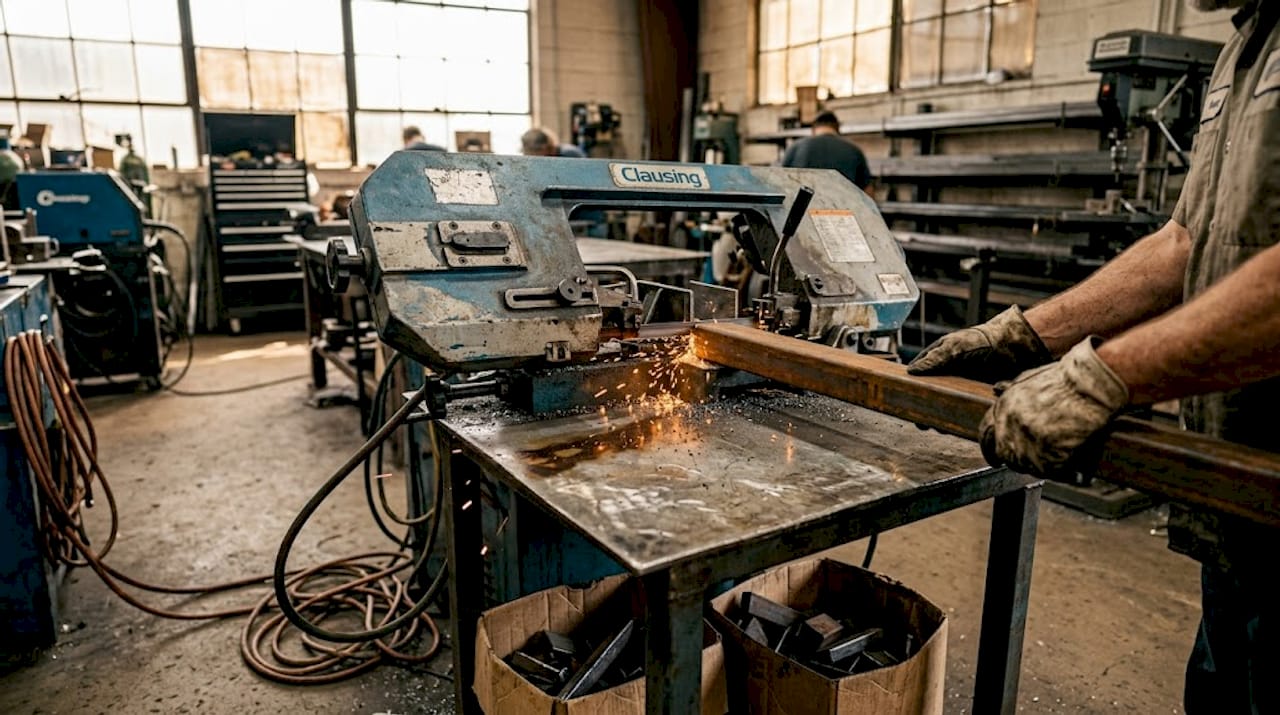
Laser cutters deliver the highest precision and edge quality available for sheet and plate up to about 1 inch. Laser precision and edge quality make them the preferred choice for parts requiring tight tolerances and minimal post-processing. However, the capital cost is high and cutting speed drops sharply on thick material.
Waterjet systems use a high-pressure stream of water mixed with abrasive grit to cut virtually any material without heat. Waterjet cold cutting means zero HAZ, making it ideal for heat-sensitive alloys like titanium, hardened tool steel, or aluminum composites. The tradeoff is slow cutting speed and high operating cost.
Pro Tip: If your shop regularly handles both mild steel roughing and precision stainless work, don’t try to do both with one tool. Keeping dedicated abrasive tools for carbon steel and separate precision methods for stainless prevents cross-contamination and saves finishing time.
Comparison table: Cutting methods by material, thickness, and finish
A head-to-head comparison makes it easier to pinpoint the right tool for any given job. The table below gives you a fast reference for the most common shop scenarios.
| Cutting method | Best materials | Max practical thickness | Cut speed | Edge finish | HAZ level |
|---|---|---|---|---|---|
| Oxy-fuel torch | Mild steel, low-alloy steel | 12+ inches | Moderate | Rough | High |
| Plasma cutter | All conductive metals | Up to 2 inches (heavy units) | Fast | Good | Moderate |
| Angle grinder / cut-off wheel | Steel, stainless, aluminum | Up to 0.5 inches | Very fast (short cuts) | Fair to good | Moderate |
| Bandsaw (vertical/horizontal) | Steel, aluminum, tube, bar | Up to 12 inches (blade dependent) | Moderate | Very good | Very low |
| Laser cutter | Sheet and plate metals | Under 1 inch (optimal) | Fast on thin, slow on thick | Excellent | Very low |
| Waterjet | Virtually all materials | 6+ inches | Slowest | Excellent | None |
Reading the table for real decisions:
For complex shapes and tight tolerances on thin sheet, laser wins on edge finish and HAZ control. Laser cutting’s precision advantage is clearest when you’re cutting parts that go straight to welding without secondary grinding. For thick structural plate where shape complexity is low, oxy-fuel or plasma is faster and far more cost-effective.
When heat sensitivity is the primary concern, waterjet’s no-HAZ process is the only method that eliminates thermal damage entirely. That matters enormously for hardened steels, pre-heat-treated aluminum, or any material where the mechanical properties must remain intact right up to the cut edge.
For high-volume production cutting of bar and tube stock, a horizontal bandsaw delivers consistent, clean cuts with minimal operator fatigue and very low per-cut cost once the blade is set up. Budget-conscious shops running repetitive structural cuts will find the bandsaw’s low HAZ and good finish quality hard to beat.
The common mistake is treating cut speed as the primary filter. Speed matters, but only after you’ve confirmed the method can actually produce the edge quality and HAZ level your downstream welding process requires. A fast, rough cut that needs 20 minutes of grinding is not actually fast.
Situational recommendations: Which cutting tools to use and when
Comparison is helpful, but real shop scenarios bring tool choices into focus. Here are the most common situations fabricators face, with direct tool recommendations for each.
-
Rapid roughing of mild steel plate (0.25 to 1 inch): Plasma cutter is your first choice. It’s fast, handles the thickness range cleanly, and the moderate HAZ is acceptable for most structural applications. Follow up with a flap disc if the weld joint needs cleanup.
-
Precision cuts on stainless sheet for food-grade or sanitary applications: Laser cutting is the professional standard here. The clean edge and minimal HAZ mean no oxidation contamination and no need for extensive post-cut cleaning. If laser isn’t available, a fine-tooth bandsaw with a blade rated for stainless is a solid backup.
-
Heavy gauge structural steel (over 2 inches thick): Oxy-fuel torch is the practical choice. Nothing else matches its capacity at this thickness range without massive capital investment. Expect to grind the cut face before welding.
-
High-volume production cuts on bar stock and tube: A horizontal bandsaw handles this better than anything else in the shop. Consistent cut angles, low blade cost per cut, and minimal operator input make it the efficiency leader for repetitive work.
-
Heat-sensitive alloys (titanium, hardened tool steel, pre-treated aluminum): Waterjet’s cold cutting process is the only method that guarantees zero thermal damage. The slow speed is a real cost, but it’s unavoidable when material integrity is non-negotiable.
-
Complex contoured cuts in medium plate: Plasma with CNC guidance or laser for thinner stock. For manual contour work, a vertical bandsaw gives you the control to follow curved layouts accurately.
“The biggest efficiency gain in weld prep isn’t a faster grinder. It’s choosing a cutting method that gets you closer to net shape with less HAZ, so your fit-up is tighter and your weld quality goes up without adding labor.” This principle applies whether you’re running a one-person shop or a full production floor.
One of the most common mistakes fabricators make is using an abrasive cut-off wheel for cuts that really need a bandsaw or plasma cutter. Cut-off wheels are fast and convenient, but they’re not designed for long straight cuts in thick stock. Pushing them beyond their rated capacity creates dangerous wheel failure risk and produces a rough, overheated edge that needs significant rework. A quality drill bit set paired with proper layout tools helps you plan hole locations accurately before cutting, reducing the number of cuts needed and keeping your workflow clean.
Laser cutting’s performance on thin to medium metals is genuinely in a different class from abrasive methods, but it’s only worth the investment when your job mix justifies it. For most general fabrication shops, plasma and bandsaw cover 80 percent of cutting needs efficiently.
What most welders miss about cutting tool efficiency
Here’s the uncomfortable reality: most shops optimize for the wrong thing. They chase cut speed because it’s easy to measure. You can time a plasma cut. You can’t easily measure the cost of a bad HAZ on a weld that fails inspection, or the labor hours spent grinding a rough oxy-fuel cut down to a weldable edge.
Real efficiency is about total process cost, not just the time the tool is running. A slower bandsaw cut that produces a clean, square edge ready for immediate fit-up is almost always more efficient than a fast plasma cut followed by 15 minutes of grinding and re-squaring. The downstream costs are invisible until you start tracking them deliberately.
The other thing most welders underestimate is setup time. Grabbing a 6-inch cut-off wheel and going is fast. But if the job calls for 40 identical cuts in 1-inch bar stock, spending five minutes setting up a bandsaw stop will save you an hour of grinding inconsistent cut faces. The best fabricators think two steps ahead. They ask not just “how do I make this cut?” but “what does this cut need to look like when it gets to the welder?”
Invest time in tool selection and setup at the front of every job. It’s the single highest-return habit in any fabrication workflow.
Shop industry-leading cutting tools at Simpleweld
With these efficiency lessons in mind, find tools designed for real-world welders and fabricators.
At Simpleweld, we stock the cutting tools and consumables that professional fabrication shops rely on every day. From high-performance abrasive wheels to industrial bandsaws, our product range is built around the scenarios covered in this guide. Whether you need a fast abrasive solution for daily roughing or a precision wheel for weld prep, you can shop cut-off wheels and browse our full cutting tool lineup to match the right product to your exact job requirements. Our team understands the demands of production shops and contractors, and our catalog reflects that with tools built to perform at industrial volume.
Frequently asked questions
What cutting tool offers the cleanest edge for thin steel?
Laser cutting provides the highest precision and cleanest edge quality for thin to medium steel under 1 inch, with minimal HAZ and near-net-shape results that require little to no secondary finishing.
What’s the safest cutting method for heat-sensitive metals?
Waterjet cutting is safest for heat-sensitive metals because waterjet cold cuts produce zero HAZ, leaving the material’s mechanical properties fully intact right up to the cut edge.
Which cutting tool is fastest for most shop jobs?
Abrasive cut-off wheels and plasma cutters are typically the fastest for standard shop cuts on mild steel and conductive metals, though the best choice depends on material thickness and the edge quality required for downstream welding.
How do I minimize heat distortion during metal cutting?
Choose a cold-cutting method like waterjet or use fast, consistent passes with plasma and allow adequate cooling between cuts. Waterjet’s no-heat process completely eliminates thermal distortion, making it the definitive solution when heat distortion is unacceptable.