

Reaching for the wrong wheel mid-job is one of the most frustrating setbacks in a fabrication shop. You stall the grinder, burn the workpiece, or end up chasing a rough finish that should have taken seconds to clean up. The real problem is rarely skill. It’s wheel selection. Professional welders and fabricators who master the logic behind grinding wheel types stop guessing and start producing consistent, high-quality results on every pass. This guide breaks down the major wheel families, abrasive materials, and selection criteria so you can match the right tool to the task every single time.
Table of Contents
- How to evaluate grinding wheel types
- The main families of grinding wheels
- Review of popular abrasives: Silicon carbide, aluminum oxide, ceramic
- Grinding wheel comparison: Surface finish, cost, and workflow fit
- What most welders miss about grinding wheel selection
- Get the right grinding wheel for your next job
- Frequently asked questions
Key Takeaways
| Point | Details |
|---|---|
| Wheel selection matters | Matching wheel type, abrasive, and bond boosts quality, efficiency, and safety. |
| Know abrasive options | Silicon carbide, aluminum oxide, and ceramic wheels each serve different use cases for welders. |
| Optimize for your workflow | Choose based on surface finish, cost, and grinding speed for your material and job. |
| Don’t ignore specs | Always verify RPM rating and compatibility to avoid accidents and wasted wheels. |
How to evaluate grinding wheel types
Understanding what separates one wheel from another is the foundation of good selection. Most welders start with grit number, which is understandable, but grit alone tells an incomplete story. The variables that actually govern performance are wheel shape, abrasive type, bond system, hardness grade, and RPM rating. Each of these factors interacts with the others, and ignoring even one can cost you finish quality, wheel life, or worse, safety.
Wheel shape determines how the wheel contacts the material and what guard configuration it requires. A flat Type 1 wheel behaves very differently from a depressed-center Type 27. Abrasive controls how aggressively the wheel cuts and how it responds to heat. Bond holds the abrasive grains in place and determines how quickly spent grains release to expose fresh cutting edges. Hardness grade affects how long the wheel lasts versus how freely it cuts. A harder bond holds grains longer, which is good for soft materials but can cause glazing on hard metals.
Key selection criteria every welder and fabricator should verify before mounting a wheel:
- Wheel shape and type number (Type 1, 27, 28, 29)
- Maximum operating RPM printed on the wheel label
- Abrasive material and grit range
- Bond type (vitrified, resinoid, rubber)
- Hardness grade (A through Z scale)
- Guard compatibility with your angle grinder
- Material compatibility (ferrous, non-ferrous, masonry)
As the Grinding wheel reference makes clear, treating wheel type, abrasive, and bond system as a coupled design rather than a one-dimensional grit number choice is essential for accurate selection, since bond hardness strongly influences finish, wheel life, and optimal operating parameters. This systems-level thinking is what separates experienced fabricators from those who burn through wheels unnecessarily.
Pro Tip: Don’t reflexively reach for a higher grit to get a smoother finish. A softer bond at medium grit can outperform a fine grit on a hard bond when the material and speed are well matched. Run the combination, not just the number.
Safety is non-negotiable here. OSHA records grinding-related injuries every year, and a significant portion trace back to wheel-grinder mismatches. A wheel rated for 10,000 RPM mounted on a grinder running 13,000 RPM is a structural failure waiting to happen. Always check the grinding wheel types and their rated speeds before mounting anything.
The main families of grinding wheels
With a clear sense of what to look for, let’s break down exactly what the most common grinding wheel families are and how they’re best used.
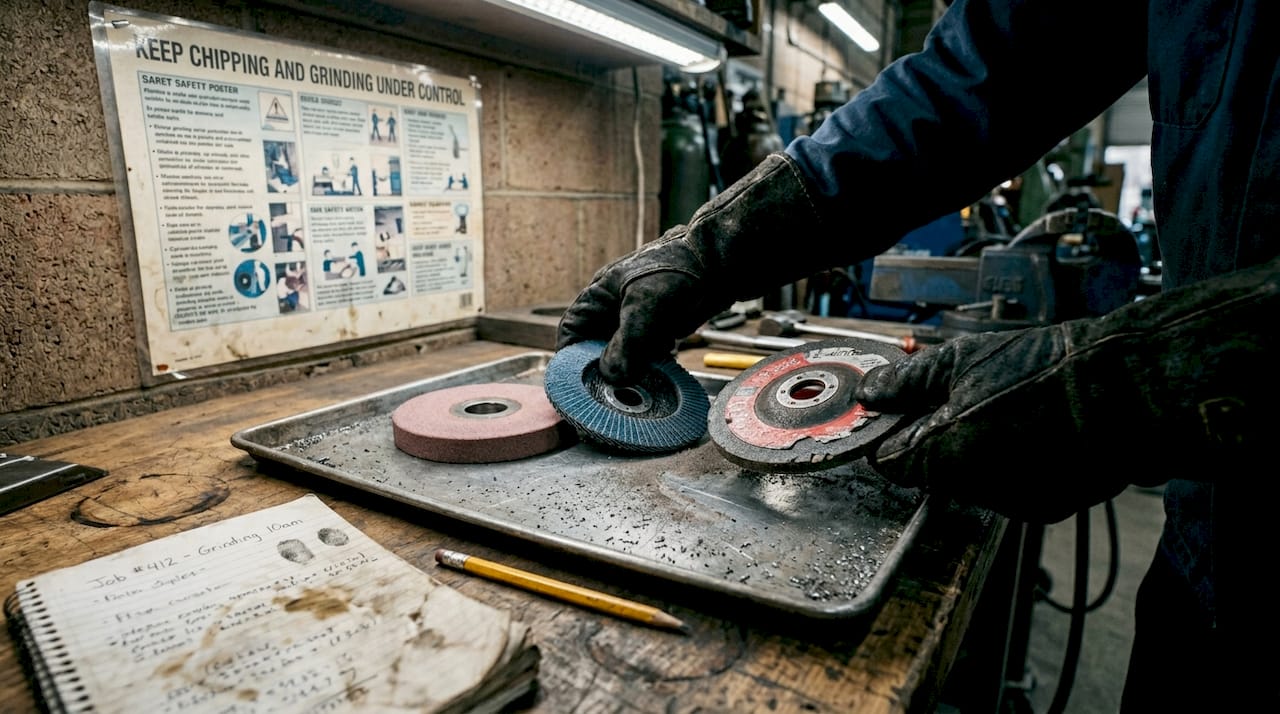
Think of grinding wheel families the way you think about hand tools. You would not use a file where a flap disc belongs, and you would not reach for a cutting disc when you need surface blending. Each family has a core job, and the best shops stock all three.
Depressed-center grinding wheels (Type 27/Type 28)
These are the heavy lifters. Depressed-center wheels are designed for aggressive material removal, weld bead grinding, deburring, and beveling. The recessed hub allows flat or angled contact depending on the disc type.
- Core job: Heavy weld removal, bevel prep, aggressive stock removal
- Key advantage: Maximum material removal rate with good durability
- Common specs: 4.5 to 9 inch diameter, 24 to 60 grit, aluminum oxide or ceramic abrasive
Flap discs
Flap discs layer overlapping abrasive cloth segments over a fiberglass or plastic backing. They’re versatile, conforming to contours better than rigid wheels, and they self-renew as outer layers wear down to expose fresh abrasive.
- Core job: Blending welds, finishing surfaces, light to medium stock removal
- Key advantage: Smoother finish with less gouging risk, better contour following
- Common specs: 4.5 to 7 inch diameter, 40 to 120 grit, zirconia or ceramic abrasive cloth
Explore flap discs for blending when your job calls for weld blending or surface prep before coating.
Cutting discs (Type 1)
Thin cutting discs are in a category of their own. As noted in guides on types-of-angle-grinder-discs, cutting discs differ from grinding wheels and are typically thinner, meant for slicing rather than heavy surface blending. Using them sideways for grinding is a serious hazard because they are not designed to handle lateral force.
- Core job: Cutting bar stock, structural sections, pipe, plate
- Key advantage: Fast, clean cuts with minimal kerf
- Common specs: 1 mm to 3 mm thick, 60 to 80 grit, aluminum oxide or zirconia
For a deeper look at how these tool families stack up in practice, the guide on cutting tools vs grinding wheels covers real shop scenarios in detail. You can also review finishing disc options for specialized applications beyond standard abrasives.
Shop wisdom: Build your wheel inventory around three roles. Cut, grind, and blend. One disc family for each job. When you stop asking one tool to do everything, your finish quality and your wheel budget both improve immediately.
Review of popular abrasives: Silicon carbide, aluminum oxide, ceramic
Once you’ve matched wheel family to the task, the next factor that can make or break your results is the abrasive composition. Three abrasives dominate professional fabrication: silicon carbide (SiC), aluminum oxide (Al2O3), and ceramic alumina. Each has a specific performance profile, and running the wrong one costs time, wheel life, and finish quality.
Silicon carbide (SiC)
Silicon carbide is extremely hard and sharp, making it aggressive on contact. It works best on hard, brittle materials: cast iron, hardened steel, carbide, stone, and non-ferrous metals like aluminum. It fractures relatively quickly, which keeps cutting edges fresh but shortens wheel life on tough materials.
- Best for: Cast iron, carbide, non-ferrous, stone, hard alloys
- Weakness: Shorter life on mild or stainless steel; reacts poorly with some steels
- Best practice: Use on non-ferrous and hard alloys; avoid on standard structural steel
Aluminum oxide (Al2O3)
Aluminum oxide is the workhorse of fabrication shops. It’s tougher than SiC and holds up better on mild steel, stainless steel, and general weld grinding. It generates moderate heat and delivers consistent performance across a wide range of applications.
- Best for: Mild steel, stainless steel, general weld grinding, toolroom work
- Weakness: Less aggressive than SiC; can glaze on very hard surfaces
- Best practice: Reliable for most day-to-day fabrication and structural work
Ceramic alumina
Ceramic abrasives are engineered at the grain level to micro-fracture under pressure, constantly exposing sharp new cutting edges. This means cooler grinding, longer wheel life, and better finish consistency on demanding materials. Research on aerospace/superalloy grinding confirms that abrasive selection significantly affects surface roughness evolution over multiple passes, with substantial differences between silicon carbide and aluminum oxide wheels. Ceramic bridges that performance gap for high-value materials. Check out the ceramic flap discs for a practical example of ceramic abrasive in a finishing format.
- Best for: Superalloys, stainless, hardened steel, high-value workpieces
- Weakness: Higher cost per disc
- Best practice: Justified on precision parts or materials where heat damage is costly
Abrasive comparison table
| Abrasive | Wear Rate | Material Fit | Typical Finish | Relative Cost |
|---|---|---|---|---|
| Silicon carbide | High (fractures fast) | Hard alloys, non-ferrous | Aggressive | Low to medium |
| Aluminum oxide | Medium | Mild/stainless steel | Moderate | Low |
| Ceramic alumina | Low (self-sharpening) | Superalloys, hardened steel | Fine to very fine | Medium to high |
Pro Tip: For superalloys, inconel, or hardened tool steels, go ceramic first. The higher upfront cost is typically recovered in fewer discs used and less heat damage to the workpiece. For daily structural steel work, aluminum oxide remains the most cost-effective choice.
Grinding wheel comparison: Surface finish, cost, and workflow fit
You’ve seen each type in isolation. Now let’s put them head to head in the ways welders judge results.
Surface finish, grinding speed, tool life, and cost are the four metrics that determine whether a wheel earns a repeat order. The table below summarizes how the major wheel types and abrasives stack up:
| Wheel Type | Finish Quality | Grinding Speed | Tool Life | Cost per Job |
|---|---|---|---|---|
| Depressed-center (Al2O3) | Rough to moderate | Fast | Moderate | Low |
| Depressed-center (Ceramic) | Moderate to fine | Fast | Long | Medium |
| Flap disc (Zirconia) | Fine | Medium | Medium | Low to medium |
| Flap disc (Ceramic) | Very fine | Medium | Long | Medium to high |
| Cutting disc | N/A (cut only) | Very fast | Short to medium | Low |
Research on superalloy grinding behavior shows that surface roughness increases measurably with certain abrasive and wheel combinations over repeated passes. This is a real cost in aerospace and precision fabrication, where rework or rejection is far more expensive than upgrading the abrasive upfront.
Workflow recommendations for professional welders:
- Use depressed-center wheels for initial weld bead removal and bevel prep, then switch to flap discs to blend and refine
- When working on stainless or aluminum, never use a wheel previously run on carbon steel (contamination risk)
- For large format work and high-volume material removal, large format wheels reduce changeover time and improve consistency
- Match grit progression deliberately: heavy removal at 24 to 36 grit, blend at 60 to 80, finish at 100 to 120
- Always finish with a flap disc when the workpiece will be painted, coated, or inspected visually
The practical takeaway is that treating your wheel selection as a workflow sequence rather than a single tool choice consistently produces better results with less total consumable cost.
What most welders miss about grinding wheel selection
Here’s the shop wisdom most guides skip. The grit number is the least important variable on the label.
We see it constantly in production shops. A welder runs through disc after disc, grinding hot, glazing the wheel, and wondering why the finish is inconsistent. The usual suspect is grit selection. But the actual problem is almost always bond mismatch or the wrong wheel family for the application. A hard-bond wheel on hard stainless glazes fast because spent grains don’t release, so the wheel stops cutting efficiently and builds heat. Switching to a softer bond or a ceramic disc on the same grit often solves the problem immediately.
The other overlooked issue is wheel fatigue and guard compatibility. Shops that run wheels past their rated life or with improper guards are not just wasting money on consumables. They are creating serious structural risk. A wheel that has been impacted, dropped, or run at excess speed can fail catastrophically. That is not a finish problem. That is a safety emergency.
The practical mental shift that high-output shops make is moving from “what grit do I need?” to “what job am I doing, and what wheel-bond-abrasive combination fits the material, the finish target, and the grinder I am running?” It takes an extra 30 seconds of thought before the first pass, and it consistently eliminates the rework, the wasted discs, and the safety incidents that come from mismatched setups.
Experimenting with newer abrasives like ceramic alumina is also worth the investment for any shop doing precision work or hard alloy fabrication. Many shops stick with aluminum oxide out of habit, not performance data. The performance difference on stainless or superalloys is significant and measurable. For finishing, switching from a rigid wheel to better finishing options alone can cut finishing time by a third on complex weld geometries.
The system approach, matching guard, speed, bond, abrasive, and disc family to the actual job, is what separates efficient, safe shops from ones that are constantly fighting their consumables.
Get the right grinding wheel for your next job
If you’re ready to put this knowledge to work, here’s where to find wheels matched to your next job.
Simpleweld stocks the full range of grinding wheel families covered in this article, from depressed-center wheels for heavy removal to ceramic flap discs for precision finishing. Every product in our abrasives lineup is industrial grade and selected for professional shop use, not just spec-sheet performance.
Browse the complete shop grinding wheel types collection to find wheels organized by application, abrasive type, and diameter. Whether you’re sourcing for a single job or stocking a fabrication shop with bulk orders, the selection covers every workflow stage from rough cut to final blend. You can also browse flap discs for a curated lineup of zirconia and ceramic options that pair directly with the grinding wheels for a complete weld-to-finish workflow.
Frequently asked questions
What’s the difference between a cutting disc and a grinding wheel?
Cutting discs are thinner and designed to slice through material, while grinding wheels are thicker and used for heavy material removal and beveling. As industry references confirm, cutting discs are thinner and meant for slicing, not surface blending.
Which abrasive works best for stainless steel?
Ceramic and aluminum oxide abrasives are the most common choices for stainless due to their durability and lower heat generation. Empirical data on abrasive performance differences confirms significant variation in surface roughness outcomes between silicon carbide and aluminum oxide wheels on demanding alloys.
What RPM rating should my wheel match?
Always match the wheel’s rated RPM to your grinder’s maximum speed and never exceed it. As wheel design references confirm, RPM rating compatibility is a core part of a coupled design system that includes bond and abrasive, not an optional spec.
When should I use a flap disc instead of a grinding wheel?
Use a flap disc for blending, finishing, and when you need smoother surface control with less risk of gouging. Per practical angle grinder guidance, flap discs provide better contour control and typically produce less heat concentration than rigid wheels.