

Unreliable welding equipment doesn’t just slow you down. It costs you contracts, creates safety incidents, and quietly drains your shop’s profitability before you even realize what’s happening. Too many experienced welders accept intermittent failures as part of the job, chalking up a burned-out torch or a faulty switch to bad luck. But that mindset is expensive. This guide breaks down exactly why equipment durability is a non-negotiable factor for any serious fabrication operation, covering the production, safety, and financial angles with evidence to back every claim. If you’re ready to stop treating gear failures as routine, read on.
Table of Contents
- The core reasons durable welding gear matters
- How durability drives safety in welding environments
- Durability and long-term cost savings: the real numbers
- Matching equipment durability to the work profile
- The overlooked productivity and morale advantages of robust gear
- Finding the right durable welding equipment for your needs
- Frequently asked questions
Key Takeaways
| Point | Details |
|---|---|
| Improved throughput | Durable welding gear keeps your shop running smoothly with fewer interruptions for repairs or replacements. |
| Enhanced safety | Reliability directly minimizes hazardous situations related to burns, electrical faults, and equipment failure. |
| Long-term savings | An investment up front pays back through reduced operational costs and less downtime over years of service. |
| Right fit matters | Your equipment’s durability must match your workload and duty cycle, not just a price tag or spec sheet. |
The core reasons durable welding gear matters
With the stage set, let’s break down exactly why durable welding tools are a must, not a luxury.
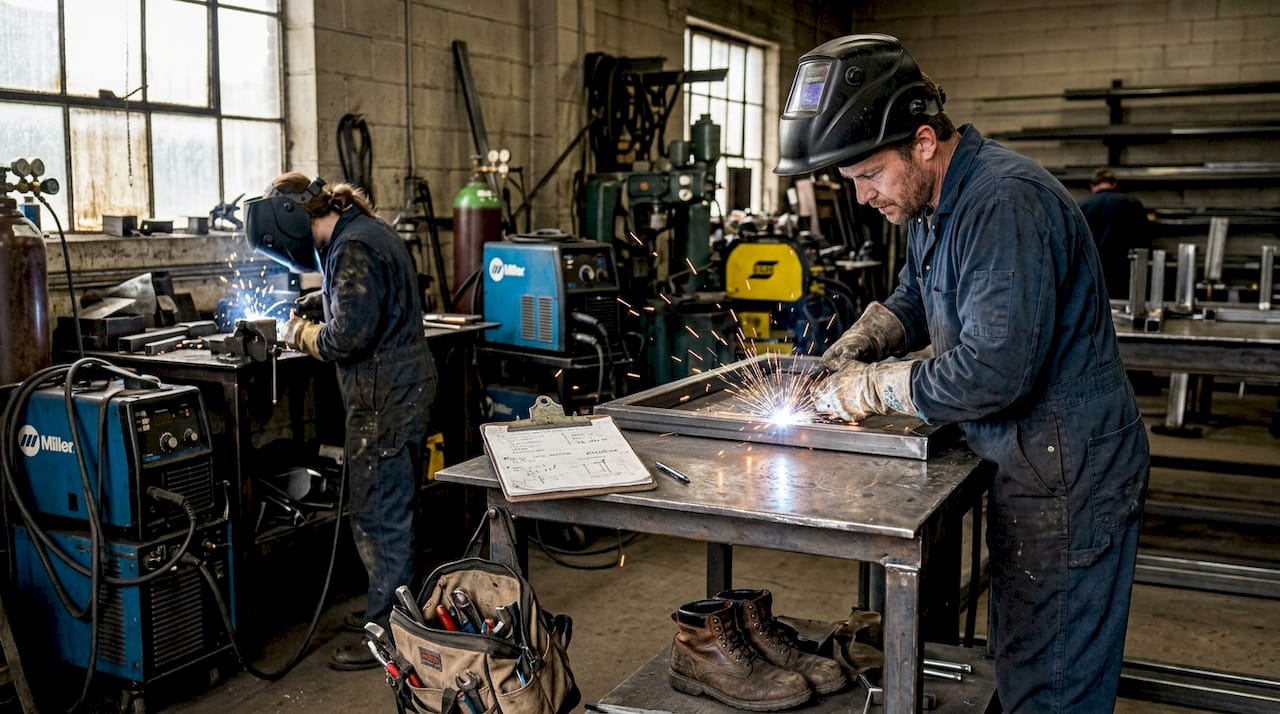
At its core, durability means your equipment shows up every shift and performs the same way it did on day one. That consistency is what keeps production schedules intact. When a welder goes down mid-shift, you’re not just losing the minutes it takes to swap it out. You’re losing the setup time, the quality checks, and sometimes the entire weld run if the joint has cooled. Durable welding equipment reduces downtime and repair cycles, which directly improves throughput and repeatability across your operation.
The weak points in lower-grade equipment tend to cluster in the same places: cable insulation that cracks under heat cycling, trigger switches that fail from repeated use, and torch bodies that warp or leak when pushed past their rated capacity. These aren’t catastrophic failures at first. They’re small degradations that compound over time until the machine becomes unreliable and eventually unusable.
Here’s what non-durable welding equipment actually costs a shop:
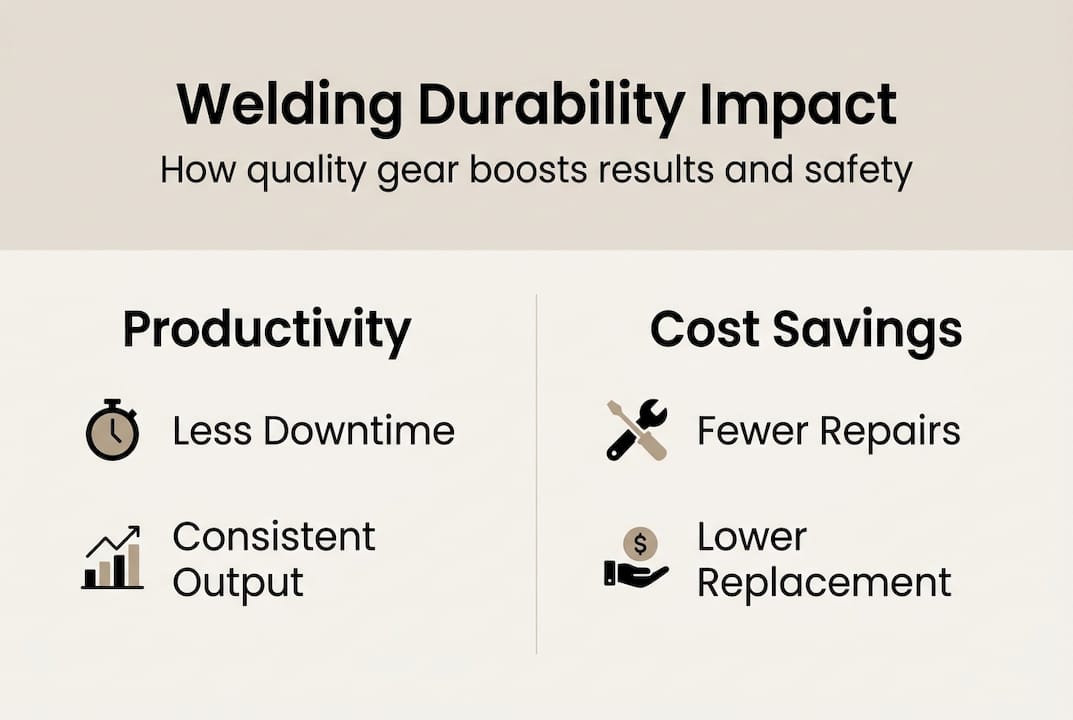
- Unexpected downtime that disrupts production schedules and delays deliveries
- Inconsistent weld quality that leads to rework, scrap, and failed inspections
- Lost contracts when clients lose confidence in your ability to deliver on time
- Accelerated replacement cycles that inflate your annual equipment budget
- Technician time diverted from productive work to troubleshooting and repairs
The numbers reinforce this. 79% of downtime in robotic spot-welding traces directly to maintenance-related issues, meaning most production losses aren’t random. They’re predictable consequences of equipment that isn’t built to handle the workload. Focusing on minimizing repair cycles through better equipment selection is one of the highest-leverage moves a shop manager can make.
The shops that consistently hit their production targets aren’t necessarily running more machines. They’re running machines they can trust.
How durability drives safety in welding environments
Productivity is only one side. We also need to consider how durability ties into daily life-and-limb safety.
A welding machine that’s degrading isn’t just inefficient. It’s dangerous. Worn cable insulation creates shock hazards. A torch body that’s cracked or improperly sealed can expose the welder to elevated fume concentrations. Faulty ground connections cause arc instability, which increases spatter and the risk of burns. These aren’t edge cases. They’re the predictable outcomes of running equipment past its reliable service life.
“Welders face increased vulnerability when protections or equipment are suboptimal.”
Occupational health research confirms that wear and equipment failure introduce direct electrical and burn risks for welders, reinforcing what experienced fabricators already know from the shop floor.
Here’s how incident rates compare between substandard and high-quality gear:
| Risk factor | Substandard equipment | High-quality equipment |
|---|---|---|
| Electrical shock incidents | Elevated due to insulation wear | Low, with intact rated insulation |
| Burn injuries from arc instability | Higher from inconsistent arc | Stable arc reduces spatter exposure |
| Fume overexposure | Increased from torch seal failures | Controlled with intact torch body |
| Equipment-related downtime injuries | More frequent during emergency swaps | Rare due to predictable performance |
Robust equipment is a core pillar of a safe shop environment, not an optional upgrade. Pairing durable machines with proper PPE for welding safety creates a layered defense that keeps your team protected even during demanding runs.
Pro Tip: Build a daily pre-shift inspection checklist that covers cable condition, torch integrity, ground clamp connection, and trigger response. Catching degradation early stops a safety incident before it starts.
The shops with the best safety records aren’t lucky. They’re disciplined about equipment condition and they don’t wait for failures to act.
Durability and long-term cost savings: the real numbers
Beyond safety, let’s consider justification of investment. What do the numbers actually say?
The sticker price of a welding machine is the least useful number when evaluating cost. What matters is total cost of ownership over the machine’s service life. That includes consumables, repairs, downtime losses, and eventual replacement. When you run that calculation honestly, the gap between durable and budget equipment widens fast.
| Cost category | Budget welder (3-year period) | Industrial-grade welder (3-year period) |
|---|---|---|
| Initial purchase | Low | Higher upfront |
| Repair and parts | Frequent, adds up quickly | Minimal, predictable |
| Downtime losses | High, often untracked | Low, rare disruptions |
| Replacement cycle | Often within 18-24 months | Typically 5+ years |
| Total cost of ownership | Significantly higher | Lower over time |
Reliability-centered maintenance significantly cuts downtime and operational costs in automated welding setups, and the same principle applies to manual fabrication shops. The trap most shops fall into is treating the purchase price as the cost, rather than the full operational picture.
To get a clear view of your shop’s true cost of ownership, work through these steps:
- Log every repair event for each machine over the past 12 months, including parts and labor time.
- Calculate downtime hours caused by equipment failure and multiply by your shop’s hourly production rate.
- Track consumable burn rates and identify whether failures are accelerating consumable use.
- Compare replacement frequency of budget units versus industrial-grade machines in your fleet.
- Project forward 36 months using current repair trends to see where each machine category lands.
When you run this audit, the welding equipment cost and ROI picture becomes very clear. Durable gear isn’t a premium. It’s the cost-effective choice when you measure what actually matters.
Matching equipment durability to the work profile
Knowing durable gear pays off, let’s get specific. How do you select the right level of build quality for your shop’s real workload?
Not every shop needs the same machine. A job shop running light structural tacks a few hours a day has different demands than a fabrication floor running continuous production on thick plate. The mistake is applying the same equipment logic to both scenarios.
Before any purchase decision, work through these questions:
- What is the maximum material thickness you weld regularly, not just occasionally?
- What duty cycle do you actually need? A 60% duty cycle machine run at 80% capacity will fail early.
- Are you running automated or semi-automated processes that demand consistent machine output?
- How many shifts per day is the machine expected to operate?
- What is the ambient temperature in your shop, since heat affects thermal management and duty cycle performance?
Cheaper welders may work for occasional, light-duty welds, but they struggle with thick materials and long welds due to inferior durability. If your shop profile involves any combination of thick plate, long weld runs, or multi-shift operation, a budget machine is a liability, not a savings.
For TIG work on demanding materials, robust TIG welders built for industrial cycles give you the arc stability and thermal headroom that light-duty machines simply can’t match. For shops that need flexibility across processes, multiprocess welder options rated for industrial use eliminate the need to compromise on build quality for versatility.
Pro Tip: Always spec equipment for your peak demand, not your average demand. Under-speccing leads to thermal shutdowns, accelerated wear, and early failure. The extra capacity costs less than the downtime it prevents.
The overlooked productivity and morale advantages of robust gear
The operational and financial benefits of durable equipment are substantial. But there’s another side to this topic that’s often ignored: workplace culture.
In a professional shop, every minute a welder spends troubleshooting a failing machine is a minute they’re not welding. But the damage goes beyond lost time. Repeated equipment failures signal to your team that management is cutting corners. That perception erodes trust, and trust is hard to rebuild once it’s gone.
When welders know their equipment will perform, they work with confidence. They push harder on tight timelines because they trust the machine to keep up. That reliability creates a quiet but powerful morale advantage. The shops with the lowest turnover and the most consistent output tend to be the ones where the tools simply work.
“Shop culture is set by the reliability of its tools. Broken gear signals cut corners.”
This is the intangible ROI that never shows up in a cost-of-ownership spreadsheet but shows up every day in how your team operates. Explore welding downtime stories from real shops and you’ll see this pattern repeat: the moment management invested in dependable equipment, team performance followed. Durability isn’t just a machine spec. It’s a statement about the standards your shop holds.
Finding the right durable welding equipment for your needs
Ready to upgrade your workflow with equipment built to last? Here’s the next step.
At Simpleweld, we vet every product in our catalog against industrial performance standards before it reaches your shop. We know that professional welders can’t afford to gamble on gear that looks good on paper but fails under real load.
Whether you need a Multiprocess welder with TIG kit for a versatile fabrication setup or a high-durability TIG welder built for demanding industrial cycles, our selection is built around what serious welders actually need. Browse our full range of durable welding tools and find equipment matched to your shop’s real workload, not just the lightest use case.
Frequently asked questions
What is considered durable welding equipment?
Durable welding equipment is designed for high-frequency, industrial use and resists wear from heat, electrical load, and long-duty cycles. Durability improves long-term performance and reduces the need for repairs across the machine’s service life.
How does durable welding equipment improve safety?
Durable gear is less likely to fail mid-operation, which reduces the risk of burns, shocks, and injuries caused by equipment breakdowns. Lower quality or failing equipment increases hazards for welders by introducing electrical and thermal risks.
Is investing in durable equipment cost-effective?
Yes. It reduces downtime, repair costs, and lost output over time, leading to significant long-term savings compared to frequent replacement of budget machines. Downtime and costs are lowered with reliability-focused maintenance and robust equipment.
Can less expensive welding machines be suitable sometimes?
They can work for light or occasional use, but often fail during intense, repeated, or high-payload jobs. Cheap welders are typically suited for light-duty work and struggle with heavy industrial use.