

Grab the wrong disc off the shelf and you’re either re-grinding a weld you already finished or burning through consumables twice as fast as your job budget allows. For professional fabricators and welders running multiple operations daily, abrasive selection isn’t a secondary decision — it directly shapes cycle time, surface quality, safety margins, and bottom-line cost. This guide breaks down every major abrasive category, maps each type to specific welding tasks, covers specialty applications like TIG tungsten prep, and gives you the troubleshooting knowledge to keep your shop running at full efficiency.
Table of Contents
- Key types of welding abrasives and their uses
- Task-matched abrasive examples: What to use and when
- Troubleshooting and selection tips for best performance
- Why simply choosing ‘by the book’ often falls short
- Find the perfect abrasive for your next weld
- Frequently asked questions
Key Takeaways
| Point | Details |
|---|---|
| Task-specific abrasive choice | Selecting the right abrasive for each welding task significantly improves efficiency and finish quality. |
| Multipurpose options exist | Flap discs and certain wheels can handle multiple jobs but may not always outperform specialized products. |
| Proper tungsten prep matters | Using the right abrasive for TIG electrodes affects weld performance and longevity. |
| Shop experience is vital | Practical knowledge often leads to better abrasive selection than rigidly following charts alone. |
Key types of welding abrasives and their uses
Understanding abrasive categories is the foundation for smart selection. Every type has a mechanical purpose, and mismatching tool to task costs you time, money, and sometimes safety.
Grinding wheels are your workhorses for aggressive stock removal. Designed for direct lateral pressure against the workpiece, they’re built to cut through weld beads, remove heat-affected zones, and reshape metal quickly. You’ll find them in Type 27 (flat) and Type 28 (depressed center) profiles, each optimized for different attack angles. A detailed breakdown of grinding wheel types covers grit specs, bond types, and ideal applications for welders.
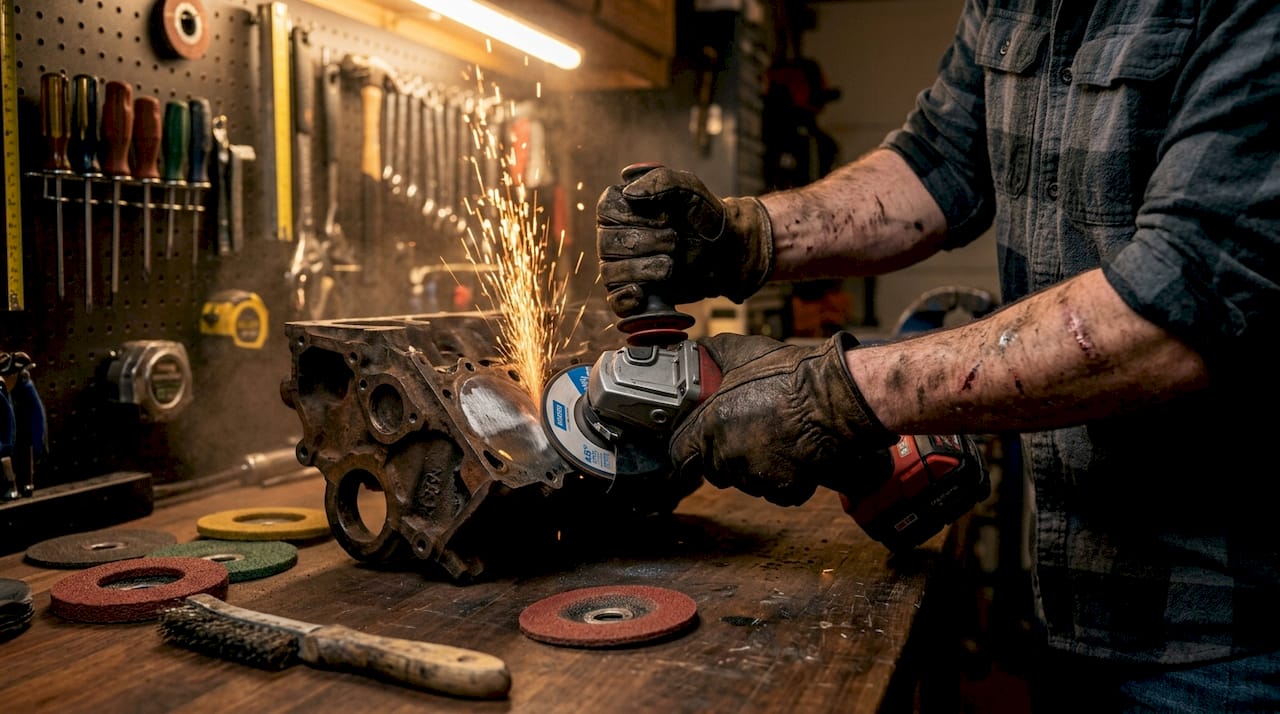
Cut-off wheels are thin, rigid discs purpose-built for slicing through metal cleanly. They’re not grinding tools — they’re cutting tools. Using a cut-off wheel as a grinding surface is a common and dangerous mistake that causes disc fracture. For a broader view of where these fit into your workflow, cutting tools for welding puts them in the right context.
Flap discs are the most versatile abrasive in most shops. Made from overlapping layers of abrasive cloth bonded to a backing plate, they grind, blend, and finish in a single tool. Flap discs consistently outsell other abrasive categories in fabrication environments because they reduce tool changes and deliver a controlled, consistent finish. Abrasive products commonly used across weld grinding, beveling, blending, deburring, and spatter removal include high-performance flap discs built for demanding workloads.
Wire wheels and wire brushes are not cutting tools — they’re cleaning tools. They remove rust, mill scale, weld spatter, and surface oxides without significantly altering the base metal profile. Available in knotted and crimped wire configurations, knotted wire is more aggressive and suited for heavy scale, while crimped wire handles lighter cleaning and final prep.
Specialty abrasives include surface conditioning discs, interleaved abrasive wheels, and ceramic fiber discs that bridge the gap between aggressive grinding and fine finishing. These often appear later in the workflow, once primary material removal is done.
Here’s a quick task-to-tool overview:
- Weld removal and bead grinding: Type 27 or Type 28 grinding wheels
- Cutting pipe, bar stock, and structural steel: Cut-off wheels
- Blending, finishing, and light grinding: Flap discs (T27 or T29 profile)
- Rust and spatter removal, surface cleaning: Wire wheels, wire brushes
- Final surface prep and cosmetic finishing: Surface conditioning discs, fine-grit flap discs
Angle-grinder disc types used after welding include grinding wheels, cut-off wheels, flap discs, and wire brushes, each performing a distinct job in the process chain.
Pro Tip: When you’re unsure which abrasive to reach for, ask one question first: “Am I removing metal, blending a surface, or cleaning it?” Each category owns one of those three functions. Narrowing the job to one of those three instantly points you to the right tool family.
Task-matched abrasive examples: What to use and when
The real skill in abrasive selection is task-matching — knowing which tool to pull out at each phase of the fabrication and finishing sequence. Here’s a practical step-by-step breakdown of a common post-weld workflow:
- Weld prep and joint cleaning: Wire brush or wire wheel to remove rust, scale, and contamination from the base metal before striking an arc.
- Initial weld grinding: Type 27 grinding wheel at 5 to 7 inches, 24 to 36 grit, for aggressive weld bead removal.
- Edge beveling: Grinding wheel or coarse flap disc (36 to 60 grit) for creating consistent joint angles.
- Blending and transitioning: Medium-grit flap disc (60 to 80 grit) to smooth the transition between weld and base metal.
- Surface finishing: Fine-grit flap disc (120 grit) or surface conditioning disc for the final texture before coating or inspection.
- Rust and spatter removal between passes: Wire brush or wire wheel, especially on multi-pass structural welds.
The principle behind flap discs for finishing is well-established: they outperform grinding wheels when you need to blend rather than cut, reducing the risk of gouging and dish grinding into base material.
Here’s a comparison table that puts abrasive type against welding task, with a real product example for each:
| Task | Abrasive type | Grit/spec | Example product |
|---|---|---|---|
| Heavy weld removal | Type 27 grinding wheel | 24 to 36 grit | Standard A/O grinding wheel |
| Edge beveling | Coarse flap disc (T29) | 36 to 60 grit | T29 flap disc |
| Blending and finishing | Ceramic flap disc (T27) | 60 to 120 grit | Ceramic flex flap disc |
| Cutting and slicing | Cut-off wheel | .045 to 1/8 inch | Thin cut-off disc |
| Rust and scale removal | Knotted wire wheel | N/A | Angle grinder wire cup |
| Spatter removal | Crimped wire brush or flap disc | 80 grit | Standard crimped wire brush |
| Final cosmetic prep | Surface conditioning disc | Medium to fine | Non-woven conditioning disc |
Pro Tip: Matching your abrasive to the base metal pays off beyond just finish quality. Aluminum loads (clogs) standard abrasives rapidly, driving up cost. Ceramic abrasives run cooler and cut faster on stainless steel, significantly reducing discoloration from heat. On carbon steel, aluminum oxide is reliable and economical. That one material-to-abrasive match decision can cut your consumable spend noticeably per project.
Don’t overlook your accessory game either. Anti-spatter preparation, proper flange use, and backing pad condition all affect how your abrasive performs. A worn or off-center backing pad creates uneven pressure that burns through flap discs prematurely and leaves an inconsistent scratch pattern.
Specialty abrasives for TIG welding and tungsten prep
TIG welding demands a level of precision that most other processes don’t require, and tungsten electrode preparation is where that precision starts. A poorly ground electrode produces an unstable arc, increased contamination risk, and inconsistent fusion — problems that show up in X-ray or dye penetrant inspections downstream.
Tungsten electrode grinding is a specialized abrasive task that demands its own dedicated tools. Here’s what that process requires:
- Dedicated fine grinding wheel: A silicon carbide (SiC) or diamond grinding wheel in the 80 to 120 grit range for controlled material removal. Never use a shared wheel — cross-contamination from steel particles embeds into the tungsten and transfers directly into your weld pool.
- Bench grinder over angle grinder: A bench grinder provides a stable, consistent grinding angle that’s nearly impossible to replicate freehand with an angle grinder.
- Longitudinal grinding direction: Always grind along the length of the tungsten, not perpendicular. Circumferential grinding marks create a stress-riser pattern that causes electrode tip fracture mid-weld.
- Belt sander with fine SiC belt: An alternative to a grinding wheel, fine-grit SiC belts (120 to 220 grit) allow smooth, scratch-free tungsten preps ideal for critical GTAW applications.
You can see the full range of compatible tungsten electrode products to pair with your prep process.
Here’s a quick reference for grit range versus TIG process outcome:
| Grit range | Surface result | TIG arc effect | Risk |
|---|---|---|---|
| 60 to 80 grit | Rough longitudinal scratches | Slightly erratic arc start | Higher contamination if cross-ground |
| 80 to 120 grit | Fine, consistent finish | Stable arc, good directional control | Low with correct technique |
| 120 to 220 grit | Near-polished tip | Very stable, tight arc cone | Minimal |
| Side-ground (any grit) | Circumferential lines | Arc wander, tip fracture risk | High |
Common mistakes include using a contaminated wheel, grinding at the wrong angle (30 to 45 degrees is standard for most DC TIG), and failing to remove the sharp tip on electrodes used for AC aluminum welding, which requires a balled-end profile, not a point.
Troubleshooting and selection tips for best performance
Even with the right abrasive in hand, poor technique and avoidable choices kill performance. Here are the most common issues professionals encounter and how to correct them:
- Premature disc wear: Usually caused by excessive downward pressure. Let the abrasive cut. More force doesn’t mean faster cutting — it means faster heat buildup and glazing. Maintain a 15 to 30 degree angle on grinding wheels and 5 to 15 degrees on flap discs.
- Surface gouging and dish grinding: Classic grinding wheel misuse. If your goal is blending, you need a flap disc, not a grinding wheel. Grinding wheels concentrate pressure at a point; flap discs distribute it across a wider contact patch.
- Clogging on aluminum and soft metals: Switch to a zirconia or ceramic abrasive with open-coat construction. Closed-coat discs load quickly on non-ferrous metals and lose their cut rate within minutes.
- Inconsistent finish across a large panel: Usually a backing pad issue. Check for wear or runout on your angle grinder’s pad before blaming the disc.
- Disc fracture during use: Often caused by using a cut-off wheel for lateral grinding, using a damaged disc, or exceeding the rated RPM. Always check the disc’s maximum RPM against your grinder’s no-load speed before mounting.
Shop rule worth posting: Never exceed the RPM rating printed on your abrasive. Even a 10% overspeed can push a disc into catastrophic failure territory, especially on cut-off wheels and bonded grinding wheels. Match the tool to the machine, every single time.
For weld spatter specifically, the right abrasive products for spatter removal include both wire brushes and flap discs, depending on how much surface blending you need after cleaning. Heavy spatter often benefits from a brief pass with a flap disc after wire brushing to restore a clean, uniform surface.
Pro Tip: Run your best ceramic or zirconia disc first on a job, then follow up with a fresh but less expensive aluminum oxide disc for the final finishing passes. The premium disc does the hard cutting work; the backup disc refines the surface. You’ll get better results than using one disc type throughout, and your premium discs last significantly longer.
Pairing your abrasive strategy with proper spatter prevention upstream is equally valuable. Using anti-spatter spray before welding reduces the amount of cleaning work your abrasives have to do post-weld, cutting consumable use noticeably on high-volume MIG or flux-core work.
Actionable performance tips at a glance:
- Store discs flat in a dry environment to prevent warping and moisture absorption in bonded wheels
- Inspect every disc visually before mounting — cracks, chips, and delamination are rejection criteria, not “close enough” situations
- Use the correct flange size and never mount a disc without the proper backing flange
- Dress grinding wheels regularly to maintain a flat, true cutting surface
- Track disc life per material type to build better procurement estimates
Why simply choosing ‘by the book’ often falls short
Standard abrasive charts are a starting point, not a finishing line. Every reputable manufacturer publishes application guides, and those guides are valuable — but they’re written for average conditions with average operators on average materials. Your shop isn’t average.
Here’s what the charts can’t account for: your specific grinder’s actual RPM under load (not rated speed), the exact alloy composition of the steel you’re running, your operators’ grinding angle habits, ambient temperature in the shop affecting bond hardness performance, and the cumulative wear state of your backing pads. All of these variables shift optimal abrasive selection away from the chart and toward what actually works in your specific environment.
The most effective fabrication shops we’ve seen test aggressively. They run two or three disc types on the same job, track actual disc life, measure finish quality against inspection requirements, and build their own internal selection standards from real data. That’s not inefficiency — that’s professional process optimization.
False economy in abrasive selection is a real and costly trap. A disc that costs 30% less but lasts 60% fewer passes costs more per linear inch of weld. When you’re running high-volume structural work or critical pipe welds, cheap consumables also introduce finish inconsistency that can fail inspection, requiring re-grinding and re-welding — costs that dwarf whatever you saved per disc.
For shops ready to move beyond the basics, advanced abrasive selection strategies offer a deeper look at matching wheel specs, grit types, and bond grades to specific fabrication environments. The investment in getting this right compounds over every project you run.
Experimenting with hybrid approaches — for example, using a ceramic flap disc for the initial weld blend, then switching to a fine zirconia disc for the final finish — often outperforms single-disc strategies for demanding cosmetic or code-compliant work. Build your toolkit around tested performance, not just lowest unit cost.
Find the perfect abrasive for your next weld
Knowing the right abrasive for the job is only half the equation — having it stocked and ready when you need it is the other half.
At Simpleweld.com, you can browse the full welding abrasives collection filtered by application, material type, and disc spec, so you’re not scrolling through irrelevant inventory. Need a complete cut-off wheels lineup for your structural steel or pipe cutting work? That’s stocked and ready to ship. From TIG tungsten prep wheels to high-performance ceramic flap discs for stainless and carbon steel, the catalog is built around what fabrication professionals actually need on the floor, not what looks good in a category listing. If your shop runs high volume or has specialty requirements, the product range is there to match.
Frequently asked questions
What is the best abrasive for removing weld spatter?
Flap discs and wire brushes are the go-to tools for weld spatter removal, with flap discs preferred when you also need to blend the surrounding surface after cleaning.
Can one abrasive disc be used for both grinding and finishing a weld?
Multi-purpose flap discs handle both grinding and finishing in a single tool, but for critical cosmetic or code-compliant welds, using task-specific discs at each stage produces better, more consistent results.
What abrasive should be used for preparing a TIG welding electrode?
A fine grinding wheel or SiC belt in the 80 to 120 grit range is the standard recommendation for tungsten electrode prep, always grinding longitudinally to avoid arc instability and contamination.
How do I extend the life of my grinding wheel?
Use controlled, moderate pressure, maintain the correct grinding angle, avoid side loading, and match the wheel’s bond hardness and grit to the specific metal you’re working — mismatched specs are the leading cause of premature wear.