

Working metal requires more than a welder and raw material. The abrasive tools list you run in your shop determines surface quality, weld prep accuracy, and how long your consumables actually last. With dozens of wheel types, grit grades, bond systems, and abrasive minerals to choose from, picking the wrong tool costs you time and money fast. This article breaks down every major abrasive tool type used in metalworking, explains what drives performance differences, and gives you direct guidance on which tools suit which jobs.
Table of Contents
- Key takeaways
- Key criteria for choosing abrasive tools in metalworking
- The abrasive tools list: types, functions, and best uses
- 1. Grinding wheels
- 2. Cut-off wheels
- 3. Flap discs
- 4. Sanding belts and discs
- 5. Diamond abrasive tools
- 6. CBN (cubic boron nitride) wheels
- 7. Wire brushes and cup brushes
- 8. Mounted points
- 9. Polishing pads and buffing wheels
- 10. Honing stones and sticks
- Abrasive tool comparison at a glance
- Situational recommendations for metalworking projects
- My honest take on abrasive tool selection
- Stock your shop with abrasives from Simpleweld
- FAQ
Key takeaways
| Point | Details |
|---|---|
| Match abrasive to material | Aluminum oxide suits steel; silicon carbide works better on non-ferrous metals and cast iron. |
| Bond type affects performance | Vitrified bonds self-sharpen; resinoid bonds absorb shock for aggressive grinding applications. |
| Superabrasives last far longer | Diamond and CBN tools can outlast conventional abrasives by roughly 100 times in tool life. |
| Safety standards are non-negotiable | OSHA and ANSI require guards on all abrasive wheels, with strict exposure angle limits for every machine type. |
| Right tool, right project | Flap discs handle blending and light grinding; mounted points reach internal geometry; wire brushes handle scale removal. |
Key criteria for choosing abrasive tools in metalworking
Before you look at any abrasive tools checklist, you need to understand what separates a good tool selection from a waste of money. The right abrasive for one job can destroy a workpiece on the next.
Material compatibility is where selection starts. Aluminum oxide is the standard for carbon steel and alloy steel. Silicon carbide cuts harder but is more brittle, making it the better choice for cast iron, titanium, and non-ferrous metals. Diamond is the hardest natural abrasive, followed by corundum and emery. Each mineral brings specific hardness and brittleness characteristics that affect cut rate and finish quality.
Bond type directly controls how a wheel behaves under load. Vitrified bonds are porous and self-sharpening but brittle. Resinoid bonds absorb shock and handle aggressive, interrupted cuts far better. Rubber bonds provide flexibility and produce finer finishes on sensitive surfaces. Choosing bond type based on your wheel speed, machine type, and material is not optional. It is what separates controlled metal removal from wheel failure.
Consider these additional criteria before finalizing your tool selection:
- Grit size: Coarser grits (24 to 60) remove material faster; finer grits (80 to 220+) finish and polish
- Hardness grade: Softer grades release grains faster for harder materials; harder grades hold grains longer for softer workpieces
- Expected tool life: Calculate cost per hour of use, not just purchase price
- RPM rating: Never exceed the wheel’s maximum operating speed. Period.
- Application type: Cutting, grinding, blending, and polishing each require different tool geometry
Safety standards are not suggestions. OSHA 29 CFR 1910.215 and ANSI B7.1 require all abrasive wheels to use safety guards covering the spindle end, nut, and flange projections, with a maximum exposure angle of 180 degrees on portable grinders. Work rests must be kept within 1/8 inch of the wheel to prevent work jamming and wheel breakage.
Pro Tip: Always ring-test a vitrified grinding wheel before mounting. A clear tone when tapped with a wooden mallet means the wheel is crack-free. A dull thud means do not use it.
The abrasive tools list: types, functions, and best uses
This is the core of the article. What follows is a detailed abrasive tools list covering every major category used in metal fabrication and finishing. Think of this as your abrasive tools explained reference that you can return to when scoping a new project.
1. Grinding wheels
Grinding wheels are the backbone of any metalworking shop. They come in multiple bond types: vitrified (most common for precision work), resinoid (for heavy-duty and portable grinding), and rubber (for fine finishing). Common shapes include straight wheels, depressed-center wheels, and cup wheels, each designed for a specific grinding geometry.
Straight wheels work on bench grinders for tool sharpening and general stock removal. Depressed-center wheels mount on angle grinders for surface grinding and weld blending. The role of abrasives in metalwork centers heavily on grinding wheels because they cover the widest range of material removal tasks. See grinding wheel types for a deeper breakdown of shapes and applications for welders specifically.
Grinding wheels must be mounted on properly dimensioned flanges with blotters to distribute clamping pressure evenly and prevent localized stress fractures.
2. Cut-off wheels
Cut-off wheels are thin, reinforced discs designed for one thing: cutting metal cleanly. Thicknesses typically range from 0.040 inches to 1/8 inch. Thinner wheels cut faster and waste less material. Thicker wheels handle rough cutting and abuse better.
These are your go-to for cutting bar stock, angle iron, pipe, and structural shapes. Forcing a cut-off wheel sideways for grinding is one of the fastest ways to shatter a disc and send fragments into your face. They are made for cutting, not lateral load.
Pro Tip: Let the wheel do the work. Excessive pressure on a cut-off wheel generates heat that degrades the resinoid bond and glazes the wheel. Light, consistent pressure gives you faster, cleaner cuts.
3. Flap discs
Flap discs use overlapping abrasive cloth flaps bonded to a backing plate. As the outer flaps wear, fresh abrasive is exposed, giving you a more consistent cut rate over the life of the disc compared to a solid grinding wheel.
They are excellent for blending welds, removing mill scale, and surface preparation before painting or coating. Type 27 flap discs sit flat against the surface. Type 29 are angled for more aggressive stock removal. For weld prep and light grinding in the same pass, flap discs are one of the most versatile tools in the abrasive tools list.
4. Sanding belts and discs
Belt sanders and disc grinders use coated abrasives bonded to a flexible backing. Aluminum oxide is standard for steel; zirconia alumina handles stainless and harder alloys longer before glazing.
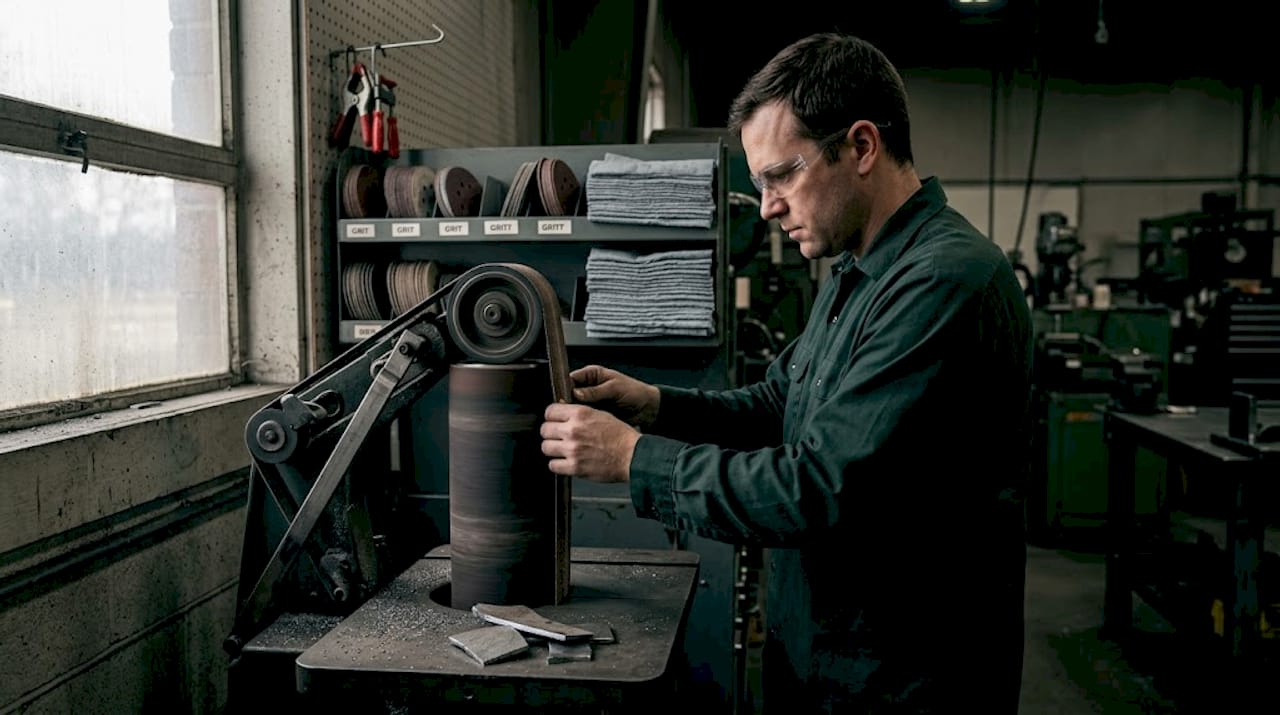
Sanding belts work fast on flat stock and long workpieces. Discs handle contoured surfaces better when mounted on a random orbit sander. For finish work before welding or painting, belts in the 80 to 120 grit range prep surfaces efficiently without gouging.
5. Diamond abrasive tools
Diamond and CBN abrasives dramatically extend tool life, outperforming traditional silicon carbide or aluminum oxide by approximately 100 times in longevity. They suit challenging materials like Inconel, hardened steels, and carbide tooling where conventional abrasives simply wear out too fast.
Diamond wheels are used for grinding carbide inserts, ceramic components, and hardened tool steels. They come in electroplated, sintered, and resinoid bond forms. The upfront cost is higher, but the cost per part drops significantly in high-volume or precision applications.
6. CBN (cubic boron nitride) wheels
CBN wheels are the ferrous counterpart to diamond. Diamond reacts chemically with iron-based materials at high temperatures, degrading the abrasive. CBN does not. For grinding hardened steel, tool steel, and high-speed steel, CBN wheels hold geometry and finish quality far longer than aluminum oxide alternatives.
These are the right call in production grinding of bearing races, camshafts, and precision tooling. For the hobbyist sharpening HSS lathe tools, a CBN wheel on a bench grinder is a long-term investment that pays back quickly in sharpening time and consistency.
7. Wire brushes and cup brushes
Wire brushes do not remove metal the way grinding wheels do, but they are critical abrasive adjuncts for scale removal, weld cleaning, and surface conditioning. Twisted wire brushes are aggressive. Crimped wire brushes are less so and work better on softer metals.
Cup brushes mount on angle grinders and cover large areas fast for rust and paint removal. Knot-wire cup brushes handle heavy scale and spatter. One rule applies universally: always use wire brushes rated for the RPM of your grinder. An over-spun wire brush can shed wires with enough velocity to penetrate skin.
8. Mounted points
Mounted points are small grinding wheels on a steel shank, designed for use in die grinders and rotary tools. They reach internal cavities, bores, and tight radii that no larger wheel can access.
They come in dozens of profiles: cylinder, tree, flame, and cone shapes. Aluminum oxide mounted points handle steel. Silicon carbide versions work on cast iron and non-ferrous alloys. For die work, mold finishing, and internal weld cleanup, mounted points belong on any abrasive tools checklist.
9. Polishing pads and buffing wheels
Once you are into sub-100-grit finish territory, polishing pads and buffing wheels take over from abrasive wheels. Foam pads with polishing compound work for metal finishing and scratch removal. Sisal buffing wheels cut faster. Cotton muslin wheels finish finer.
The role of abrasives in fabrication does not stop at grinding. Surface finish affects adhesion, corrosion resistance, and aesthetics. Getting the right sequence from coarse abrasive through to final polish is what separates amateur results from professional ones.
10. Honing stones and sticks
Honing is a precision, low-speed abrasive process that delivers tight tolerances and smooth bore finishes that grinding cannot match alone. Abrasive honing offers high accuracy on cylinder bores, hydraulic valve bodies, and precision-fit components.
Silicon carbide and aluminum oxide honing stones are standard. For superfinish requirements in aerospace or automotive work, CBN and diamond honing tools are the only realistic option.
Abrasive tool comparison at a glance
| Tool type | Best material | Grit range | Typical cost | Primary use |
|---|---|---|---|---|
| Grinding wheel | Steel, alloys | 24 to 80 | $5 to $40 | Stock removal, shaping |
| Cut-off wheel | Steel, stainless | N/A | $2 to $15 | Cutting bar and plate stock |
| Flap disc | Steel, stainless | 40 to 120 | $3 to $20 | Weld blending, surface prep |
| Diamond wheel | Carbide, ceramics | 100 to 600 | $30 to $300+ | Precision grinding, hard materials |
| CBN wheel | Hardened steel | 80 to 400 | $50 to $400+ | Tool grinding, bearing races |
| Wire brush | All metals | N/A | $4 to $25 | Scale, rust, spatter removal |
| Mounted point | Steel, cast iron | 46 to 120 | $1 to $15 | Internal geometry, tight areas |
| Honing stone | Steel, alloys | 100 to 600 | $10 to $80 | Bore finishing, precision fits |
Situational recommendations for metalworking projects
Knowing what is on the abrasive tools list is one thing. Knowing which tool to grab for a specific job is another. Here is how to match tool to task.
Weld preparation and cleanup: Use a 40 or 60 grit flap disc to blend the weld bead, then step to 80 grit for surface blending. A wire cup brush removes spatter before you start. For tight welds or inside corners, a mounted point on a die grinder gives you access without damaging adjacent material.
Heavy stock removal and shaping: Depressed-center grinding wheels in 24 to 36 grit remove material fast. For cutting operations, pair a thin cut-off wheel with a stable cutting setup and consistent pressure.
Surface finishing before coating: Work through grit progressions: 80 grit belt to 120 grit disc to 180 grit flap disc. Do not skip grits. Each step removes the scratch pattern from the last. Jumping from 60 to 180 leaves sub-surface scratches that show through primer.
Precision and toolroom work: CBN wheels for HSS and tool steel. Diamond for carbide and ceramics. Honing stones for bore work. Engineered abrasives matched precisely to application demands reduce downtime and hold tighter tolerances in aerospace and automotive production.
Consider these practical tips when planning your abrasive strategy:
- Match RPM rating to your grinder before mounting any wheel
- Keep a ring-test habit for all vitrified wheels
- Store abrasive wheels in a dry environment to prevent moisture absorption in resinoid bonds
- Inspect wheels after any drop. A hairline crack you cannot see can still cause wheel failure
- Budget-conscious shops should prioritize premium abrasives for critical finish work and use economy grades for rough cutting
Pro Tip: On stainless steel, use abrasives specifically labeled “stainless safe” or “inox.” Standard aluminum oxide wheels can embed iron particles from previous steel use, causing rust contamination on your stainless workpiece.
My honest take on abrasive tool selection
I have watched metalworkers spend significant money on a welder and then buy the cheapest grinding wheels they can find. That logic never made sense to me. The abrasive tools you use touch every part of your workpiece. They determine finish quality, dimensional accuracy, and how long your prep work takes. Skimping there undermines everything else.
What I see misunderstood constantly is the idea that abrasive tools are interchangeable. They are not. A resinoid wheel rated for aggressive stock removal will behave completely differently from a vitrified wheel on the same material. Using the wrong bond type for the job is not just inefficient. At high RPM, it creates genuine safety risk.
The safety side of this bothers me more than people admit. Missing or improperly adjusted guards are among the most common OSHA violations on abrasive equipment. A work rest out of position by more than 1/8 inch can jam work between the wheel and rest and shatter the wheel. I have seen it happen. It is fast and it is violent.
My recommendation: build your abrasive knowledge before you build your tool collection. Understand grit, bond, and abrasive mineral for each job you run. The shop that runs the right abrasive for each application spends less money over a year than the one buying whatever is on sale.
— Taylor
Stock your shop with abrasives from Simpleweld
Simpleweld carries the abrasive tools metalworkers actually need, from grinding wheels in multiple bond types and grit grades to cut-off wheels, flap discs, and specialty abrasives for stainless and non-ferrous work. Every product in the catalog is sourced to meet industrial performance standards, so you are not guessing about quality when a job demands consistent results. Browse the full range of cutting tools and abrasives at Simpleweld alongside safety gear rated for abrasive operations. Whether you are outfitting a fabrication shop or adding to your hobbyist setup, Simpleweld has you covered at simpleweld.com with fast ordering and a product range built for serious metalwork. Do not overlook welding safety gear while you are there. Grinding without proper face and eye protection is not a calculated risk. It is an avoidable one.
FAQ
What is abrasive grinding in metalworking?
Abrasive grinding is the process of using a bonded or coated abrasive material to remove metal from a workpiece through friction. It covers everything from rough stock removal to precision surface finishing.
What are the most common abrasive tools for metalwork?
The most common abrasive tools for metalwork include grinding wheels, cut-off wheels, flap discs, sanding belts, wire brushes, and mounted points. Each serves a distinct material removal or finishing function.
How do I choose between aluminum oxide and silicon carbide?
Use aluminum oxide for carbon steel and alloy steel. Silicon carbide performs better on harder, more brittle materials like cast iron, titanium, and non-ferrous metals, as it cuts faster but wears quicker on tough steel.
Are diamond and CBN wheels worth the cost?
Yes, especially for production work or precision applications. Diamond and CBN abrasives can outlast conventional abrasives by approximately 100 times, making them cost-effective over a full production run despite their higher upfront price.
What safety standards apply to abrasive wheels?
OSHA 29 CFR 1910.215 and ANSI B7.1 require proper safety guards on all abrasive wheel machinery, with maximum exposure angles varying by machine type. Bench grinders are capped at 90 degrees; cylindrical grinders allow up to 180 degrees of wheel exposure.