

A single spool of rusted MIG wire can shut down production, force costly rework, and erode your reputation for quality welds. In busy fabrication shops, wire often gets left on the machine overnight, stacked near damp concrete floors, or tossed in an open bin between jobs. The result is porosity, erratic wire feed, and defects that eat into your margins. Proper storage isn’t a housekeeping detail. It’s a direct investment in weld quality, uptime, and material efficiency. This guide walks you through every step to protect your consumables and keep your shop running clean.
Table of Contents
- Why proper MIG wire storage matters
- What you need: Tools and conditions for MIG wire storage
- Step-by-step: How to store MIG wires correctly
- Special considerations for aluminum and critical applications
- Troubleshooting and common storage mistakes
- A welder’s perspective: What shops actually overlook about wire storage
- Reliable wire, safer welds: Find the right tools and consumables
- Frequently asked questions
Key Takeaways
| Point | Details |
|---|---|
| Dry, stable storage is critical | Moisture and temperature swings are the main threats to MIG wire quality. |
| Airtight bins and desiccant | Use sealed containers and desiccant packs to lock out humidity and extend usability. |
| Special care for aluminum | Aluminum wires need 24-hour acclimation and careful handling to prevent defects. |
| Limit exposure time | Reseal or cover wire spools after each shift to avoid contamination and rust. |
| Monitor humidity levels | Keep your storage space below 50% relative humidity to safeguard your consumables. |
Why proper MIG wire storage matters
Before you can store your wire correctly, it’s vital to recognize what can go wrong when you don’t. MIG wire may look tough sitting on a spool, but it’s actually quite sensitive to environmental conditions. Moisture, temperature swings, dust, and chemical contamination can degrade wire quality in ways that don’t always show up until you’re mid-weld on a critical part.
Understanding the benefits of MIG welding starts with protecting those benefits from day one. Poor storage directly undercuts every efficiency advantage MIG welding delivers.
The core problem is surface oxidation. When wire rusts, even lightly, the rust particles break loose inside the liner and the contact tip. That causes irregular feeding, arc instability, and, worst of all, porosity. Porosity refers to gas pockets trapped inside the weld bead. Those pockets weaken the joint structurally and often require the weld to be ground out and redone. For pressure vessels, structural steel, or aerospace components, a porous weld isn’t just a quality issue. It’s a liability.
Moisture is the primary enemy of MIG wire. It causes rust, porosity, and feed problems. The solution comes down to controlling your environment, sealing your wire, and keeping it elevated off concrete. (source)
Key risks of improper storage include:
- Rust and surface oxidation causing liner wear, tip burnback, and contaminated welds
- Wire feed problems from rust flakes, debris buildup, or deformed wire
- Porosity in finished welds from moisture-introduced hydrogen or oxygen contamination
- Costly rework and scrap when defects aren’t caught until post-weld inspection
- Unplanned downtime while you track down the source of inconsistent arc performance
Industry data shows that weld rework can account for 2 to 5 percent of total project costs on large fabrication jobs. A big chunk of that is preventable with better consumable management. That percentage might seem small, but on a $500,000 fabrication contract, you’re looking at $10,000 to $25,000 in avoidable loss.
What you need: Tools and conditions for MIG wire storage
Knowing the risks, let’s outline exactly what you’ll need and the right conditions for proper wire storage. The good news is that you don’t need an expensive climate-controlled vault. You need a disciplined setup that most shops can build with simple materials.
The first rule is environment. Store MIG wire in a dry, stable indoor location, away from concrete floors, exterior walls, and anything that produces moisture. Concrete breathes. It absorbs and releases moisture, and wire sitting directly on a concrete slab will absorb that moisture through the spool itself over time.
Maintain humidity below 50% RH and keep temperatures between 50°F and 80°F (10°C to 27°C). Use a dehumidifier in any shop that runs damp. A digital hygrometer costs around $15 and gives you a real-time reading of both temperature and humidity at your storage location.
Here’s a quick overview of storage conditions and tools:
| Storage factor | Ideal condition | What to use |
|---|---|---|
| Humidity | Below 50% RH | Dehumidifier, desiccant packs |
| Temperature | 50°F to 80°F (10 to 27°C) | Climate control or insulated cabinet |
| Container type | Airtight or sealed | Sealable bins, original packaging |
| Floor contact | None | Wire racks, shelving, pallets |
| Light exposure | Minimal direct sunlight | Cabinet storage, shaded area |
| Organization | Wire type and date labeled | Label maker, FIFO rotation system |
Additional tools and materials you should have on hand:
- Airtight storage bins or totes in various sizes for different spool diameters
- Silica gel desiccant packs (replaceable or rechargeable versions work well)
- A digital hygrometer to monitor storage area conditions
- Wire racks or shelving that keep spools off the floor entirely
- Resealable plastic bags or shrink wrap for partially used spools
- A portable dehumidifier for humid shops or seasonal conditions
Some experienced fabricators get creative. An old refrigerator with the compressor disconnected and a small lightbulb installed makes an excellent low-humidity cabinet. The bulb generates just enough gentle heat to keep condensation from forming. Cat litter in a mesh bag also works as a cheap desiccant in a pinch. These aren’t replacements for a proper setup, but they show how the core principle (keep it dry and sealed) can be applied practically.
When selecting wire for your shop, your MIG wire selection should also factor in packaging quality. Wire that ships in moisture-barrier packaging retains its factory condition much longer once you apply a proper storage system.
Step-by-step: How to store MIG wires correctly
With your tools and storage space ready, let’s walk through the steps to keep your wires in top shape.
-
Prepare your storage space. Clear a dedicated area on shelving or a wire rack, away from exterior walls, overhead pipes, and the shop floor. Wipe down the area and check for any signs of moisture or condensation.
-
Check your environment. Use your hygrometer to confirm humidity is below 50% RH and temperature is within range. If humidity reads high, run the dehumidifier for several hours before placing wire in the space.
-
Choose the right container. Use sealed containers or airtight bins for spare spools, or keep wire in its original moisture-barrier packaging until needed. Don’t just stack spools on an open shelf.
-
Add desiccant packs. Place one or two silica gel packs inside each sealed container. Check them monthly and replace or recharge them when the color indicator shows they’re saturated.
-
Position wire correctly. Store spools upright (not flat) to prevent the wire from shifting on the spool and creating tangles or uneven tension. Label each container with wire type, diameter, and the date received.
-
Rotate your stock with FIFO. FIFO stands for First In, First Out. Use older spools before newer ones. Place new deliveries at the back and pull from the front. This prevents wire from sitting in storage longer than necessary.
-
Reseal after every shift. Limit wire exposure by resealing any unused portion of a spool after each 8-hour shift. A resealable plastic bag and a rubber band works when you don’t have the original packaging.
-
Keep wire types separated and labeled. Don’t mix carbon steel, stainless, and aluminum wire in the same bin. Label everything clearly. Cross-contamination between wire types causes immediate weld quality problems and can ruin an entire job.
Pro Tip: Set a monthly storage audit on your shop calendar. Walk through your wire inventory, check for rust or deformed coils, verify desiccant condition, and confirm every spool is labeled correctly. Fifteen minutes a month prevents hours of rework.
Aluminum MIG wire and hard-facing wire both require the same sealed, dry environment, but aluminum demands even more attention, which brings us to the next section.
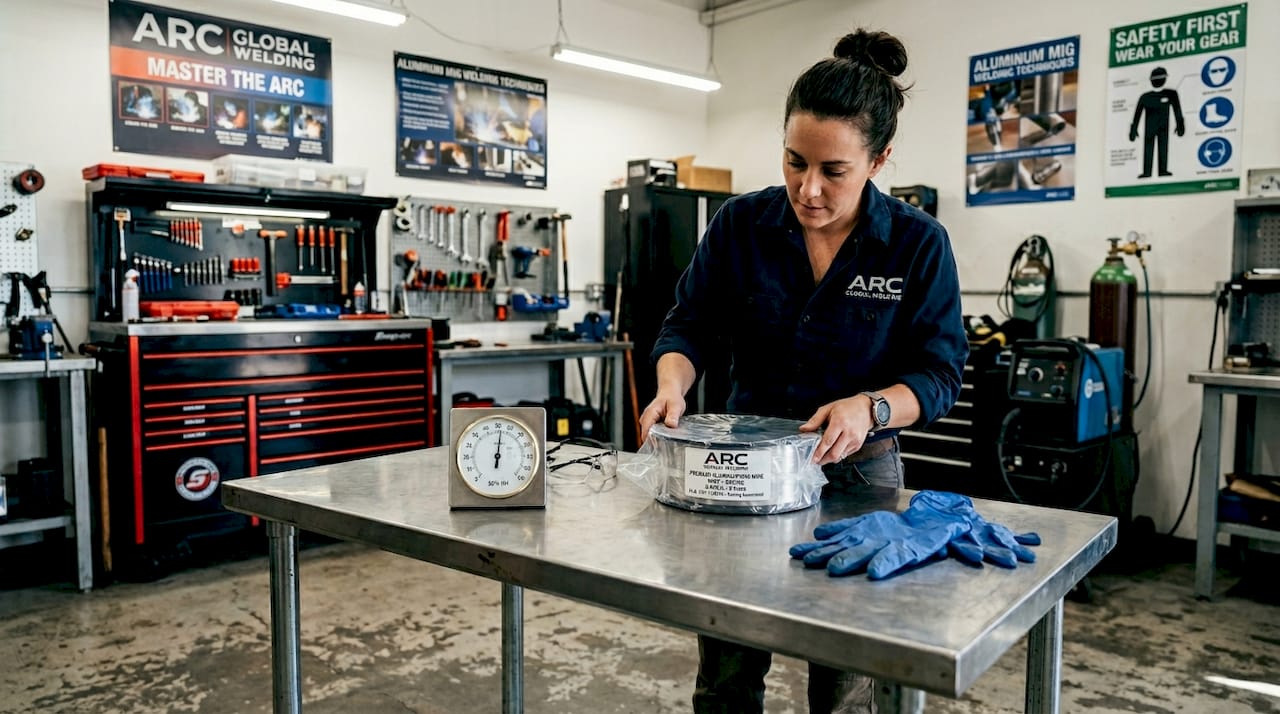
Special considerations for aluminum and critical applications
Not all wires are created equal. Let’s cover special steps for aluminum, flux-cored, and regulated industries where standard storage just isn’t enough.
Aluminum MIG wire is extremely sensitive to temperature variation. If you move a cold spool from a storage area into a hot welding bay, condensation forms on the wire surface. That surface moisture then gets driven into the weld pool, causing porosity almost immediately. Allow 24 hours for aluminum wire to acclimate to ambient shop temperature before use. This single step prevents a significant percentage of aluminum weld porosity complaints.
Flux-cored wires present a different challenge. The flux inside the core can absorb atmospheric moisture even through small gaps in the spool packaging. Once the flux is moisture-contaminated, you’ll see increased spatter, porosity, and inconsistent arc behavior that’s frustratingly hard to diagnose without checking the wire first.
For shops doing aerospace work, structural fabrication, or other regulated applications, here’s how standard and critical storage protocols compare:
| Consideration | Standard shop storage | Critical or regulated application |
|---|---|---|
| Container | Sealed airtight bin | Dedicated storage oven or nitrogen-purged container |
| Desiccant | Silica gel packs | Active desiccant with humidity indicator |
| Acclimation required | Recommended | Mandatory, minimum 24 hours |
| Documentation | Basic labeling | Full traceability: batch, date, storage temp log |
| Humidity monitoring | Periodic hygrometer check | Continuous data logging |
| Wire oven use | Optional | Often required by specification or code |
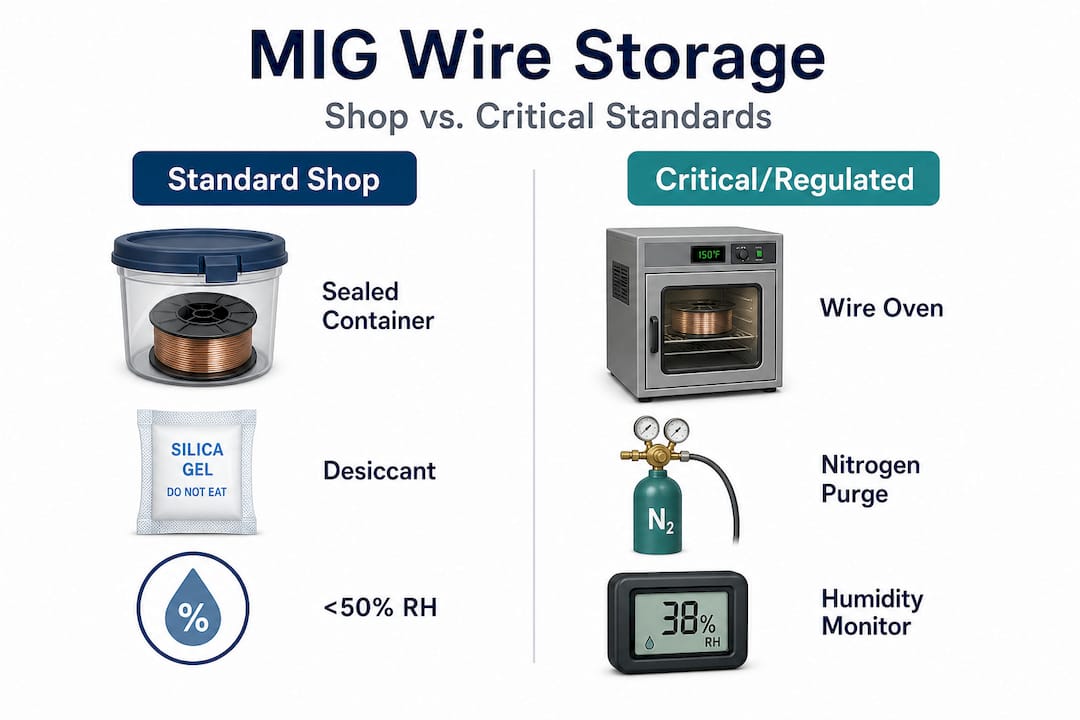
In high-humidity environments or aerospace manufacturing, wire ovens and nitrogen purging are standard practice. Wire ovens maintain a controlled low-humidity environment that actively removes absorbed moisture from flux-cored and metal-cored wires before use. Nitrogen purging in sealed containers displaces oxygen and moisture entirely, making it the most aggressive solution for zero-tolerance applications.
Pro Tip: If you’re welding aluminum and can’t wait 24 hours, use a heat gun on low setting to gently warm the outside of the spool for 5 to 10 minutes. Don’t heat the wire directly. Just bring the package up to room temperature to prevent condensation when it’s opened.
For everyday carbon steel MIG wire, standard sealed storage with desiccant is usually sufficient. But don’t get complacent. Even ER70S-6 will rust in a persistently humid shop.
Troubleshooting and common storage mistakes
Even with best practices, issues arise. Here’s how to catch and correct the most common pitfalls before they cost you a full weld reject.
Early signs that your wire has been compromised by poor storage include:
- Rust flecks or reddish powder visible on the wire surface or inside the liner
- Stiff or jerky wire feed caused by rust debris partially blocking the liner bore
- Visible dust or grime on the wire surface when it comes off the spool
- Spatter increase and arc instability that wasn’t present with the previous spool
- Porosity under X-ray or visual inspection with no obvious shielding gas or technique issue
The most common storage mistakes in professional shops are surprisingly consistent. Storing wire near hand wash sinks, coolant lines, or overhead cranes (which drip hydraulic fluid) accounts for a large portion of contamination problems. Leaving spools on the machine over a long weekend, especially in a shop that loses climate control after hours, is another recurring error. And skipping desiccant entirely because “we never had a problem before” is exactly the thinking that eventually causes a very expensive problem.
There’s genuine debate in the welding community about how critical storage really is. Some experienced welders report leaving wire in the machine for 20-plus years in mild climates without noticeable issues, while others reseal religiously after every shift. The reality depends heavily on your local climate, application tolerance, and material type.
The practical takeaway here is that relaxed storage works until it doesn’t. For non-critical mild steel welds in a dry climate, you may never see a problem. For anything structural, high-visibility, or involving sensitive alloys, proper sealed storage is non-negotiable. Your welding rod storage protocol deserves the same attention, since stick electrodes are equally susceptible to moisture damage.
A welder’s perspective: What shops actually overlook about wire storage
Theory is one thing, but real-world fabrication shops reveal another layer to effective wire storage. Most shops that struggle with wire quality aren’t ignoring storage completely. They’re doing most things right but missing the details that matter most in their specific environment.
The hidden cost nobody talks about is the gradual degradation of weld consistency. A shop that stores wire casually doesn’t suddenly produce bad welds. It produces welds that are slightly less consistent, with slightly more spatter, slightly higher rejection rates at inspection, and slightly less trust from customers on critical jobs. Those small losses compound quietly. A 1% increase in rework on a shop running 40 hours a week adds up to hundreds of hours of lost productivity annually.
Many shops also underinvest in storage because they’re focused on equipment. A new welder or plasma cutter gets immediate budget attention. A proper storage cabinet, a dehumidifier, and a rack system get pushed to next quarter indefinitely. The ROI on proper wire storage infrastructure is genuinely high. You’re protecting consumables that cost real money and directly impact the quality of every part you ship.
Where to focus your storage effort for maximum return: prioritize sealed storage and desiccant for any wire that isn’t used within a single shift. That one step alone addresses the majority of moisture-related wire failures. After that, tackle your shop environment by checking for moisture sources near your storage area. Temperature and humidity monitoring comes next, and it costs almost nothing.
Investing in premium storage makes sense when you’re running advanced MIG welding techniques on critical applications, working with aluminum or stainless regularly, or running a shop where your reputation depends on first-pass quality. Keeping it simple works fine for high-volume mild steel in a controlled shop. Know your application and match your storage investment accordingly.
Reliable wire, safer welds: Find the right tools and consumables
Protecting your MIG wire through proper storage is only half the equation. The other half is starting with high-quality wire that performs consistently from the first arc to the last. Every storage upgrade you make pays bigger dividends when the wire inside the container is already built to a professional standard.

At Simpleweld, we supply professional shops with a full range of premium MIG wires and welding rods sourced from trusted industrial brands. Whether you’re running carbon steel, aluminum, hard-facing wire, or specialty alloys, our catalog is built for fabricators who can’t afford inconsistency. Browse our full selection to find the right wire diameter, alloy, and spool size for your application, and pair it with a storage system built to keep it in peak condition from the day it arrives to the last inch on the spool.
Frequently asked questions
Can I store MIG wires in my welding machine long-term?
It’s possible in mild, low-humidity shops, but best practice is to reseal or remove spools overnight to prevent rust or contamination from building up over time.
How do I keep aluminum MIG wire from getting porosity?
Allow at least 24 hours for the wire to acclimate to shop temperature before use, and store it in airtight containers with desiccant packs to prevent condensation on the wire surface.
What humidity level is safe for MIG wire storage?
Keep storage areas below 50% relative humidity and maintain temperatures between 50°F and 80°F for optimal wire longevity and consistent performance.
Are desiccant packs necessary in every spool container?
Desiccants are highly recommended in all environments, and sealed containers with desiccant significantly extend wire usability by protecting against humidity, dust, and atmospheric contamination between shifts.