

Walk into a hardware store and grab a box of welding rods off the shelf. That works fine if you’re fixing a gate at home. But if your shop runs three shifts, burns through electrodes by the case, and has production deadlines that can’t slip, retail sourcing will cost you more than money. B2B welding supply operates on an entirely different level, built specifically for businesses that depend on consistent material quality, volume availability, and supplier expertise to keep fabrication lines moving. This guide breaks down exactly what that means and how to use it to your operational advantage.
Table of Contents
- Understanding B2B welding supply: Definition and scope
- Key products and services in B2B welding supply
- Comparing B2B welding supply to retail: What makes it different?
- How to maximize value when sourcing B2B welding supplies
- The real challenges and hidden opportunities in B2B welding supply
- Find your industrial welding supply solution with Simpleweld
- Frequently asked questions
Key Takeaways
| Point | Details |
|---|---|
| B2B means business-focused | B2B welding supply targets industrial buyers, not hobbyists, offering specialized products and expertise. |
| Rich product selection | B2B supply channels provide wider ranging equipment, consumables, and safety gear for fabrication processes. |
| Better support and value | Industrial suppliers offer technical support, volume deals, and after-sales service missing in retail. |
| Choose suppliers carefully | Evaluate welding suppliers based on certifications, reliability, and ability to solve real manufacturing challenges. |
| Leverage supplier expertise | Maximizing value means using distributor knowledge, not just their catalogs, to improve your operation. |
Understanding B2B welding supply: Definition and scope
Business-to-business (B2B) welding supply focuses on serving companies, not individual hobbyists. The model is structured around industrial procurement needs, which means larger order quantities, technical product support, and supply relationships that go far beyond a simple transaction. According to the welding equipment distributors industry overview, “B2B welding supply” generally means welding supplies sold to businesses rather than individual hobbyist or retail buyers.
“B2B welding supply is not simply a bulk version of retail. It is a specialized distribution model built to serve the operational, technical, and logistical demands of industrial buyers.”
This distinction matters. A fabrication shop running structural steel projects needs guaranteed electrode consistency across batches, not just a reasonable price on a single box. The scope of B2B supply includes:
- Welding consumables such as electrodes, MIG wire, flux-cored wire, and TIG filler rods in industrial quantities
- Capital equipment including multi-process welders, plasma cutters, and automated welding systems
- Safety and PPE covering helmets, gloves, respiratory protection, and flame-resistant clothing
- Cutting and abrasive products including grinding wheels, flap discs, and cutting torches
- Technical services such as equipment calibration, on-site consultation, and custom sourcing
For a deeper grounding in the terminology that governs these products and processes, welding industry terms are worth reviewing before you start evaluating suppliers. Understanding classifications, certifications, and standard naming conventions will make your procurement conversations far more productive.
Key products and services in B2B welding supply
Having defined B2B welding supply, let’s break down what you can actually expect when sourcing through these business-focused channels.
Industrial distributors stock a significantly wider product range than retail outlets. Distributors provide rods, electrodes, power units, torches, and safety equipment specifically designed for industrial environments. The table below illustrates the contrast between what retail and B2B channels typically offer:
| Product or service category | Retail supply | B2B supply |
|---|---|---|
| Electrode variety | Limited SKUs, general purpose | Full classification range, industry-specific |
| Order quantity | Single unit to small multi-pack | Case, pallet, and contract quantities |
| Technical support | None or minimal | Dedicated application support |
| Equipment sourcing | Off-the-shelf only | Custom and specialized sourcing |
| Safety gear | Basic consumer grade | Industrial and ANSI-certified options |
| After-sales service | Warranty returns only | Ongoing service agreements |
| Supply chain flexibility | Fixed stock only | Consignment and scheduled delivery options |
This breadth makes a real difference. When your production process calls for a specific electrode classification like E7018 or a particular MIG wire diameter for thin-gauge aluminum work, B2B channels stock those specifics. Retail rarely does. Similarly, cutting tools for welding need to match the material and process, not just be “close enough.”
Services are equally important. A strong B2B supplier offers:
- Application consulting to match products to your specific metal types and welding processes
- Supply chain planning to prevent costly stockouts during high-volume production runs
- Custom equipment sourcing for specialized fabrication requirements
- Training and technical resources for your welding team’s ongoing development
- Quality documentation including certifications and material traceability records
Pro Tip: When evaluating a B2B supplier, don’t just review their product catalog. Ask them a technical question about your specific application. How they respond tells you more about their real capability than any brochure can. A supplier worth partnering with will have a knowledgeable answer, not a sales pitch.
Consistent material quality also ties directly to your bottom line. Understanding weld quality essentials helps you specify the right products and hold suppliers accountable to the right standards.
Comparing B2B welding supply to retail: What makes it different?
With the core products and services mapped out, here’s how B2B supply stands apart from retail and why it matters for your business.
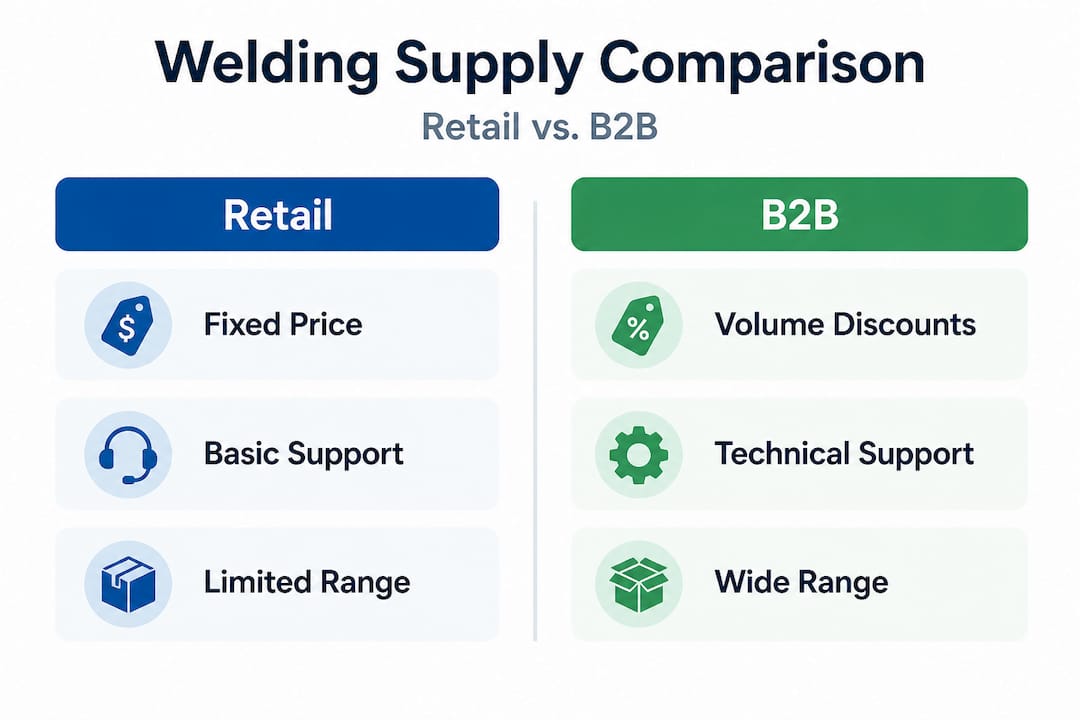
The most visible difference is pricing structure. Retail operates on fixed shelf pricing. B2B supply is built around volume brackets, negotiated contracts, and long-term agreements that reward consistent purchasing. But pricing is only the surface. Commercial distributors deliver supplies geared for construction and industrial activities, not hobbyist use. That means the quality thresholds, material certifications, and product consistency are held to a higher standard from the start.

| Feature | Retail | B2B supply |
|---|---|---|
| Pricing model | Fixed retail price | Volume brackets and negotiated contracts |
| Product quality assurance | Consumer grade, limited traceability | Industrial certified, full documentation available |
| Technical support | Minimal to none | Dedicated application support |
| Volume flexibility | Small quantity only | Scalable to production demand |
| Supply reliability | Stock-dependent, no commitments | Scheduled delivery, contract supply options |
| Warranty and after-sales | Basic manufacturer warranty | Extended coverage and service agreements |
Beyond the table, the operational impact compounds quickly. A retail electrode may not carry lot-traceability records. For shops that perform code-compliant welding on structural or pressure vessel work, traceability is not optional. It’s a job requirement.
Transitioning from retail to B2B procurement doesn’t have to be disruptive. Here’s a straightforward process to make the shift:
- Audit your current consumption. Document every welding consumable, equipment item, and safety product your shop uses monthly. Include quantities and specifications.
- Identify critical products. Flag the items where quality failure or stockout would directly impact production or compliance.
- Request proposals from qualified B2B suppliers. Provide your consumption data and ask for pricing, lead times, and support capabilities.
- Evaluate total cost, not unit cost. Factor in quality consistency, support, delivery reliability, and downtime risk.
- Start with a pilot order. Test the supplier’s responsiveness, product quality, and documentation before committing to a full supply agreement.
- Review and adjust after 90 days. Use real production data to refine your supply strategy and negotiate improvements.
Investing in durable welding equipment is a direct extension of this logic. Every dollar spent on quality equipment and consumables through the right channel returns more value than chasing the lowest unit price through retail.
How to maximize value when sourcing B2B welding supplies
Understanding the unique benefits of B2B supply is one thing. Putting those benefits to work is where business owners and procurement managers gain the edge.
Industry distributors support fabrication processes through tailored supply solutions, but you have to engage strategically to access the full value. Here’s how to do it:
Start with supplier qualification. Not every distributor claiming to serve industrial buyers actually has the depth to back it up. Evaluate based on:
- Quality certifications. Does the supplier carry products with AWS, ISO, or ANSI certification where applicable?
- Technical team depth. Are there certified welding inspectors or application engineers on staff?
- Inventory breadth. Can they source specialty items, or are they limited to common stock?
- Delivery reliability. What are their lead times, and do they offer guaranteed delivery for critical items?
- Volume flexibility. Can they scale supply up or down with your production schedule?
Streamlining your supply chain reduces both cost and administrative burden. Consolidating multiple product categories under one or two qualified B2B suppliers simplifies ordering, invoicing, and relationship management. It also creates leverage for better pricing and service terms.
Before signing with any B2B supplier, ask these questions directly:
- What quality documentation do you provide with each order?
- How do you handle backorders or supply shortages on critical items?
- What technical support is available if we encounter a product application issue mid-production?
- Can you accommodate emergency orders outside of standard lead times?
- How do you communicate product updates, recalls, or specification changes?
- What does your account management structure look like for ongoing support?
The answers reveal whether you’re dealing with a true industrial supply partner or simply a distributor with a business-facing storefront.
For improving weld quality across your shop, the right supply relationship is foundational. Consistent electrode classifications, certified wire specifications, and properly stored consumables directly affect bead quality, deposition rates, and code compliance.
Pro Tip: Schedule a formal supply review every six months. Product formulations change, pricing structures evolve, and new technologies enter the market regularly. A review keeps your supply agreements current and often reveals opportunities to reduce costs or upgrade to better-performing products without increasing spend.
The real challenges and hidden opportunities in B2B welding supply
After exploring best practices and comparing supply models, here’s an insider perspective: what really makes a supply partnership valuable, and how to avoid the traps others fall into.
The most common mistake procurement managers make is treating welding supply as a commodity purchase. They focus on unit price, run a competitive bid process, and award the contract to the lowest number. That logic works for paper clips. It doesn’t work for welding consumables that directly affect the structural integrity of finished fabrications.
We’ve seen shops spend six figures reworking welds caused by inconsistent electrode batches sourced from low-cost, non-specialist distributors. The per-unit savings were real. The rework costs were real too, and they were much larger. True B2B supply value lives in consistency, traceability, and support. Those aren’t line items on a quote sheet. They show up in your production data over time.
The other underestimated factor is technical support. Most companies think about supplier expertise only when something goes wrong. That’s backwards. Engaging your supplier’s technical team before a production challenge becomes costly is where the leverage is. A good distributor knows which electrode performs better on high-sulfur steel, which MIG wire minimizes spatter on thin-gauge work, and how humidity storage conditions affect flux-cored wire performance. That knowledge is free if you ask for it.
“The shops that get the most from B2B supply relationships are the ones that treat their distributor like a technical partner, not just a vendor. The knowledge transfer alone is worth more than any volume discount.”
Hidden opportunities also exist in lead time management. B2B suppliers often offer consignment inventory or scheduled delivery programs that reduce your on-hand stock requirements without creating stockout risk. That frees up working capital without sacrificing production readiness. Very few retail channels offer anything close.
Practical weld insights point consistently to one conclusion: the supply chain behind your welding process is as important as the equipment in front of it.
Find your industrial welding supply solution with Simpleweld
Now that you’re equipped with knowledge and insight, here’s your next step to reliable industrial supply.
Simpleweld is built specifically for businesses like yours, fabrication shops, contractors, and industrial operations that need dependable product quality and a supply source that understands how professional welding actually works.
Browse our full range of industrial welders for sale, sourced and stocked for production-level demands. Stock up on welding rods for sale covering the electrode classifications your shop relies on, with the consistency and documentation industrial work demands. Complete your supply with certified welding safety gear built to meet ANSI and industry safety standards. Simpleweld gives your procurement team a single, reliable industrial source backed by genuine product expertise.
Frequently asked questions
What types of businesses use B2B welding supply?
Construction companies, manufacturing plants, and fabrication shops commonly use B2B welding supply because B2B welding distributors serve construction and industrial buyers who need volume, consistency, and technical support.
How is B2B welding supply different from buying retail?
B2B supply offers larger product ranges, volume discounts, technical support, and tailored solutions for businesses. B2B welding supply means supplies sold to companies with industrial needs, not hobbyist or individual buyers.
What are the most important factors when choosing a welding supplier?
Key factors include quality certifications, supply reliability, technical support, and deep industry expertise. Distributors provide expert support and tailored solutions for fabrication processes, and that expertise is what separates strong supply partners from basic vendors.
Can small businesses benefit from B2B welding supply?
Yes. B2B supply channels offer volume pricing and expert guidance that can help even small operations improve weld quality and reduce per-unit material costs over time.