
Laser welding runs 10 times faster than TIG and uses 60% less energy than arc welding, yet many fabrication shops are still struggling to communicate clearly about the processes driving those gains. The problem isn’t the technology. It’s the terminology. As AWS D1.1:2025 rolls out new definitions, and processes like WAAM and HLAW move from research floors to production lines, the gap between operators who know the language and those who don’t is becoming a real operational liability. This article decodes what’s changed, what’s emerging, and what it means for your shop in 2026.
Table of Contents
- What’s new in welding terminology for 2026
- Emerging processes: Hybrid, automation, and additive terms
- Standard updates: Compliance and industry impact
- Evolving challenges: Nuances, edge cases, and what to watch for
- Why precision in terminology matters more than ever
- Take your welding knowledge and capabilities further
- Frequently asked questions
Key Takeaways
| Point | Details |
|---|---|
| Updated industry terminology | Knowing current terms like HLAW, WAAM, and recent AWS updates keeps welders compliant and competitive. |
| Process innovations | Hybrid and additive technologies are reshaping efficiency, safety, and environmental impact. |
| Standard compliance | AWS D1.1:2025 introduces definitions and clauses every shop must understand to pass inspections. |
| Mitigating edge challenges | Understanding nuanced terms helps troubleshoot complex issues such as solidification cracking and porosity. |
| Precision pays off | Using terminology accurately in high-tech environments increases qualification rates, reduces defects, and maximizes safety. |
What’s new in welding terminology for 2026
The release of AWS D1.1:2025 updates marks one of the most significant revisions to structural welding language in recent years. For shop managers and senior welders, the terminology shifts are not cosmetic. They carry direct compliance implications.
Key changes introduced in AWS D1.1:2025 include:
- LRFD (Load and Resistance Factor Design): A new dedicated subclause that formalizes probabilistic load calculations into the structural welding code, replacing older allowable stress approaches in many design contexts.
- Toughness provisions: Expanded definitions around notch toughness requirements for weld metal and base metal, especially relevant for low-temperature service applications.
- MT/PT terminology updates: Magnetic Particle Testing (MT) and Penetrant Testing (PT) terms have been revised to align with broader NDE (Non-Destructive Examination) standards, reducing ambiguity during inspection reporting.
- Contrast with prior editions: Where AWS D1.1:2020 used broader, less prescriptive language around joint qualification, the 2025 edition tightens definitions to reduce interpretation gaps during third-party audits.
These updates directly affect how your QA team documents inspections, how engineers specify welds on drawings, and how welders interpret procedure qualification records (PQRs). Misusing even one term during a third-party audit can trigger a non-conformance report. Keeping your team aligned with industry welding definitions is no longer optional.
The broader manufacturing landscape reinforces this urgency. Manufacturing trends for 2026 show that data-driven quality control and process standardization are the top priorities for industrial facilities. Terminology precision sits at the center of both.
| Term | AWS D1.1:2020 usage | AWS D1.1:2025 update |
|---|---|---|
| LRFD | Referenced externally | Dedicated subclause added |
| Toughness provisions | General language | Expanded, prescriptive definitions |
| MT/PT inspection terms | Varied by inspector | Aligned with NDE standards |
| Joint qualification language | Broad interpretation allowed | Tightened for audit consistency |
Understanding these distinctions before your next inspection or bid submission puts your shop in a stronger position than competitors still working from outdated reference copies.
Emerging processes: Hybrid, automation, and additive terms
The vocabulary around advanced welding processes is expanding fast. If you’re quoting jobs, writing WPSs (Welding Procedure Specifications), or evaluating new equipment, you need to know what these acronyms actually mean in practice.
HLAW (Hybrid Laser-Arc Welding) combines a laser beam with a conventional arc process, typically MIG or SAW (Submerged Arc Welding). Research on HLAW for thick plates demonstrates that combining HLAW with narrow-gap SAW on 80mm S355ML steel plates significantly reduces weld volume, filler consumption, and heat input compared to conventional SAW alone. For fabrication shops working on heavy structural or offshore components, this translates directly to material savings and reduced distortion.
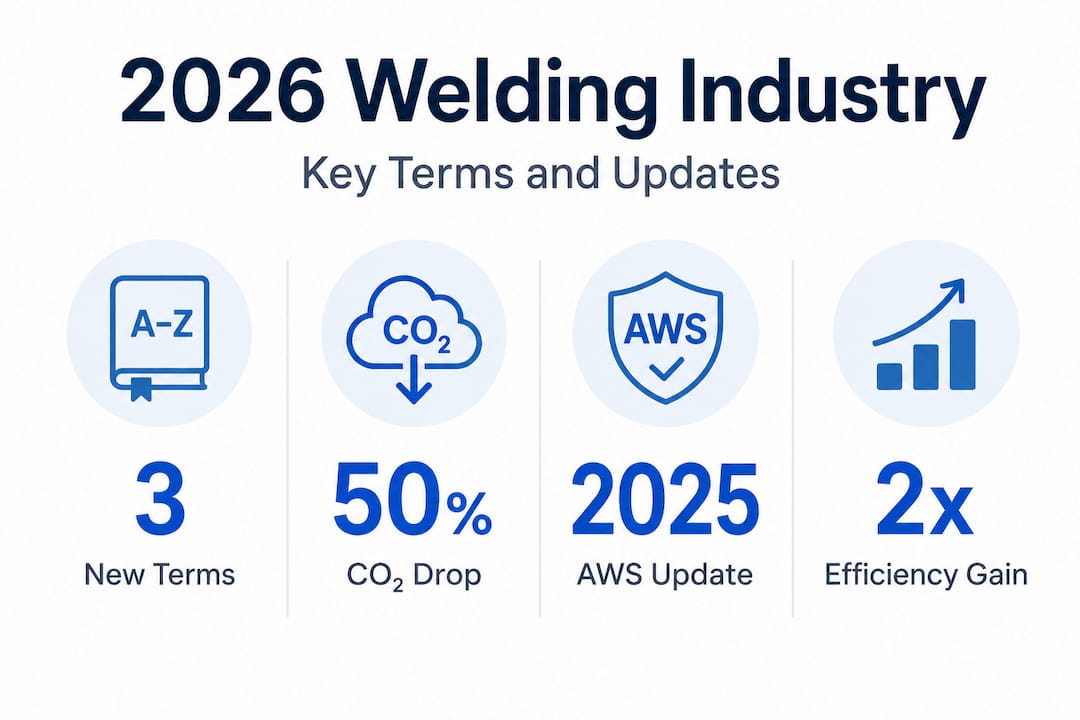
WAAM (Wire Arc Additive Manufacturing) is the process of building near-net-shape metal components layer by layer using arc welding as the energy source. It’s not science fiction. WAAM sustainability data shows it reduces CO2 emissions by up to 50% compared to conventional forging, with energy intensity dropping from 958 MJ/kg for forging to 574.9 MJ/kg for WAAM. For large aerospace and defense components with high buy-to-fly ratios (the ratio of raw material to finished part weight), WAAM is becoming a serious production option.
LUPuS (Laser Upstream Plasma Stabilization) is a hybrid variant designed to handle gap and offset tolerances that would cause conventional laser welding to fail. It avoids solidification cracking by controlling plasma formation ahead of the weld pool. This is a term you’ll start seeing in high-spec fabrication contracts.
Here’s a quick performance comparison across key processes:
| Process | Speed vs TIG | Energy use | HAZ reduction | Best application |
|---|---|---|---|---|
| Laser welding | 10x faster | 60% lower | 70% vs MIG | Thin sheet, precision parts |
| HLAW | 3-5x faster | 40% lower | 50% vs SAW | Thick structural plate |
| WAAM | Varies | 574.9 MJ/kg | N/A (additive) | Large near-net-shape parts |
| Robotic arc | 2-3x faster | Similar to manual | Consistent | High-volume production |
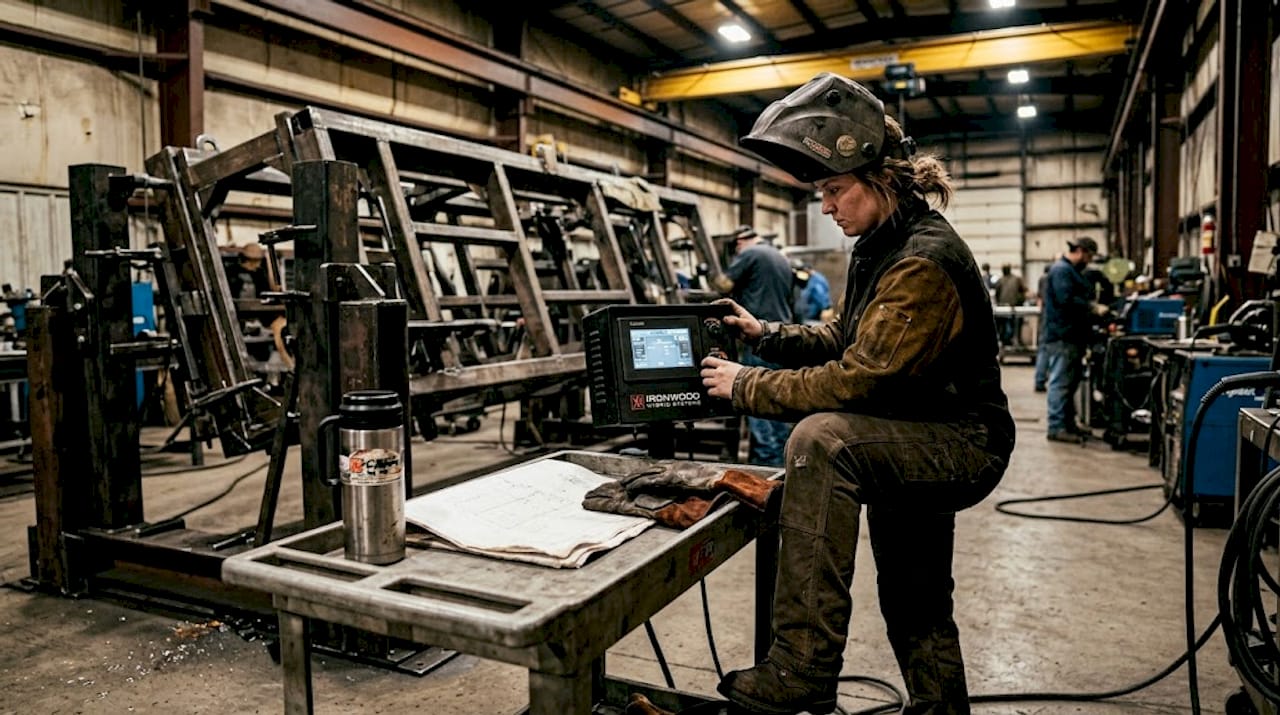
Robotic welding systems are also generating new terminology. Laser welding benchmarks show robotic systems achieving 99% uptime, with sensor-integrated defect detection reducing defects by 25%. Terms like “adaptive arc control,” “seam tracking,” and “real-time parameter adjustment” are appearing in equipment specs and customer contracts. If your operators don’t know what these mean, you risk miscommunication during equipment commissioning or handover.
Pro Tip: When evaluating a multiprocess welder for hybrid or automated applications, confirm that the machine’s documentation uses current AWS/ISO terminology. Mismatched terminology between your WPS and the equipment spec sheet can create compliance headaches during audits.
“The shift from manual to automated and hybrid processes isn’t just a productivity upgrade. It’s a language upgrade. Shops that don’t update their internal vocabulary alongside their equipment will struggle to communicate with engineers, inspectors, and clients who already have.”
Data-driven efficiency frameworks in 2026 manufacturing are built on standardized terminology. Without it, even the best equipment underperforms because teams can’t coordinate accurately around it.
- Audit your current WPS documents for outdated process terminology.
- Cross-reference against AWS D1.1:2025 and relevant ISO standards.
- Update internal training materials to include HLAW, WAAM, and automation-specific terms.
- Confirm that equipment suppliers use matching terminology in their documentation.
- Schedule a terminology review with your QA team before your next third-party audit.
Standard updates: Compliance and industry impact
Terminology changes in AWS D1.1:2025 have downstream effects that reach every corner of a fabrication shop, from how welders log their work to how managers write purchase orders for updated AWS terms on filler metals.
The updated AWS standards place greater emphasis on documented traceability. Every term used in a PQR or WPS must now align precisely with the code’s definitions. A term like “preheat temperature” that was loosely applied in previous editions now carries a specific measurement and documentation requirement. This affects how shops specify procedures and how inspectors validate them.
From a market perspective, the stakes are significant. The global welding market is projected to reach USD 34.96 billion by 2030 at a CAGR of 5.4%, with arc welding holding a 58.3% market share. Robotic welding adoption is accelerating, and those systems reduce workplace injuries by up to 50%. Shops that stay current with terminology and standards are better positioned to win contracts in regulated industries like infrastructure, energy, and defense.
Key compliance impacts from the 2025 update:
- PQR documentation: More explicit language requirements mean generic descriptions will no longer pass audits.
- Inspector qualification: MT/PT terminology alignment means inspectors must demonstrate familiarity with updated NDE language.
- Filler metal specification: Toughness provision changes affect how you specify and order consumables, including rod terminology on purchase orders.
- Training records: Qualification records must reflect updated terminology to remain valid under the new code.
Pro Tip: Pull your last three completed PQRs and check them against the AWS D1.1:2025 definitions section. If you find terminology gaps, address them before they surface during a client audit. Proactive correction is far less costly than a formal non-conformance.
2026 efficiency trends consistently show that compliance-ready shops win more bids, retain clients longer, and reduce costly rework cycles.
Evolving challenges: Nuances, edge cases, and what to watch for
Even with updated standards in hand, real-world application surfaces edge cases that can catch experienced operators off guard. The most common issues cluster around hybrid processes and the AWS versus ASME terminology divide.
Solidification cracking is one of the primary failure modes in hybrid laser-arc welding. It occurs when the weld pool solidifies under tensile stress before the grain boundaries have fully formed. Hybrid welding research identifies preheating, tandem torch configurations, and controlled cooling rates as the primary mitigation strategies. Porosity in deep-penetration laser welds is a related issue, caused by keyhole instability. Both require precise process terminology to diagnose and document correctly.
“If your defect report says ‘cracking’ when the correct term is ‘solidification cracking,’ your corrective action plan may target the wrong variable. Precise terminology isn’t pedantic. It’s diagnostic.”
AWS vs ASME terminology creates real confusion for shops that work across both structural and piping applications. AWS D1.1 governs structural steel welding. ASME Section IX governs pressure vessels and piping. The two codes use different terms for similar concepts:
- AWS uses “prequalified joint” while ASME uses “standard welding procedure specification (SWPS).”
- AWS refers to “essential variables” in a specific context; ASME uses the same phrase but with a different scope of application.
- NDE acceptance criteria language differs between the two, which matters when the same shop handles both structural and process piping work.
Mitigation strategies for edge cases:
- Implement a process-specific terminology checklist for each job type (structural vs piping).
- Use a multiprocess welder with documentation that references both AWS and ASME where applicable.
- Train QA personnel on code-specific language differences, not just general welding theory.
- Flag any job that crosses code boundaries (e.g., structural attachments to pressure vessels) for a dedicated terminology review.
Pro Tip: Keep a side-by-side reference card for AWS D1.1 and ASME Section IX terminology posted in your QA station. It takes minutes to create and prevents hours of rework when a cross-code job comes through.
The surfacing rod selection process is another area where terminology precision matters. Specifying the wrong hardness designation or deposit chemistry because of a terminology mismatch can result in a weld that passes visual inspection but fails in service.
Why precision in terminology matters more than ever
Here’s the uncomfortable truth most shops don’t want to hear: terminology is not administrative overhead. It’s a performance variable.
Automation benchmarks show that facilities with standardized, precisely defined process language achieve qualification rates of 98.9%, reduce cycle time by 18%, and cut energy consumption by 8.6%. Top-quartile steel maintenance costs drop below $12 per ton. These aren’t marginal gains. They’re the difference between a shop that scales and one that stagnates.
The myth is that terminology is something you clean up before an audit. The reality is that shops using precise language daily, in WPS documents, on the shop floor, in supplier communications, build systems that catch errors before they become defects. Imprecise language creates ambiguity. Ambiguity creates variation. Variation creates scrap and rework.
Consider automation as a case study. When a robotic welding cell is commissioned, every parameter, travel speed, wire feed rate, shielding gas flow, must be documented using terms that match the WPS exactly. If the commissioning engineer uses one term and the QA inspector uses another for the same parameter, you get a documentation gap that can void a weld qualification. That’s not a hypothetical. It happens in shops that treat terminology as secondary to production output.
Keeping your team fluent in current precision definitions is one of the highest-return investments a shop manager can make. It costs almost nothing and pays dividends every time a bid, audit, or client review comes through.
Take your welding knowledge and capabilities further
Staying current with evolving welding standards and terminology is only half the equation. You also need equipment that performs to those standards and consumables that match your updated specifications.
At Simpleweld, we stock industrial-grade equipment built for the processes and standards shaping 2026 fabrication. Whether you’re upgrading to a precision TIG and Stick welder for tighter qualification requirements or sourcing the right welding rod to match updated filler metal specifications, our catalog is organized around the terminology and standards your shop actually works with. Our team understands B2B procurement, compliance requirements, and the operational pressures fabrication shops face in a fast-moving market. Browse our full range and find what your shop needs to stay compliant and competitive.
Frequently asked questions
What are the most important new welding terms for 2026?
New terminology centers on hybrid welding, automation, additive manufacturing (WAAM), and AWS D1.1:2025 updates such as LRFD and expanded toughness provisions. These terms appear in contracts, WPS documents, and audit reports, so familiarity is essential.
How does WAAM reduce environmental impact?
WAAM cuts CO2 emissions by up to 50% compared to traditional forging, dropping energy intensity from 958 MJ/kg to 574.9 MJ/kg, making it a viable option for shops targeting sustainability metrics on large components.
Why is precision important when using new welding standards?
Precise terminology ensures that WPS documents, PQRs, and inspection reports align with current code language. Automation benchmarks show that standardized process language drives qualification rates to 98.9% and reduces cycle time by 18%.
What are the differences between AWS and ASME welding terminology?
AWS focuses on structural steel while ASME covers pressure vessels and piping, leading to different terms for joint qualification, essential variables, and NDE acceptance criteria, which matters when a shop handles both types of work.
Can robotic welding really reduce workplace injuries?
Yes. Robotic welding systems reduce workplace injuries by up to 50% while simultaneously improving consistency and uptime, making them a strong investment for high-volume fabrication environments.
Recommended
- Weld quality factors, standards, and practical insights – Simpleweld
- How to Prepare Weld Joints for Strong, Quality Results – Simpleweld
- Why Durable Welding Equipment Matters for Industrial Success – Simpleweld
- Master TIG Welding: Technique, Precision, and Modern Advances – Simpleweld
- Master industrial blasting terminology for precision – Blast Trader