

Outdated cutting setups are costing fabrication shops real money. Scrapped parts, rework cycles, and unpredictable tool life are the direct result of running 2020-era process recipes on 2026 materials and production expectations. The competitive landscape has shifted sharply, and shops that rely on static feed/speed charts and manual quality checks are seeing margins erode fast. AI-driven CNC control has moved beyond pilot programs into embedded daily machine operation, and fabricators who haven’t adapted are already falling behind on quality, efficiency, and sustainability benchmarks.
Table of Contents
- What’s changed in metal cutting: Key technologies and trends in 2026
- Preparation: Tools, materials, and technology setup for advanced metal cutting
- Step-by-step: Executing the optimal 2026 metal cutting process
- Verification and troubleshooting: Achieving quality and sustainability targets
- What most guides miss: The 2026 shift from set recipes to adaptive excellence
- Equip your shop for next-gen cutting excellence
- Frequently asked questions
Key Takeaways
| Point | Details |
|---|---|
| AI-driven control is standard | Process reliability and efficiency now depend on smart CNC systems, digital twins, and real-time adaptive machining. |
| Hybrid and MQL methods excel | Combining advanced cooling and adaptive tool paths consistently yields lower tool wear and improved cut quality. |
| Continuous monitoring beats static settings | Real-time adjustments to parameters outperform legacy ‘set-and-forget’ approaches, especially with diverse alloys. |
| Tool selection impacts performance | 2026 tools focus on minimizing vibration and maximizing process stability, particularly for difficult materials. |
| Validation includes sustainability | Best practices now require tracking energy and CO2 as well as dimensional and surface quality. |
What’s changed in metal cutting: Key technologies and trends in 2026
The biggest shift in metal cutting this year isn’t a single machine or a flashy new tool. It’s the convergence of multiple technologies that now work together in ways they simply couldn’t three years ago.
AI is now integral to machine control, actively managing tool paths, spindle loads, and feed rates in real time rather than waiting for operator intervention. Digital twins have evolved from static simulation models into continuously updated operational ecosystems that unify live data from machining to inspection, giving process engineers instant feedback across every critical variable.
Here’s what’s driving the industry forward in 2026:
- AI-embedded CNC control that adapts parameters mid-cut based on real-time sensor data
- Digital twins that mirror every operational variable and flag deviations before they become scrap
- Stability-optimized tooling designed to suppress vibration and micro-movement, especially in high-mix environments
- Hybrid machining strategies including laser-assisted cutting, ultrasonic assist, and cryogenic fluid delivery
- Minimum quantity lubrication (MQL) as a mainstream alternative to flood cooling, cutting both energy use and waste disposal costs
- Empirical parameter benchmarking that connects speed, feed, and depth of cut directly to energy output and surface finish metrics
Key stat: Shops using AI-connected digital twins report measurable reductions in scrap rates and unplanned downtime within the first six months of full deployment, according to multiple 2026 manufacturing case studies.
On the tooling side, 2026 tool innovation now centers on process security over raw material removal rates. The emphasis has moved toward stability, predictable wear patterns, and integrated under-coolant delivery for tough materials and long chips. This matters because in high-mix fabrication environments, inconsistent tool engagement is often the root cause of surface finish failures and dimensional drift.
For anyone keeping up with AI and digital trends in manufacturing, the key takeaway is that machine intelligence and real-time data are no longer add-ons. They’re load-bearing infrastructure for competitive shops. And finding the best cutting tools for fabrication now means evaluating tool design alongside the digital systems that will run them.
Now that you have a sense of what’s driving the industry forward in 2026, let’s dig into what you’ll need to implement these advances.
Preparation: Tools, materials, and technology setup for advanced metal cutting
With the latest trends and why they matter in mind, your prep phase is critical. Getting this right before the first cut saves hours of troubleshooting downstream.
Equipment selection for 2026 processes
| Equipment type | Key feature | Best application |
|---|---|---|
| CNC machining center with AI controller | Adaptive feed/speed, predictive maintenance alerts | High-mix precision parts |
| Digital twin software platform | Real-time process mirroring, deviation flagging | Complex alloy components |
| Indexable milling cutter (e.g., CoroMill MR20) | Stability-optimized, integrated under-coolant system | Tough materials, long chip alloys |
| Fiber laser cutting system | High power density, fine kerf control | Thin to thick plate, stainless/aluminum |
| Plasma cutter with height control | Fast removal, cost-effective on mild steel | Structural fab, thick carbon steel |
| MQL delivery unit | Precise lubricant dosing at cutting zone | Energy-efficient finish milling |
Your cooling and lubrication setup is just as important as your tooling selection. For advanced material cutting, hybrid approaches like laser-assisted cutting, ultrasonic machining, and MQL-based strategies are now widely implemented in high-performance shops. Each has a specific role: MQL excels in finish milling and energy reduction, while high-pressure under-coolant is essential when you’re dealing with long chips on stainless or Inconel.
Before any critical run, pre-inspect your work material. Check alloy composition, hardness grade, and plate thickness, then cross-reference that data with your parameter tables. Variable material properties between batches, especially in recycled or secondary grade stock, will defeat even the best tooling if your starting parameters are wrong.
For advanced cutting tool selection, it’s worth mapping your job mix first. A shop running mostly mild steel structural work has very different needs than one cutting Inconel or hardened tool steel. The tooling geometry, substrate, and coating should match your material reality, not just what’s available from your current supplier.
For precision secondary operations, TIG welding for precision work often follows tight-tolerance cutting. Your cut quality directly affects weld fit-up, so edge burrs and dimensional drift from the cutting stage compound into rework at the welding stage.
Pro Tip: Always update machine firmware and verify sensor calibration before high-stake production runs. A miscalibrated spindle load sensor will feed bad data to an AI controller, which then compounds the error by making parameter adjustments based on false readings. Five minutes of calibration verification can prevent hours of bad parts.
Step-by-step: Executing the optimal 2026 metal cutting process
Proper setup paves the way. Here’s exactly how to execute with real-world results in 2026 conditions.
-
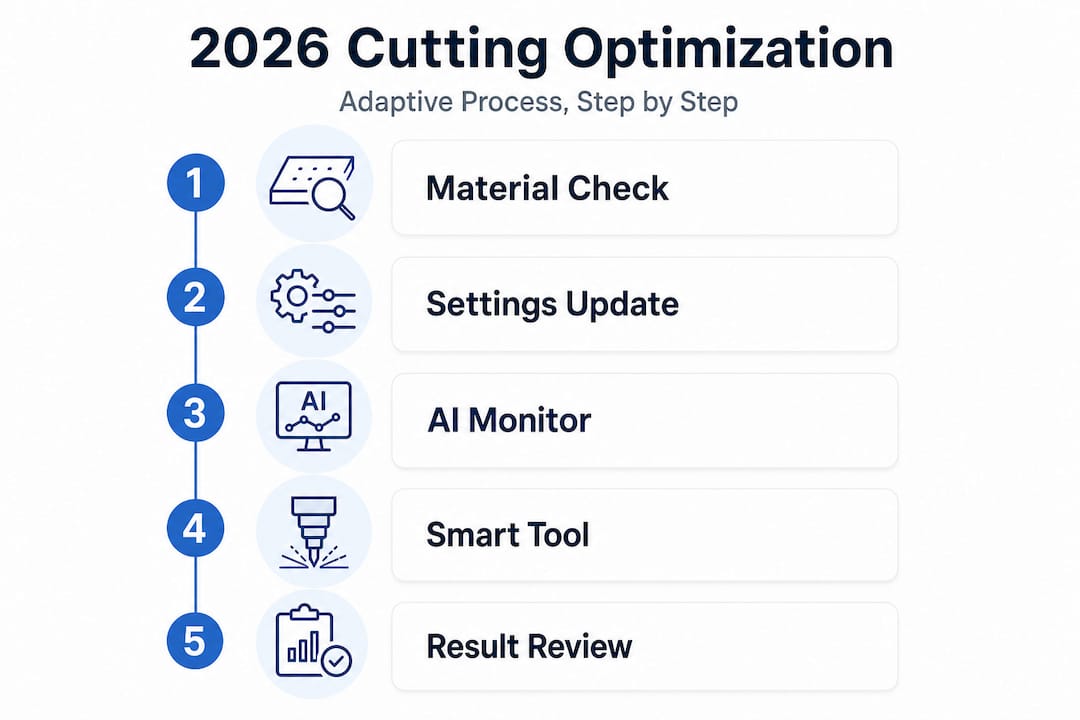
Set up machine and digital twin parameters. Load your work order data into the digital twin platform. Input material spec, target dimensions, and tolerance bands. The twin will establish baseline process expectations against which live run data will be compared continuously.
-
Install stability-optimized tooling. Mount your indexable cutter or end mill with verified runout below 0.005 mm. For long-chip materials, confirm under-coolant ports are clear and pressure is set to specification. Poor tool installation is still the leading cause of early insert failure even in shops with excellent process controls.
-
Select and configure your coolant or lubricant delivery. Match the lubrication strategy to your material and operation. Use MQL for finish passes where surface quality and energy are priorities. Switch to high-pressure coolant for roughing passes on heat-resistant alloys where thermal management at the cutting edge is critical.
-
Run an adaptive pilot cut. Execute a short test cut at 70 to 80 percent of target parameters. Monitor spindle load, vibration signature, and chip formation. This gives your AI controller real baseline data to work from before you commit to full production parameters.
-
Monitor real-time feedback and adjust continuously. Let the AI controller adapt feed and speed based on live sensor input. Don’t override adaptive adjustments unless you see a clear error. Hybrid and adaptive machining strategies consistently yield lower energy consumption and better surface finish at the parameter sets they converge on, compared to static settings.
Cutting process comparison: Speed, quality, and application
| Process | Typical speed (mm/min) | Edge quality (Ra) | Best thickness range | Cost per cut |
|---|---|---|---|---|
| Fiber laser | 8,000 to 25,000 | 0.8 to 3.2 µm | 0.5 to 25 mm | High upfront, low/run |
| Plasma with CNC height control | 3,000 to 12,000 | 3.2 to 12.5 µm | 3 to 50 mm | Moderate, all-in |
| Hybrid laser-plasma | 5,000 to 18,000 | 1.6 to 6.3 µm | 5 to 40 mm | High, versatile |
| Waterjet (reference) | 500 to 3,000 | 1.6 to 6.3 µm | Up to 150 mm | High running cost |
Research on PcBN tooling in abrasive materials found optimal material removal efficiency at 15.04 cm³/min, a rate that balances tool wear against productivity and becomes the kind of benchmark your digital twin should be tracking automatically.
Pro Tip: Stop treating feed and speed settings as fixed values you set at job start. The whole point of AI-connected controls is continuous parameter adaptation. A tool that’s 60 percent worn cuts differently than a fresh insert. Your system should already know this and be compensating. If it isn’t, your control software integration needs attention.
For more detail on plasma cutting best practices, especially for structural plate and thick carbon steel, the fundamentals of kerf width, standoff height, and travel speed still apply. What’s changed is how precisely you can control and monitor them in 2026.
Verification and troubleshooting: Achieving quality and sustainability targets
After execution, validation is crucial. Here’s how to ensure your process meets performance and environmental targets, with safety at the forefront.
Post-cut verification checklist
- Surface finish: Measure Ra with a contact profilometer. Compare against job specification. Any value outside tolerance triggers a parameter review before the next piece.
- Dimensional accuracy: CMM or precision gauge the critical features. Drift beyond 50 percent of tolerance band is a warning sign that tool wear or thermal expansion has shifted your process.
- Edge condition: Inspect for burrs, rollover, and heat-affected zone (HAZ) width. Excess burring typically points to dull tooling or incorrect chip load. Wide HAZ indicates coolant delivery failure.
- Energy and emission outputs: If your facility tracks carbon intensity per part, log the run data from your digital twin. Process parameters connect directly to both surface quality and sustainability metrics, so tracking both together gives you real tradeoff data.
- Tool wear state: Measure flank wear and compare to expected wear curves for the material and parameter set. Complex wear mechanisms including abrasive, chemical, and adhesive wear often act together in advanced alloys.
Common troubleshooting by symptom
- Rough surface finish: Check chip load first. Too high a feed per tooth causes surface tearing. Also check coolant delivery and insert condition.
- Rapid tool wear: Evaluate cutting speed against material hardness. Excessive speed on hardened steels drives thermal wear hard. Switch to MQL or under-coolant if running dry.
- Vibration signatures in cut data: Look at tool overhang and workpiece clamping first. Then check spindle bearing condition. Chatter that persists after clamping improvements often means your toolholder is the weak link.
- Dimensional drift mid-run: Thermal growth in the spindle or fixture is the most common cause. Confirm your machine’s thermal compensation is active and the environmental temperature in the shop hasn’t changed sharply.
Safety note: Post-cut material handling requires the same discipline as the cut itself. Freshly machined parts from high-speed operations retain significant heat, especially in the chip pile. Use appropriate PPE when clearing chips from the machine, and never handle cut edges bare-handed. Burr-related lacerations are among the most common fabrication injuries and are entirely preventable.
For tracking plasma cutting quality metrics specifically, dross formation on the cut underside is your most direct indicator of travel speed and power balance. Learn to read it as a process diagnostic, not just a cleanup problem.
What most guides miss: The 2026 shift from set recipes to adaptive excellence
Here’s the thing most process guides won’t tell you directly: the rigid setup sheet is a liability now, not a resource.
The conventional approach, locking in feed rates, spindle speeds, and coolant pressure at job setup and running the same values from first piece to last, made sense when machine intelligence was limited and material consistency was high. Neither of those conditions is reliable in 2026. Material variability between heats, tool wear progression across a run, and thermal drift in the machine itself mean your “proven” settings from piece one are working against you by piece fifty.
The shops winning on quality and throughput right now are the ones that have shifted from recipe execution to adaptive cycle management. Every run is a data collection event. Every parameter adjustment the AI makes is a lesson stored in the digital twin for the next job on similar material. The process gets smarter with every part made.
Winning 2026 approaches center on reducing process variability with real-time controls, smart tooling, and lubrication strategies tailored to each job. That’s a fundamentally different operating philosophy than “run the recipe and inspect at the end.”
The operator’s role has shifted too. The skill that separates a great machinist in 2026 from an average one isn’t setup speed. It’s the ability to read live process data, interpret what the digital twin is flagging, and make informed decisions about when to intervene and when to trust the adaptive control. Invest in training for live data interpretation and digital twin operation. Shops that do this consistently outperform shops that only train for machine setup.
Pro Tip: Evaluate your team’s digital literacy as seriously as their mechanical skills. The best new cutting tool technologies are only as effective as the operators who can read the process data they generate. A skilled machinist who understands adaptive control feedback is a significantly higher-value asset than one who only knows how to run a program.
Equip your shop for next-gen cutting excellence
Implementing everything covered in this guide requires the right equipment foundation, and that includes not just the capital machinery but the consumables, tooling, and safety gear that make every cut repeatable and safe.
At Simpleweld, we supply the full range of cutting tools, plasma consumables, abrasives, and safety gear that professional fabrication shops need to execute 2026-level processes without sourcing from a dozen different vendors. Whether you’re upgrading from legacy tooling to stability-optimized inserts or equipping a new cell with plasma and laser accessories, our cutting tools selection covers the industrial-grade options your team needs. For shops running mixed operations, our welding solutions catalog ensures your cutting and joining operations are supported from a single, reliable source. Upgrade confidently with products built to industrial performance standards.
Frequently asked questions
What is the biggest advancement in metal cutting technology in 2026?
AI-driven CNC control and digital twins have become the central advancement, enabling real-time adaptive machining, predictive maintenance, and continuous process optimization that was simply not achievable with previous control architectures.
How do I choose between plasma and fiber laser cutting for thick metal in 2026?
For metal thicker than 2 inches, high-power fiber lasers outperform plasma on both cut speed and edge quality benchmarks, though plasma remains the more cost-effective choice for high-volume mild steel plate work where finish tolerance is moderate.
Which cooling or lubrication method lowers both energy use and tool wear?
MQL consistently delivers optimal results for energy consumption, tool wear, and CO2 emission reduction compared to dry cutting or compressed air strategies, based on 2026 machine learning-validated milling studies on difficult alloys.
What is the main cause of premature tool failure in advanced materials?
Abrasive, chemical, and adhesive wear mechanisms typically act together in hard or heat-resistant alloys, meaning tool failure rarely has a single cause and requires parameter optimization across speed, feed, and lubrication simultaneously to extend tool life effectively.