

Welding gas is one of those fundamentals that separates a clean, structurally sound weld from a porous, contaminated failure. Yet too many welders treat it as an afterthought, grabbing whatever cylinder is on hand and hoping for the best. Understanding what is welding gas, which type fits your process, and how to handle it safely is not optional knowledge. It is the difference between passing an inspection and grinding out a bad weld for the third time. This guide covers every angle: definitions, types, process-specific recommendations, and safety practices that actually hold up in real shop conditions.
Table of Contents
- Key Takeaways
- What is welding gas and why it matters
- Types of welding gases and what they do
- How gas selection affects weld quality and cost
- Welding gas safety tips every welder should know
- Choosing the right gas for your welding process
- My take on welding gas selection after years in the trade
- Get the right welding supplies from Simpleweld
- FAQ
Key Takeaways
| Point | Details |
|---|---|
| Welding gas serves multiple roles | Gases shield, fuel, purge, and blanket, each function protecting weld quality in different ways. |
| Gas choice affects weld quality | The wrong gas causes porosity, spatter, and weak welds regardless of your skill or equipment. |
| Blends outperform pure gases | A 75% Ar/25% CO2 blend delivers better arc stability and appearance than pure CO2 for most MIG work. |
| Safety is non-negotiable | Poor ventilation and improper cylinder storage create serious health and fire hazards on any job site. |
| Match gas to metal and process | Mild steel, stainless, and aluminum each require different gas strategies to achieve the best results. |
What is welding gas and why it matters
At its core, welding gas is an inert or semi-inert gas used to protect the molten weld puddle from atmospheric contamination during welding. Oxygen, nitrogen, and water vapor in the air will react with superheated molten metal, causing porosity, oxidation, and structural defects if left unchecked. Welding gas creates a controlled environment around the arc or flame so the metal can fuse cleanly.
The role of welding gases extends well beyond simple shielding, though. Gases perform four distinct functions depending on the process:
- Shielding: Protects the molten weld pool and arc from atmospheric gases like oxygen and nitrogen.
- Fuel: Generates the high heat flame required in oxy-fuel cutting and welding processes.
- Purging: Applied to the back side of a weld joint to protect the root from oxidation, common in pipe welding.
- Blanketing: Covers completed welds or sensitive materials during cooling to prevent post-weld oxidation.
Without proper gas coverage, you get porosity (small gas pockets trapped in the weld), irregular bead profiles, and welds that look fine on the surface but fail under load. The global welding consumables market, including shielding gases, is projected to reach USD 36.9 billion by 2036, a figure that reflects just how central gas management has become in modern fabrication.
Pro Tip: If you notice consistent porosity in your welds despite good technique, check your gas flow rate and hose connections before blaming your wire or machine settings. A small leak upstream is often the hidden culprit.
Types of welding gases and what they do
Welding gas types break into three main categories: shielding gases, fuel gases, and purging or backing gases. Each category contains specific gases with distinct properties.
| Gas | Category | Key Properties | Common Applications |
|---|---|---|---|
| Argon (Ar) | Shielding | Inert, excellent arc stability, low spatter | TIG welding aluminum and stainless, MIG blends |
| Carbon Dioxide (CO2) | Shielding | Reactive, deep penetration, low cost | MIG welding mild steel (pure or blended) |
| Helium (He) | Shielding | Inert, high heat input, fast travel speed | TIG welding thick aluminum and copper alloys |
| Argon/CO2 75/25 blend | Shielding | Balanced stability, penetration, and appearance | MIG welding mild steel, most common shop blend |
| Oxygen (O2) | Shielding additive | Improves fluidity and grain refinement | Small additions in tri-mix gases for specialty work |
| Acetylene (C2H2) | Fuel | Highest flame temperature of fuel gases | Oxy-fuel cutting, brazing, and gas welding |
| Propane | Fuel | Lower temperature than acetylene, widely available | Heating, preheating, and light cutting work |
| Nitrogen (N2) | Purging | Inert at lower temperatures, low cost | Pipe purging, root pass protection on stainless |
| Hydrogen (H2) | Shielding (small %) | Increases heat input, reduces oxidation | TIG welding austenitic stainless steel |
Argon is the workhorse of shielding gases. It is inert, produces a stable arc, and works across a wide range of metals and processes. The trade-off is cost. Inert gases like argon are expensive, which is why most shops use blends rather than pure argon for high-volume MIG work.
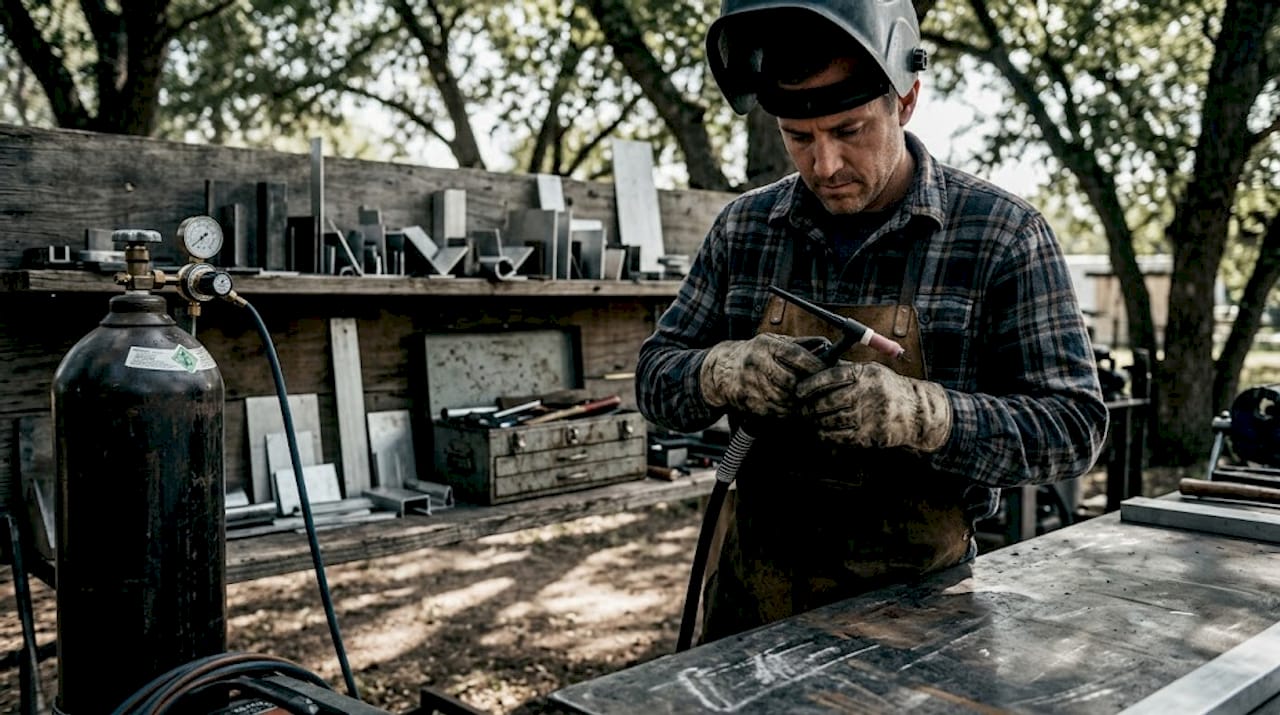
CO2 on its own costs roughly half of what argon costs, making it attractive for production environments focused on mild steel. The downside is more spatter and a rougher bead profile, which means more cleanup time and consumable wear.
Acetylene remains the standard fuel gas for oxy-fuel work because of its high flame temperature, reaching approximately 3,500°C. Propane and butane burn cooler and suit preheating and light cutting better than precision gas welding.
Pro Tip: For TIG welding on stainless steel pipe, a tri-mix gas containing argon, helium, and a small percentage of hydrogen improves penetration and produces a cleaner, brighter bead with less discoloration. It costs more than straight argon, but the reduction in post-weld cleaning time usually justifies it.
How gas selection affects weld quality and cost
Choosing the wrong gas does not just look bad. It changes the physics of your weld. Different gases affect arc stability, penetration depth, heat input, spatter levels, and bead geometry in measurable ways. Understanding these effects lets you dial in results rather than guessing.
The most common MIG shielding gas for mild steel in 2026 is the 75% argon / 25% CO2 blend, specifically because it balances arc stability with penetration. Pure CO2 gives you deeper penetration and costs less, but the reactive nature of CO2 produces more spatter and a wider, less controlled bead. For structural work where appearance matters less, pure CO2 can be cost effective. For work that demands a clean finish, the blend is worth every extra cent.
Here is where the cost analysis gets interesting. Pure CO2 costs approximately 50% less than pure argon, but spatter increases your wire consumption, grinding time, and consumable wear on contact tips and nozzles. Over a full production run, the apparent savings on gas can disappear when you factor in labor and consumables.
On the metallurgical side, gas chemistry does more than just protect. Small controlled oxygen additions in shielding gas blends act as nucleation sites during solidification, refining grain structure and improving weld toughness. Research shows optimal toughness at an 80/16/4 Ar/CO2/O2 mix, which illustrates how precise modern gas formulations have become.
Common mistakes welders make with gas selection:
- Using the same gas blend on every metal regardless of alloy chemistry.
- Running too high or too low a flow rate, which causes turbulence or insufficient coverage.
- Assuming a more expensive gas always produces better results without testing for the specific application.
- Ignoring gas purity ratings when sourcing cylinders from unfamiliar suppliers.
Weld quality outcomes are directly tied to gas selection, and the best welders treat their gas choice as deliberately as they treat their wire selection or amperage setting. One gas does not fit all. Experienced welders avoid one-size-fits-all gas solutions because each metal and application requires specific blends for best performance.
Welding gas safety tips every welder should know
Welding gases present real hazards that go beyond the obvious fire risk. Welding fumes and gases can cause eye, nose, and throat irritation, dizziness, and nausea. In confined spaces, inert gases like argon and nitrogen displace oxygen silently, creating an asphyxiation risk with no warning odor. Any worker showing symptoms should leave the area immediately and seek medical attention.
Follow these safety steps every time you work with welding gases:
- Ventilate the workspace. OSHA guidelines mandate adequate ventilation and respiratory protection to minimize fume and gas exposure. Forced air ventilation or local exhaust systems are far more effective than relying on general airflow.
- Secure cylinders properly. Always chain or strap gas cylinders to a wall, post, or cylinder cart. A falling cylinder with a damaged valve can become a projectile.
- Store cylinders correctly. Keep fuel gases and oxidizers separated by at least 20 feet or a fire-resistant barrier when in storage. Never store cylinders near heat sources or open flame.
- Inspect equipment before use. Check hoses, regulators, and connections for damage or leaks before lighting up. Use soapy water on connections to detect leaks, never a flame.
- Use appropriate PPE. A welding helmet, heat-resistant gloves, and flame-resistant clothing are the minimum. Add a respirator when working in low-ventilation environments or on coated or galvanized materials.
- Transport safely. Move cylinders with the valve cap on and use a cylinder cart. Never roll a cylinder on its side or drag it across the floor.
Pro Tip: Keep a CO2 or oxygen monitor in any enclosed welding area. They are inexpensive relative to the risk and give you a real-time read on atmospheric conditions before a problem becomes a health emergency.
Pair your gas safety practices with the right protective safety gear to cover every exposure risk from fume to UV radiation.
Choosing the right gas for your welding process
Selecting the correct gas comes down to three variables: the welding process you are using, the base metal, and your budget. This table gives you a practical starting point.
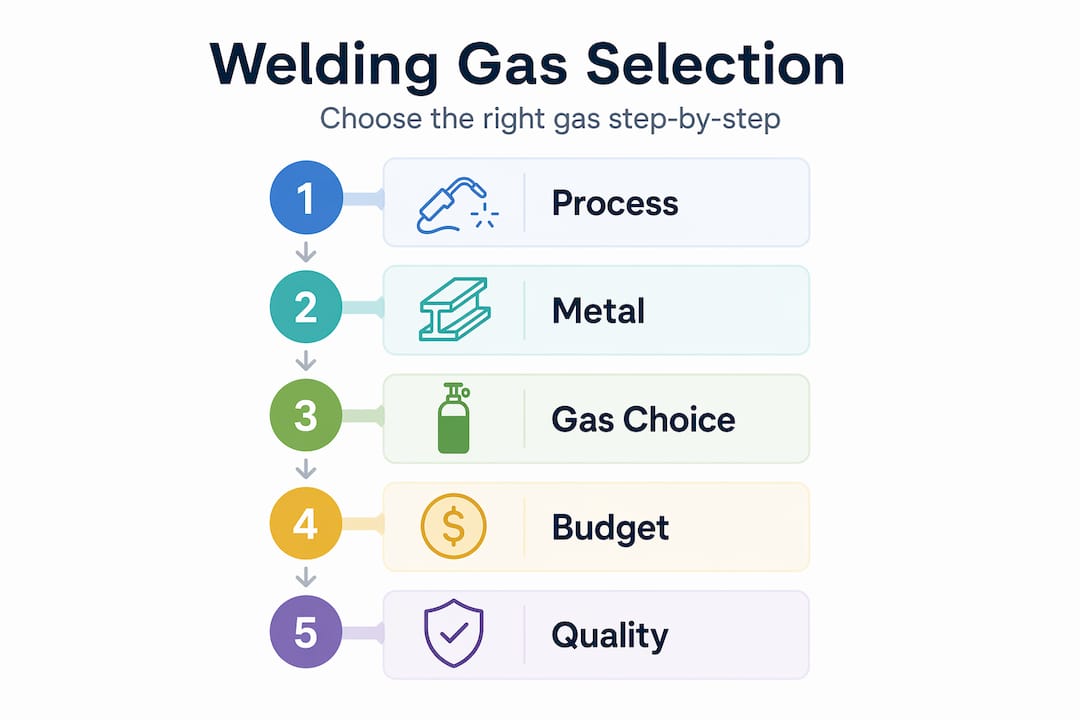
| Process | Metal | Recommended Gas | Notes |
|---|---|---|---|
| MIG (GMAW) | Mild steel | 75% Ar / 25% CO2 | Best balance of stability, penetration, and finish |
| MIG (GMAW) | Mild steel (budget) | 100% CO2 | More spatter, lower cost, good penetration |
| MIG (GMAW) | Stainless steel | 98% Ar / 2% CO2 or tri-mix | Prevents carbide precipitation and oxidation |
| MIG (GMAW) | Aluminum | 100% Argon | CO2 causes porosity on aluminum |
| TIG (GTAW) | All metals | 100% Argon | Standard choice; helium added for thick sections |
| TIG (GTAW) | Stainless (pipe) | Ar/He/H2 tri-mix | Improves penetration and bead appearance |
| Oxy-fuel | Cutting and brazing | Acetylene + Oxygen | Highest heat; propane works for preheating |
| Pipe welding (purge) | Stainless, titanium | Nitrogen or 100% Argon | Protects weld root from oxidation |
For what welding gas for MIG is best on aluminum, the answer is straightforward: pure argon only. CO2 reacts with aluminum’s oxide layer and causes porosity and poor fusion. No blend compensates for that chemistry. Aluminum MIG also demands high argon purity, so always confirm the purity grade from your supplier before starting a critical run.
When sourcing gases, consider buying in larger cylinder sizes if your consumption justifies it. The per-unit cost drops considerably with larger volumes, and many suppliers offer cylinder exchange programs that reduce downtime. For guidance on selecting welding equipment to match your process and gas setup, matching the machine to the gas strategy from the start prevents expensive rework.
As welding becomes automated and AI-driven, gas management is evolving into a data-driven parameter affecting weld speed, wire melting rate, and toughness. Robotic welding cells increasingly monitor gas flow and composition in real time, adjusting automatically for consistent quality. Even if you are running a manual shop today, understanding the logic behind gas selection puts you ahead when automation becomes part of your process.
My take on welding gas selection after years in the trade
I have watched welders spend thousands on better machines while running the cheapest gas they could find, then wonder why their welds look rough and fail inspection. In my experience, the gas mix is often the last variable people optimize, and it should be one of the first.
What I have learned from working across different fabrication environments is that the balanced use of inert and active gases is both an economic and metallurgical decision. Chasing pure inertness for every application wastes money. Chasing the cheapest gas without considering your metal type costs you in cleanup and rework.
The shift toward data-driven gas management is real and worth paying attention to. Shops that track gas consumption, monitor flow rates, and match blends to specific jobs are seeing measurable improvements in first-pass quality rates. You do not need a robotic cell to apply that logic. Even a manual welder who tests two or three gas blends on a new material before committing to a full run will consistently produce better results than one who never questions the default setup.
My practical advice: treat your gas selection as part of your weld procedure specification, not an afterthought. Document what works. When you find the right blend for a specific job, write it down and repeat it.
— Taylor
Get the right welding supplies from Simpleweld
Understanding your gas requirements is only half the equation. You also need equipment and consumables that perform at the same level.
Simpleweld carries a full range of welding tools and equipment for professional fabricators, contractors, and shop operators who cannot afford to compromise on quality. Whether you are setting up a new MIG station, upgrading your TIG setup, or stocking consumables for a production run, Simpleweld has what you need in one place. Browse welding rods and MIG wire compatible with your chosen gas setup, or check out the full welders for sale collection to match your machine to your process. Orders ship fast, and the product range is built for users who know what performance actually looks like.
FAQ
What is welding gas used for?
Welding gas serves four main functions: shielding the weld pool from atmospheric contamination, fueling oxy-fuel flames, purging the back side of joints to protect the weld root, and blanketing welds during cooling. The specific function depends on the welding process and material.
What welding gas for MIG welding is most common?
The most common MIG shielding gas for mild steel is a 75% argon / 25% CO2 blend. It delivers stable arc performance, good penetration, and a cleaner bead than pure CO2, making it the default choice in most fabrication shops.
Can you MIG weld aluminum with CO2 gas?
No. CO2 reacts with aluminum and causes porosity and poor fusion. MIG welding aluminum requires 100% argon, and the purity grade of that argon matters. Always confirm the specification from your supplier before welding aluminum.
What are the main welding gas safety risks?
The primary risks are fume inhalation, asphyxiation from oxygen displacement in confined spaces, and fire or explosion from fuel gas leaks. OSHA requires adequate ventilation, proper cylinder storage, and appropriate PPE including respirators when ventilation is limited.
Is pure argon always the best shielding gas?
Not always. Pure argon produces excellent results on aluminum and TIG work, but it is expensive and not necessary for all applications. For MIG welding mild steel, an argon-CO2 blend performs better and costs less than pure argon, while still outperforming pure CO2 in bead quality and spatter levels.