
If you’ve ever stared at a blueprint covered in symbols, watched a welder set up a machine, and felt completely lost, you already know why understand welding terminology matters. Welding language is not just jargon. It’s the shared vocabulary that lets welders, engineers, fabricators, and inspectors work together without misunderstandings that cost time, money, and safety. The AWS recognizes 93 distinct welding and joining techniques, and each one comes with its own specialized terms. Getting fluent in this language is one of the fastest ways to improve your results on the job.
Table of Contents
- Key Takeaways
- Why understand welding terminology from day one
- Welding symbols: the universal language of blueprints
- Electrical welding terminology: current, voltage, and polarity
- How welding language affects jobs and professional growth
- Practical ways to build your welding vocabulary
- My take on learning welding terminology the right way
- Get equipped with the right tools from Simpleweld
- FAQ
Key Takeaways
| Point | Details |
|---|---|
| Terminology is a safety language | Knowing welding terms prevents dangerous mistakes caused by miscommunication on the shop floor. |
| Symbols prevent costly rework | Standardized welding symbols reduce misinterpretation and help maintain structural integrity across projects. |
| Electrical terms affect weld quality | Understanding current, voltage, and polarity directly prevents defects like poor penetration and excessive spatter. |
| Vocabulary builds professional credibility | Welders who speak the language fluently collaborate better and advance faster in their careers. |
| Incremental learning works best | Focus on terms relevant to your current project or certification path rather than memorizing everything at once. |
Why understand welding terminology from day one
Most people think welding terms are a wall of complicated words they can deal with later. That’s a costly mistake. Terminology mastery transforms skill from basic metal melting into professional craftsmanship capable of diagnosing problems and reading blueprints. The gap between a welder who knows the language and one who doesn’t shows up fast, in weld quality, inspection results, and job-site communication.
The core terms you need to recognize first form the foundation of every welding conversation. Here’s what those terms actually mean and why they matter:
- Bead: The deposited weld metal left on the base metal after the electrode passes. Bead shape tells you immediately whether travel speed, heat, and technique were correct.
- Penetration: How deeply the weld metal fuses into the base metal. Shallow penetration means a weak joint. Too deep and you risk burn-through.
- Base metal: The material being welded. Its grade and condition dictate filler selection, preheat requirements, and technique.
- Electrode: The filler material or conductor used to create the arc. Electrode classification codes carry information about tensile strength, position, and flux coating.
- Arc: The sustained electrical discharge between the electrode and the base metal that generates the heat for welding.
- Puddle: The molten metal pool formed during welding. Controlling puddle size and shape is the physical skill at the heart of welding quality.
- Heat-affected zone (HAZ): The area surrounding the weld that does not melt but undergoes metallurgical changes that affect durability and strength.
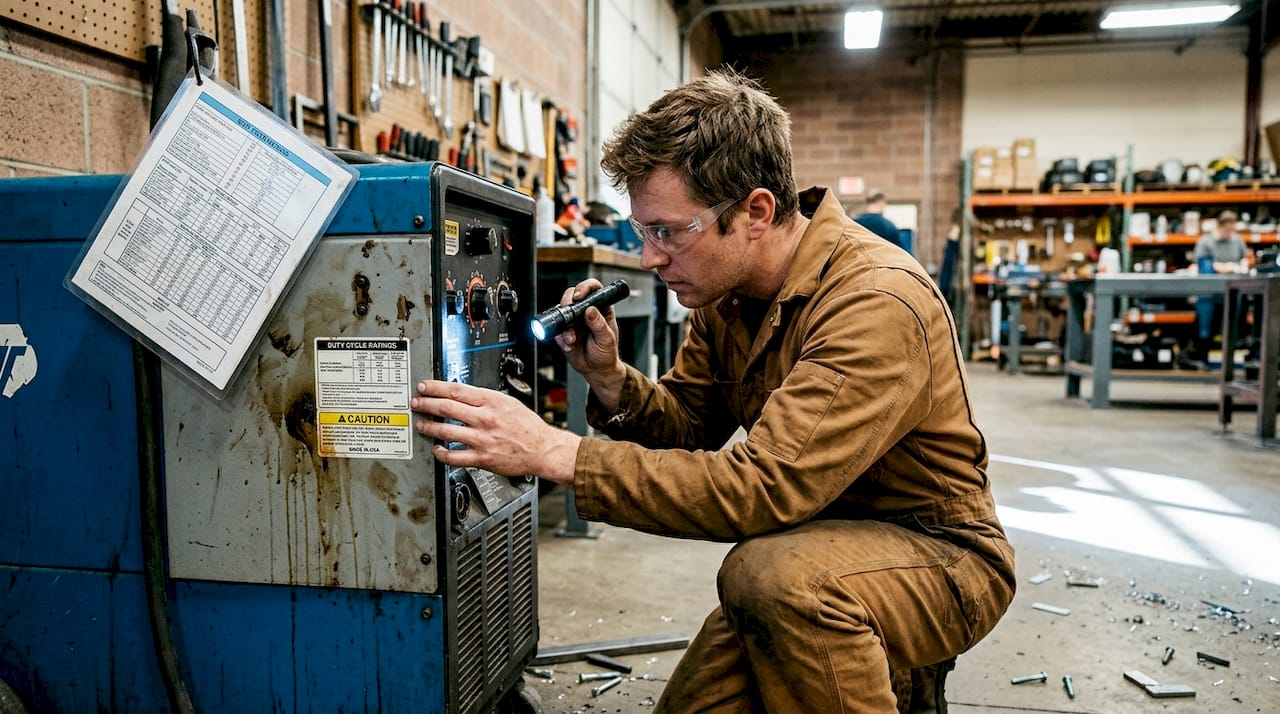
One term that trips up a lot of newcomers is duty cycle. It defines operating time per 10 minutes of total machine use. If a machine is rated at 60% duty cycle, it can run for six minutes out of every ten before needing to cool down. Ignoring this leads directly to equipment failure and unplanned downtime.
Pro Tip: When you pick up a new electrode classification, read every digit. An E7018 rod tells you: 70,000 psi tensile strength, all-position capable, low-hydrogen flux coating. That’s four pieces of critical information in one label.
Welding symbols: the universal language of blueprints
Welding symbols are where most communication between designers and fabricators actually happens. A shop drawing without correctly interpreted symbols is a blueprint for errors. Standardized symbols reduce errors and prevent costly rework by conveying precise instructions about weld type, size, location, and finish directly on the drawing.
Here’s a quick comparison of what reading versus misreading a welding symbol means in practice:
| Symbol element | Correct interpretation | Misinterpretation result |
|---|---|---|
| Reference line side | Weld on the near side of joint | Weld placed on wrong joint face |
| Weld size number | Leg or throat dimension in inches | Undersized or oversized weld |
| Supplementary symbols | Weld all around or field weld required | Weld skipped on critical joint locations |
| Finish symbol | Grind flush after welding | Unacceptable surface left for inspection |
Welding symbols guide inspectors and welders through quality checks and ensure compliance with international standards. When a fabrication shop produces parts for structural steel, aerospace, or pressure vessels, there is no room for guesswork on a symbol. One misread groove weld spec can compromise an entire assembly.
Understanding the relationship between symbols, welding codes like AWS D1.1 or ASME Section IX, and inspection standards is also where the welding standards guide becomes critical reading for anyone working under a quality management system.
Pro Tip: Keep a laminated AWS A2.4 welding symbols reference card at your workstation. Experienced welders still check it. The goal isn’t memorization. It’s accuracy.
Electrical welding terminology: current, voltage, and polarity
This is the category of welding terminology that most directly controls the quality of your weld. Get it wrong and your defects will tell you immediately. Get it right and the arc runs clean, the bead is consistent, and penetration is where it needs to be.
The core electrical terms every welder must understand:
- AC (Alternating Current): Current that reverses direction at regular intervals. AC is commonly used for aluminum welding in TIG processes and certain stick applications. It balances heat input between the electrode and the base metal.
- DC (Direct Current): Current that flows in one direction only. DC is the default for most MIG, flux-core, and stick welding because it produces a more stable arc.
- DCEP (Direct Current Electrode Positive): Sometimes called reverse polarity. The electrode is positive and the base metal is negative. This directs more heat into the electrode side, producing deeper penetration and cleaner welds on most materials.
- DCEN (Direct Current Electrode Negative): Also called straight polarity. More heat goes into the base metal. This produces faster deposition rates and is used when burn-through is a risk on thin material.
Wrong polarity causes defects like excessive spatter, lack of fusion, and unstable arc behavior. These are avoidable, but only if you know what the settings mean. A machine label that says “DCEP” or a welding procedure that specifies polarity is communicating something precise. Misreading it is not a minor error.
Voltage controls arc length and arc stability. Too low and the arc becomes erratic and the bead piles up. Too high and you lose control of the puddle and introduce porosity. Understanding voltage as a variable, not just a dial to turn up or down, is what separates welders who troubleshoot problems from those who repeat them.
Understanding current and polarity is not optional knowledge. It is foundational to reading any welding procedure specification (WPS) and to passing any practical certification exam.
How welding language affects jobs and professional growth
The benefits of knowing welding terms extend far beyond the machine. Terminology clarity prevents errors and supports compliance across manufacturing, construction, and industrial environments. Here’s how that plays out in practice:
- Between welders and engineers: When an engineer specifies a full penetration groove weld on a structural drawing, a welder who understands that term knows the root must be fully fused through the joint thickness. A welder who doesn’t may produce a partial penetration weld that passes visual inspection but fails under load.
- During quality control: Inspectors use precise language during audits and weld reports. If you don’t understand terms like “undercut,” “overlap,” “lack of fusion,” or “interpass temperature,” you cannot meaningfully respond to a nonconformance report or make the right correction.
- For certification: Every welding certification exam, whether AWS CWI, API 1104, or ASME Section IX qualification, is conducted entirely in the language of welding terminology. Terminology mastery enables professionals to interpret procedure specs, answer written exams, and perform practical tests with accuracy.
- In the supply chain: When ordering consumables, communicating with suppliers, or reviewing material certifications, welding lingo is the shared language. Knowing what AWS classification, heat number, or lot traceability means protects your project from using the wrong material.
Pro Tip: Before any new project, read the welding procedure specification from start to finish. Circle every term you don’t fully understand and look it up before you strike the first arc. This single habit will prevent more problems than any other preparation step.
You can explore how welding terms and standards connect to real manufacturing compliance requirements if you want a deeper look at how language maps to code requirements.
Practical ways to build your welding vocabulary
Building a solid welding vocabulary doesn’t require sitting in a classroom. It requires intentional, consistent exposure to terms in the context where they actually matter.
- Start with your current project or certification path. If you’re working on flux-core welding for structural steel, learn the terms specific to that process and code first. Incremental learning improves retention and practical application far more effectively than trying to absorb everything at once.
- Keep a reference accessible at all times. A physical welding terms glossary or a bookmarked digital reference is something you should consult daily. Professionals don’t guess at definitions. They verify.
- Read welding procedure specifications (WPS) and inspection reports. These documents are written entirely in welding language. Reading them regularly builds vocabulary faster than any study guide.
- Practice identifying terms on real equipment. Machine labels, electrode boxes, gas regulators, and blueprint symbols all use the language you need to learn. Every piece of equipment around you is a vocabulary lesson.
- Ask experienced welders to explain their setups. When a senior welder adjusts wire feed speed, travel angle, or interpass temperature, ask them why. The answers will teach you terminology in context, where it sticks.
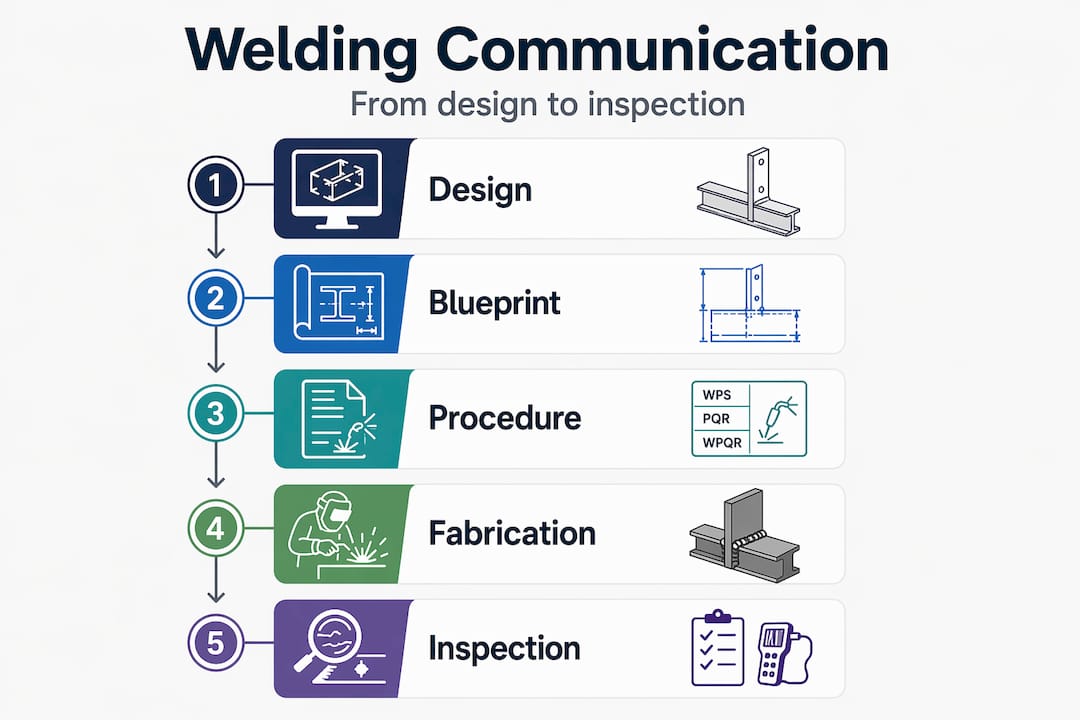
The goal of effective welding communication is to reduce ambiguity at every stage of fabrication, from design to final inspection.
My take on learning welding terminology the right way
I’ve watched welders struggle for years on the shop floor because nobody told them that the language of welding is a skill in itself. Not a side skill. Not something you pick up eventually. A real, trainable skill that directly changes how good your work looks and how far you go in the trade.
When I started paying serious attention to terminology, the first thing that changed was troubleshooting. Before, when a weld looked wrong, I’d adjust something and hope. After I understood terms like HAZ, DCEP, interpass temperature, and fusion zone, I could read a failed weld like a report. It told me what went wrong. That shift from guessing to diagnosing is everything.
What I’ve learned over the years is that new welders often get overwhelmed and either avoid the language entirely or try to memorize everything at once. Both approaches fail. The right approach is to treat every project as a vocabulary lesson. Learn the terms you need for what you’re doing right now. Then build from there.
The professionals I’ve seen advance fastest are not always the most technically gifted welders. They’re the ones who can walk into a conversation with an engineer, read a WPS without confusion, and write a nonconformance response that holds up to review. That’s terminology fluency at work. It’s what separates a tradesperson from a professional.
— Taylor
Get equipped with the right tools from Simpleweld
Understanding welding terminology is only half of the picture. The other half is having the right equipment to apply that knowledge correctly. At Simpleweld, you’ll find industrial-grade gear built for professionals who take their craft seriously.
Whether you’re setting polarity on a stick welder, selecting welding rods for a specific electrode classification, or suiting up with welding safety gear before striking an arc, Simpleweld carries the products that match the standards you’ve learned to work with. The full collection of professional welders covers MIG, TIG, stick, and flux-core applications for fabrication shops, contractors, and industrial users. And if your work extends to cutting and metal prep, the torch cutting tools selection gives you everything from cutting torches to plasma cutters. Quality equipment and solid terminology knowledge work together. One without the other will limit your results.
FAQ
What does welding terminology actually mean?
Welding terminology refers to the standardized set of words, symbols, and classifications used across the welding industry to describe processes, materials, equipment settings, and weld quality. It functions as a shared professional language for welders, engineers, inspectors, and fabricators.
Why is it important to know welding terms before certification?
Every welding certification exam is conducted using precise welding language, and procedure specifications are written entirely in technical terms. Without fluency in welding vocabulary, you cannot accurately interpret a WPS or correctly respond to inspection findings.
How does polarity affect weld quality?
Incorrect polarity is one of the most common causes of avoidable defects, including excessive spatter, poor penetration, and unstable arc behavior. Knowing the difference between DCEP and DCEN lets you match your setup to the electrode and material requirements.
What are the most important welding terms to learn first?
Start with bead, penetration, base metal, electrode, arc, puddle, HAZ, duty cycle, and polarity. These terms appear in nearly every welding discussion, procedure specification, and inspection report you will encounter.
How do welding symbols prevent rework?
Standardized welding symbols convey precise instructions about weld type, size, location, and finish directly on engineering drawings. When read correctly, they eliminate the guesswork that leads to incorrect welds, failed inspections, and costly corrections.