
Most welding professionals assume that meeting “code” means the job is covered. That’s a costly assumption. Structural fabricators sometimes cite ASME Section IX on a building steel job, pressure vessel shops occasionally apply AWS D1.1 where it simply doesn’t belong, and quality managers find out too late that ISO 5817 Level C acceptance criteria won’t cut it on a fatigue-loaded joint. Standards confusion creates real consequences: rejected welds, failed inspections, liability exposure, and lost contracts. This guide cuts through that confusion by laying out what each major code actually requires, where it applies, and how your operation can stay reliably compliant.
Table of Contents
- Understanding welding industry standards: Why they matter
- The major welding codes: AWS, ASME, and ISO compared
- Deep dive: Critical requirements and nuances of each standard
- How to stay compliant: Implementing and maintaining standards on the shop floor
- What most professionals miss about welding standards
- Welding tools and supplies for code compliance
- Frequently asked questions
Key Takeaways
| Point | Details |
|---|---|
| Know the right code | Each welding standard applies to specific materials and project types—using the wrong one can be costly and dangerous. |
| Document everything | Maintaining proper WPS and PQR documentation is essential for passing audits and proving compliance. |
| Stay vigilant | Shop practices, material choices, and process controls must continually align with the chosen code’s requirements. |
| Continuous training | Welder qualification and ongoing training help maintain compliance as codes and techniques evolve. |
Understanding welding industry standards: Why they matter
Welding standards are the formal, documented requirements that define how welds must be designed, executed, inspected, and accepted. They exist because weld quality isn’t visible to the naked eye. A bead that looks clean can hide porosity, incomplete fusion, or undercut that will fail under load. Standards close that gap by prescribing testable criteria and documented processes.
Three organizations drive most of what happens in North American and international shops. The American Welding Society (AWS) develops codes focused primarily on structural applications. The American Society of Mechanical Engineers (ASME) governs pressure-retaining equipment and piping through its Boiler and Pressure Vessel Code (BPVC). The International Organization for Standardization (ISO) produces globally applicable quality and acceptance standards used heavily in European markets and multinational supply chains. Understanding the key welding terms and standards behind these bodies is a foundational skill for any professional operating at an industrial level.
Primary welding industry standards include AWS D1.1 for structural steel welding, ASME Section IX for procedure and welder qualifications in pressure vessels, and ISO standards like 3834 for quality requirements and 5817 for imperfection acceptance levels.
Why do they matter beyond just satisfying an inspector? Consider what’s at stake:
- Safety: Sub-standard welds on structural steel can lead to catastrophic collapse. Non-conforming welds on pressure vessels create explosion risk.
- Legal and contractual liability: Contract specifications routinely require specific code compliance. A shop that delivers to the wrong standard has technically delivered a non-conforming product, regardless of how clean the weld looks.
- Customer trust: Repeated, documented compliance builds a reputation that wins repeat business, especially in sectors like oil and gas, power generation, and heavy construction.
- Operational efficiency: Shops with documented WPS (Welding Procedure Specification) and PQR (Procedure Qualification Record) files spend less time reworking and more time producing.
Non-compliance costs aren’t abstract. Rework on a rejected weld can easily run 5 to 10 times the original labor cost once you factor in material prep, NDT (non-destructive testing) re-inspection, and schedule delay. On pressure vessel work, a single non-compliant weld can pull the entire vessel out of service. For shops chasing ISO certification, gaps in their quality system can delay certification by months. This extends to how well your team understands fabrication material standards, since the base material itself has to align with what the code specifies.
“Standards are not bureaucratic overhead. They are the technical foundation that separates repeatable quality from guesswork.”
With the big picture in mind, let’s zero in on which welding standards dominate the industry and how they differ.
The major welding codes: AWS, ASME, and ISO compared
Now that you know how standards shape expectations, see how these leading codes stack up against each other.
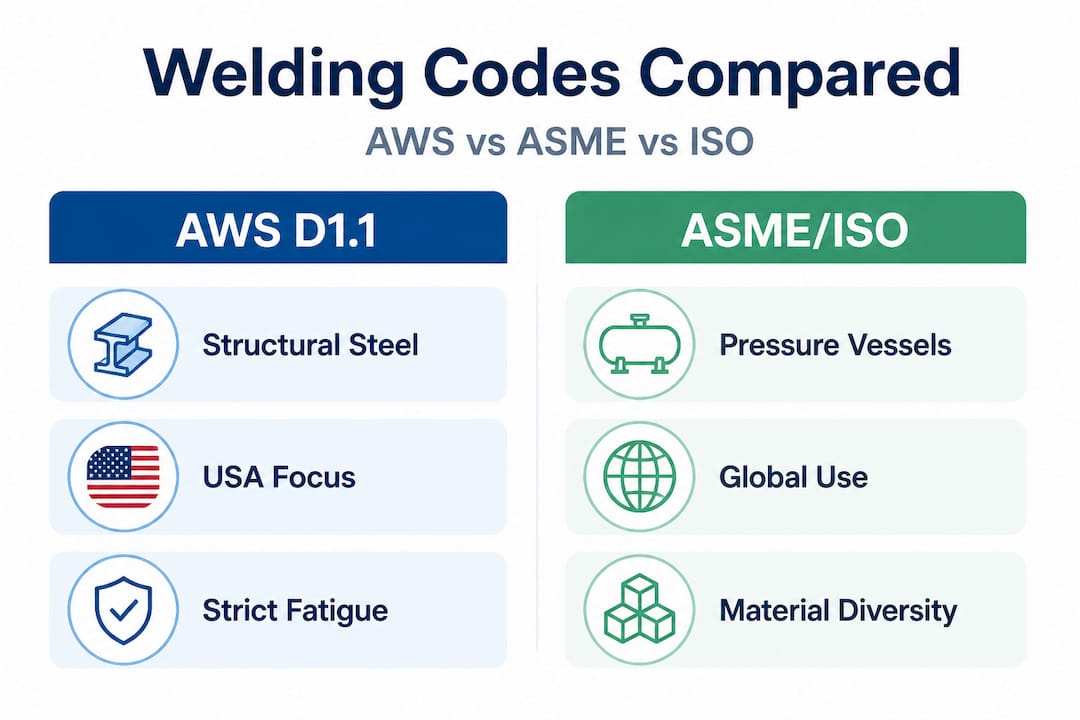
Primary welding codes each have a distinct scope. AWS D1.1 is the go-to for structural steel welding in the United States, covering everything from bridges to building frameworks to heavy equipment frames. ASME Section IX governs the qualification of welding procedures and welders for pressure vessels, boilers, and power piping. ISO 3834 defines quality requirements for fusion welding in manufacturing, and ISO 5817 establishes acceptance levels for weld imperfections across a broad range of materials and processes.
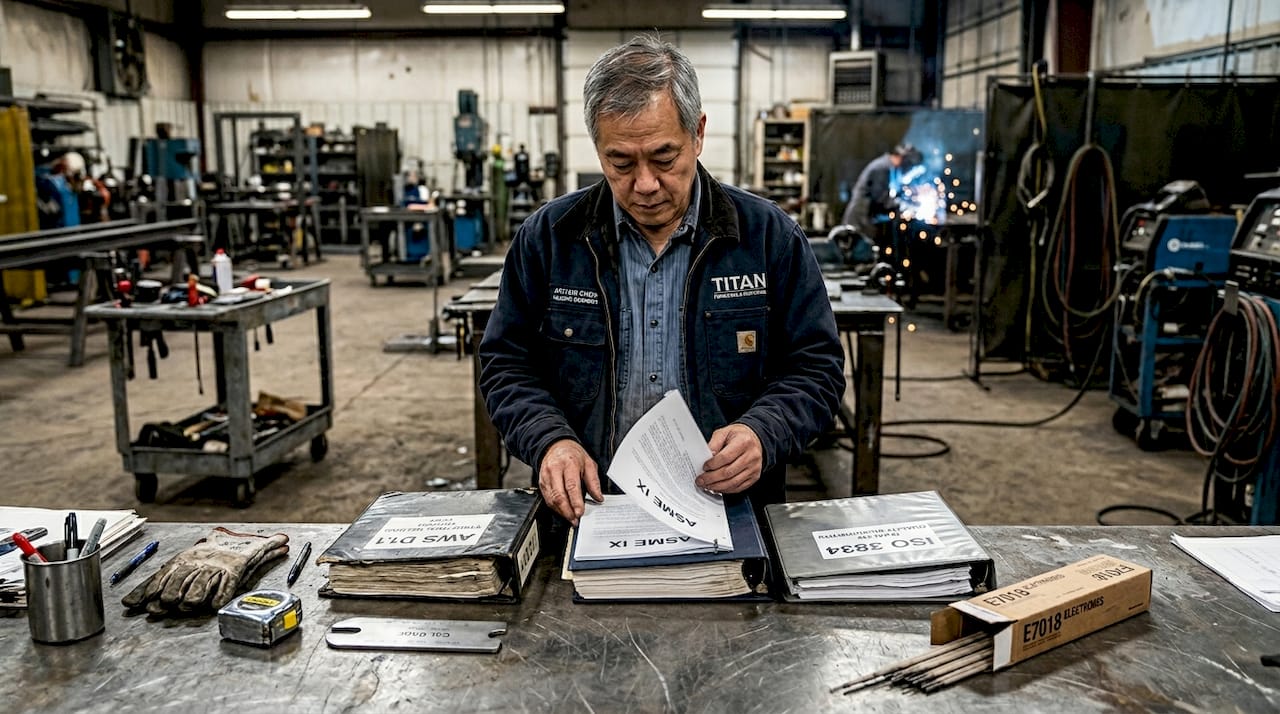
The practical differences between these codes matter a lot when you’re setting up a project. Each one was written for a specific engineering context, and the acceptance criteria, testing requirements, and documentation obligations reflect that context. Choosing the wrong one isn’t just a paperwork error. It means you may be testing to the wrong criteria, running the wrong procedures, or qualifying welders under conditions that don’t match the job. Weld quality insights consistently show that misapplied codes are one of the top causes of costly rework on fabrication projects.
Here’s how the three major standards compare side by side:
| Attribute | AWS D1.1 | ASME Section IX | ISO 3834 / 5817 |
|---|---|---|---|
| Primary application | Structural steel welding | Pressure vessels, boilers, piping | General manufacturing, quality systems |
| Geographic focus | United States | United States (global adoption) | International |
| Welder qualification | Performance qualification | Performance and procedure qualification | Based on ISO 9606 series |
| Acceptance criteria | Defined in D1.1 tables | Per construction code (ASME VIII, B31, etc.) | ISO 5817 levels A, B, C |
| Documentation | WPS required; PQR for prequalified exceptions | WPS + PQR mandatory | Quality plan, WPS, inspection records |
| Key strength | Cyclic and fatigue load provisions | Rigorous procedure testing | Flexibility across materials and processes |
Pro Tip: Never mix standards in a single project specification unless the contract explicitly permits it and the engineering team has verified compatibility. A project that references both AWS D1.1 and ASME IX without clearly defining which governs each scope creates conflicts that inspectors will flag immediately. When comparing the suitability of base materials for different code requirements, understanding carbon versus stainless behavior under each standard’s welding requirements gives your team a real operational edge.
Deep dive: Critical requirements and nuances of each standard
Beyond their broad differences, each code carries its own fine print and traps. Here’s what matters most in real shop and field use.
The WPS and PQR are the backbone of code compliance under all three major frameworks, but they work differently under each. A WPS is a written document that specifies how a weld is to be made, covering variables like base metal, filler metal, preheat, interpass temperature, position, and welding parameters. The PQR is the test record that proves the WPS produces acceptable welds when subjected to mechanical testing.
ASME Section IX requires tensile tests, guided bend tests, and documentation of essential variables such as filler metal and base metal P-number groupings. A change to an essential variable, like switching filler metal classification or significantly altering heat input, requires a new PQR. This is where many shops trip up. They assume an existing WPS covers a new job, but a material substitution or parameter change has pushed it outside qualification range. Understanding the AWS D1.1 welder test requirements is equally important for structural steel jobs, since the test geometry directly affects what thicknesses and positions a welder is qualified to perform.
For cyclic and fatigue-critical applications, AWS D1.1 applies stricter provisions, and ISO 5817 Level B is the appropriate acceptance tier when weld geometry variations could compromise fatigue life. Level C is less restrictive and suits static loading, but applying Level C to a dynamically loaded structure is a technical error that can pass visual inspection while still creating a structural risk.
Here are the key tests typically required per standard:
| Test type | AWS D1.1 | ASME Section IX | ISO 9606/15614 |
|---|---|---|---|
| Tensile test | Required (PQR) | Required | Required |
| Guided bend test | Required | Required | Required |
| Macro examination | Fillet weld PQR | Optional per code | Required |
| Impact (Charpy) | When specified | When specified | When required by design |
| Visual inspection | Always required | Always required | Always required |
Steps to prepare for and pass key qualification requirements:
- Audit your existing WPS/PQR files against the project’s specified code and confirm all essential variables are within current qualification limits before work begins.
- Review the base metal and filler metal combination to ensure P-number or material group assignments are valid under the applicable code.
- Set up a test assembly that matches production conditions including position, thickness, and joint geometry as closely as possible.
- Submit test coupons to a qualified third-party laboratory for mechanical testing, and verify that the lab reports include all required data fields for the code.
- Complete the PQR documentation immediately after testing while parameters are fresh, and have it reviewed by a Certified Welding Inspector (CWI) before filing.
- Brief welders on the approved WPS before production starts, confirming they understand the parameter limits and that monitoring is in place.
“A technically compliant weld starts with a technically sound WPS. If the procedure document is ambiguous, the weld will be too.”
Connecting the right welding certification processes to each standard your shop works under eliminates the guesswork when qualifying new personnel or adding new processes.
How to stay compliant: Implementing and maintaining standards on the shop floor
Mastering the codes is just the starting point. The real challenge lies in building a compliant operation day to day.
Documentation is only useful if it’s retrievable and current. A WPS filed in a binder that hasn’t been reviewed in three years and a PQR that predates your current filler metal supplier’s product line are not effective compliance tools. They’re liability waiting to happen. ASME Section IX essential variables like filler metal classification and base metal grouping must be actively tracked against what’s actually on your shop floor.
Practical compliance systems for day-to-day operations include:
- Centralized WPS/PQR libraries with version control so welders always pull the current, approved procedure.
- Regular internal audits conducted quarterly at minimum, checking that welding parameters in production match what’s documented in the WPS.
- Structured welder qualification tracking that flags upcoming expiration dates for performance qualifications before they lapse, not after.
- Third-party CWI inspections at key project milestones rather than only at final inspection, catching deviations while correction is still cost-effective.
- Material traceability records linking base metal mill certifications and filler metal lot numbers to specific weld joints on each project.
- Formal non-conformance reporting that documents every rejected weld, root cause, corrective action, and outcome so patterns can be identified and addressed.
Pro Tip: Upstream variable drift is one of the most common and least visible compliance threats. When a filler metal supplier changes wire chemistry slightly within the same classification, or a new base material heat arrives with different carbon equivalency, your existing WPS may no longer produce a qualified weld, even though nothing on your paperwork has changed. Establishing incoming material review as a standard step, not an afterthought, catches these shifts before they become non-conformances. Investing in ongoing welding training keeps your team calibrated to current code editions and aware of the kinds of variable changes that trigger requalification.
Standards themselves evolve. AWS and ASME typically issue updated editions on cycles ranging from 2 to 5 years. ISO standards are reviewed regularly as well. A shop that qualified procedures to an older edition of a code may find that a client’s contract references the current edition with updated acceptance criteria or qualification requirements. Building code edition review into your annual quality planning prevents this from catching you off guard.
What most professionals miss about welding standards
Here’s a truth that experience teaches faster than any code manual: compliance isn’t a destination you reach once. It’s a system you maintain continuously, and the teams that treat it as a one-time checklist are the ones who get tripped up at the worst possible moment, usually mid-project or during a client audit.
The most common gap we see isn’t in paperwork at all. It’s in the field. Small deviations in heat input, a welder slightly out of position, preheat that wasn’t verified with a contact thermometer because “it looked right,” or a filler metal substitution made on the fly without checking against the WPS. These are the real compliance breakers. The paperwork is often perfect while the weld being made is already outside qualification range.
The professionals who consistently pass audits and inspections aren’t the ones who’ve memorized the most code language. They’re the ones who’ve built a culture where the WPS is actually followed, not just filed. Where welders are trained to flag parameter drift instead of push through. Where supervisors verify preheat and interpass temperatures because they understand that equipment longevity and standard compliance are directly connected. Better equipment with stable, calibrated output makes it significantly easier to stay within WPS parameter ranges consistently.
Understanding application context separates truly skilled code compliance from box-checking. Knowing that ISO 5817 Level B is conservative enough to apply to a dynamically loaded joint, or that ASME IX’s temper bead provisions for in-service repair without post-weld heat treatment require exacting technique, means your team makes informed decisions instead of defaulting to the most permissive interpretation. That mindset is what turns compliance from a cost center into a competitive advantage.
Welding tools and supplies for code compliance
Maintaining code compliance starts with having the right equipment and consumables on every job. When your welding machines deliver stable, repeatable output and your consumables come with proper certifications and traceability, staying within WPS parameters becomes a matter of process rather than luck.
At Simpleweld.com, we supply fabrication shops, contractors, and industrial welding operations with the tools and materials they need to work confidently within code requirements. Our selection of professional welders covers the process types and output ranges required for ASME, AWS, and ISO qualified procedures. Our code-compliant safety gear keeps your team protected while meeting the PPE standards your operation depends on. From welding rods and MIG wires with documented classifications to abrasives and cutting tools built for industrial workloads, we carry what serious operations actually need. Browse the complete welding tool supply to find the right fit for your current project codes.
Frequently asked questions
What is the difference between AWS, ASME, and ISO standards?
AWS focuses on structural steel welding in construction and fabrication, ASME Section IX governs welding procedure and welder qualifications for pressure vessels and piping, while ISO standards like 3834 and 5817 address international quality requirements and weld imperfection acceptance levels across a broad range of manufacturing applications.
Which welding code should I use on a structural steel project?
AWS D1.1 is the standard for structural steel welding projects in the United States, covering bridges, buildings, and similar load-bearing fabrication. Your contract documents will typically specify which edition applies.
What are the core documents needed to prove code compliance?
A WPS and supporting PQR are mandatory under ASME Section IX and strongly required under AWS D1.1, along with welder performance qualification records that confirm each individual is qualified under the applicable procedure.
How often do welding standards and codes get updated?
Most major welding standards are reviewed and updated on cycles of 2 to 5 years, meaning your qualification records and WPS files should be periodically audited against the current edition referenced in your project contracts.
Why is welder qualification testing important?
Welder performance qualifications confirm that an individual can consistently produce welds that meet the mechanical and visual requirements of a specific code, accounting for essential variables like filler metal type, base material, and welding position that directly affect weld integrity.
Recommended
- Weld quality factors, standards, and practical insights – Simpleweld
- Stay ahead: key welding industry terms and standards explained – Simpleweld
- How to Prepare Weld Joints for Strong, Quality Results – Simpleweld
- MIG welding techniques, tools, and best practices explained – Simpleweld
- Illinois Renovation Standards 2026: Essential Compliance Guide