

Choosing the wrong cutting method doesn’t just slow down production—it can compromise weld quality, trigger costly rework, and burn through your consumable budget before you hit the second shift. Too many experienced fabricators default to whatever process they learned first or whatever equipment already sits in the shop, treating the decision like a preference rather than an engineering choice. This guide cuts through the noise with direct comparisons, real speed data, edge quality breakdowns, and practical scenarios so you can match the right process to every job—and stop leaving efficiency on the table.
Table of Contents
- How plasma and oxy-fuel cutting work
- Core differences: Materials, thickness, and speed
- Cut quality and post-processing impact
- Setup, portability, and operational considerations
- How to choose: Decision factors and real-world scenarios
- Why choosing the “right” process can be a trap
- Upgrade your cutting game with professional tools
- Frequently asked questions
Key Takeaways
| Point | Details |
|---|---|
| Material compatibility | Plasma cuts all conductive metals; oxy-fuel is limited to steels due to oxidation chemistry. |
| Thickness advantage | Oxy-fuel dominates heavy section steel; plasma shines on thin to medium plate up to about 25mm. |
| Speed and quality | Plasma is faster and produces cleaner cuts for most mild steel tasks; oxy-fuel is slower with more edge cleanup needed. |
| Setup differences | Plasma requires electricity and gas, instantly starts; oxy-fuel is more field-portable but needs preheat and careful gas handling. |
| Application strategy | Choosing the right method depends on material, thickness, environment, and downstream workflow needs. |
How plasma and oxy-fuel cutting work
Before we dive into comparisons, a clear technical foundation helps correct common misconceptions about what each process can and cannot do.
Understanding the underlying chemistry of each process tells you exactly why certain materials respond the way they do, and why swapping methods without thinking first leads to rough edges, failed starts, and wasted material.
Oxy-fuel cutting works in two stages. First, the torch preheats the base metal using a fuel-oxygen flame. Once the steel reaches ignition temperature around 1800°F, a concentrated stream of pure oxygen floods the cut zone. This triggers a rapid oxidation reaction—essentially controlled burning of iron—that melts and ejects the resulting iron oxide as slag. The cut isn’t technically melting the metal; it’s oxidizing it. That distinction matters enormously for material selection.
Plasma cutting works on an entirely different principle. A high-frequency electrical arc ionizes a stream of compressed air or gas, creating a fourth state of matter—plasma—that reaches temperatures exceeding 30,000°F. That superheated jet melts through any electrically conductive metal and blasts the molten material clear of the cut zone. You can read more about the full process in our breakdown of how plasma cutting works.
Here’s where the critical difference lands: because oxy-fuel depends on iron oxidation, it is chemically locked to carbon and low-alloy steels. Stainless steel and aluminum don’t oxidize the same way—so the reaction simply won’t sustain a cut. Plasma cuts all conductive metals including stainless, aluminum, copper, and mild steel without restriction.
Key setup differences at a glance:
- Oxy-fuel: Requires oxygen cylinders, fuel gas (acetylene, propane, or natural gas), a torch body, tip, and regulators. No electrical power source needed.
- Plasma: Requires a power supply (typically 208-480V single or three-phase), compressed air or specialty gas, a plasma torch, and consumables (electrode, nozzle, shield).
- Gas purity: Both processes are sensitive to supply quality. Contaminated oxygen significantly degrades oxy-fuel performance, and plasma gas moisture can cause erratic arc behavior.
For an overview of torch options across both categories, the cutting torches overview on our site covers functions and industrial applications in detail.
Plasma is often described as the “universal” cutter, but oxy-fuel’s chemistry gives it a decisive edge on thick carbon steel where the oxidation reaction actually accelerates the cut rather than fighting the material.
Core differences: Materials, thickness, and speed
With the fundamentals clear, the next step is comparing what really sets these methods apart in practice.
Side-by-side capability comparison
| Factor | Plasma cutting | Oxy-fuel cutting |
|---|---|---|
| Compatible metals | All conductive metals | Carbon and low-alloy steel only |
| Optimal thickness range | Up to 25mm (most efficient) | 25mm to 300mm+ |
| Max practical thickness | ~150mm (with HD plasma) | 300mm and beyond |
| Typical speed at 12mm steel | ~2,500 mm/min | ~500 mm/min |
| Initial setup time | Minutes (no preheat) | 5-15 min preheat required |
| Power source | Electrical (stable supply) | Gas cylinders only |
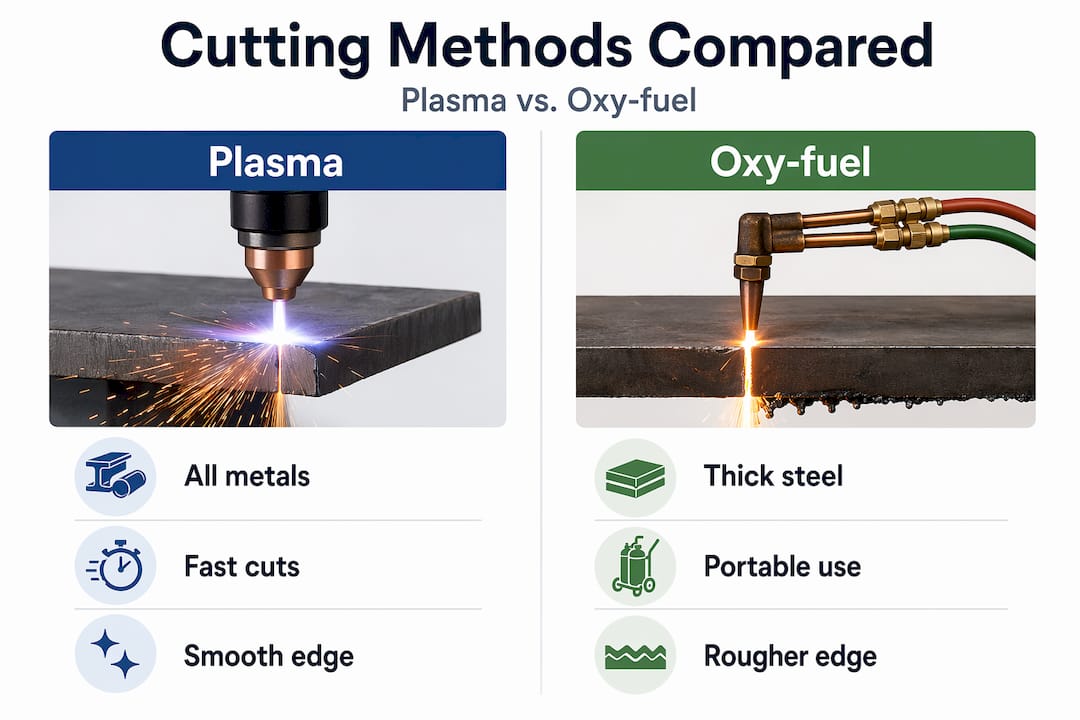
The speed numbers deserve special attention. Plasma runs up to 5x faster on 12mm mild steel compared to oxy-fuel—a gap that compounds dramatically across a full production shift. If you’re cutting 50 parts per day, that difference could mean finishing in six hours instead of ten.
Where plasma clearly wins:
- Thin to medium plate work (under 25mm) in any conductive metal
- Stainless steel fabrication in any thickness within plasma’s range
- High-volume production runs where cycle time drives cost
- Precision cutting where tight tolerances matter
Where oxy-fuel clearly wins:
- Cutting carbon steel plate over 50mm thick
- Field work with no electrical access
- Heavy structural steel demolition or site cutting
- Applications where equipment cost must stay minimal
For fabricators navigating decisions between process types, our roundup of top cutting tool choices covers the broader landscape. And if you want to see where cutting technology is heading in production environments, the metal cutting innovations piece is worth a read.
One myth that keeps circulating: “oxy-fuel is always slower.” That’s only true in the thin-to-medium range. On 100mm carbon steel plate, oxy-fuel is not just competitive—it’s often the only practical choice, since plasma efficiency drops sharply above 50mm.
Cut quality and post-processing impact
Once you know what each method can cut, it’s just as important to understand how the cut itself affects your entire workflow.
Edge quality comparison
| Characteristic | Plasma | Oxy-fuel |
|---|---|---|
| Kerf width | 1.5 to 3mm | 4 to 7mm |
| Edge hardness | 280 to 340 HV | 320 to 380 HV |
| Heat-affected zone (HAZ) | Smaller, more controlled | Larger, more significant |
| Edge oxidation | Minimal | Heavy |
| Slag formation | Light | Heavy |
| Typical weld readiness | Often direct-to-weld | Usually requires grinding |
These numbers from plasma vs. oxyfuel vs. bandsaw cutting research show that plasma produces a narrower kerf, lower edge hardness, and a tighter heat-affected zone. For production welding, this translates directly into fewer grinding hours and faster joint fitup.
Post-processing steps after oxy-fuel cutting:
- Allow the workpiece to cool completely before handling.
- Knock off heavy slag with a chipping hammer.
- Wire brush the cut surface to expose clean metal.
- Grind the edge face to remove the oxidized layer (typically 0.5 to 1mm material removal).
- Inspect for cracks or case hardening in the HAZ, especially on higher-carbon steels.
- Re-check dimensional accuracy, as thermal distortion can shift part geometry.
Post-processing steps after plasma cutting:
- Allow the workpiece to cool (cooling time is generally shorter due to smaller HAZ).
- Remove light dross from the bottom edge with a scraper or light grinder pass.
- Inspect the top edge quality, as pierce quality affects the edge condition near start points.
- On most mild steel and stainless cuts under 20mm, proceed directly to fitup and welding.
Pro Tip: Edge oxidation from oxy-fuel cutting isn’t just a cosmetic issue. On code-quality structural welds, an unground oxy-fuel edge can introduce oxygen contamination into the weld pool, causing porosity. If your WPS requires clean fusion faces, budget grinding time into every oxy-fuel job or switch to plasma where the material allows.
The quality of your pierce point on high-definition plasma systems is a separate concern worth flagging. As noted in guidance on perfecting the plasma cutting pierce, the pierce quality on thick plate affects edge consistency at the cut start, so dialing in lead-in geometry matters for weld-critical parts.
For downstream welding success, solid joint preparation is the foundation. Our guide on weld joint preparation tips covers exactly how to transition from cut edge to weld-ready joint. And if you’re working to code or procedure, the weld quality standards article gives practical context for those requirements.
Setup, portability, and operational considerations
Cutting performance isn’t the only consideration—daily workflow and on-site demands matter just as much as edge quality.
The operational reality of running either process day-to-day looks very different from just comparing speed charts.
Plasma cutting operational profile:
- Requires a stable power supply, ideally 3-phase for higher-amperage machines
- Compressed air must be clean and dry—moisture causes nozzle erosion and arc instability
-
Instant start with no preheat, meaning you can begin cutting within seconds of powering on
- Consumables (electrode and nozzle) wear predictably and are easy to change
- Operates cleanly in enclosed shops with standard ventilation
Oxy-fuel cutting operational profile:
- Fully self-contained; requires no electrical supply, making it ideal for remote sites
- Oxygen purity is critical—impure oxygen at 97% purity rather than 99.5% can reduce cut speed by up to 40%
- Preheat cycle adds 5 to 15 minutes before the first cut on cold plate
- Gas cylinder management adds logistical overhead, especially on large jobs
- Works in virtually any environment, including outdoor, confined space, or high-elevation work
Pro Tip: Field contractors often default to oxy-fuel for its portability, and that’s usually correct. But if your field site has generator power and you’re cutting 6mm to 19mm steel all day, a portable plasma unit can slash your on-site hours. Run the numbers on your actual plate thickness before assuming oxy-fuel is the automatic field choice.
The cutting torch setups resource on our site includes equipment configuration details for both processes that can help you plan a job-specific setup.
How to choose: Decision factors and real-world scenarios
With all technical details and practical realities covered, it’s time to translate them into your everyday decision-making process.
Your method selection checklist:
- Material type: Stainless, aluminum, or non-ferrous? Plasma only. Carbon or low-alloy steel? Either process applies.
- Thickness: Under 25mm? Plasma wins on speed and quality. Over 50mm carbon steel? Oxy-fuel is the practical choice.
- Production volume: High-volume thin plate? Plasma’s speed advantage compounds over a shift. Single-piece thick cuts? Oxy-fuel setup cost is justified.
- Location: Shop with 3-phase power? Plasma is the obvious choice. Remote site with no power? Oxy-fuel is often the only option.
- Weld prep requirements: Code-quality joints on production parts? Plasma’s cleaner edge reduces downstream grinding cost significantly.
- Equipment investment: Lower upfront cost and minimal training needed? Oxy-fuel has the advantage for smaller operations.
Scenario 1: Fabricating 10mm mild steel enclosures in a production shop. This is a textbook plasma application. Industrial production efficiency strongly favors plasma for thin-to-medium plate at volume. The speed advantage means more parts per shift, the cleaner edges go straight to the press brake or fitup table, and the smaller HAZ maintains tighter dimensional control.
Scenario 2: On-site bridge beam cutting during structural demolition. This is where oxy-fuel earns its place. The material is thick carbon steel, electrical access is likely unavailable, and the cut quality requirements for demolition are far less stringent than for fabrication. Oxy-fuel’s portability and ability to handle extreme thickness make it the professional’s choice in this environment.
The hidden cost most fabricators miss: Rework. Choosing oxy-fuel on a stainless steel job because that’s what’s already set up isn’t just a quality mistake—it’s a project timeline disaster. Oxy-fuel fails on alloys and wear plates, and plasma struggles above 150mm. Both failure modes generate costly rework. Matching the process to the job upfront is always cheaper than fixing a bad cut downstream.
Revisiting plasma cutting benefits and selecting cutting tools for your specific application is time well invested before committing to either process on a new job type.
Why choosing the “right” process can be a trap
Here’s the contrarian take that most comparison articles skip: the obsession with finding the single best cutting method is itself a problem.
In real fabrication shops, the most productive teams don’t debate plasma versus oxy-fuel—they run both, and they switch fluidly based on what the job demands. The shops that underperform are typically the ones that made a capital equipment decision years ago and built their entire workflow around defending that choice. That’s not process optimization; it’s inertia dressed up as expertise.
The fabricators we see adapting fastest are the ones treating both processes as tools in a kit rather than competing philosophies. A shop running plasma for their production plate work but keeping an oxy-fuel rig ready for thick carbon steel repairs or field calls isn’t indecisive—it’s positioned correctly. The process optimization strategies that actually move the needle are the ones that question assumptions regularly, not annually.
There’s also a training dimension that gets overlooked. Shops that invest in operators who genuinely understand both processes rarely get caught flat-footed when material specs change or a new contract comes in with different requirements. The equipment matters, but the knowledge to use it correctly matters more. Don’t let a sunk cost in one process type limit what your team can take on.
Upgrade your cutting game with professional tools
Whether your work demands the precision and speed of plasma or the thick-section power of oxy-fuel, the quality of your equipment directly determines your results, your safety, and your efficiency on every job.

At Simpleweld.com, we stock industrial-grade professional plasma cutting tools built for the demands of high-volume fabrication shops and precision work, alongside a complete range of reliable oxy-fuel cutting tools for heavy structural and field cutting applications. You’ll find torches, consumables, regulators, and accessories from trusted brands—everything you need to run either process at full performance. Our catalog is built specifically for professional welders and fabrication shops who need dependable equipment, not consumer-grade substitutes.
Frequently asked questions
Can plasma cutting replace oxy-fuel for all industrial jobs?
No, plasma excels for thin-to-medium conductive metals but struggles above 150mm where oxy-fuel remains the more practical and cost-effective choice for thick carbon steel sections.
Why can’t oxy-fuel cut stainless steel or aluminum?
Oxy-fuel depends on sustaining an iron oxidation reaction, which doesn’t occur in stainless or aluminum. Plasma handles all conductive metals including stainless and aluminum without this chemical limitation.
What power and gas supplies are needed for plasma and oxy-fuel cutting?
Plasma requires stable electricity and clean compressed air or specialty gas, while oxy-fuel needs only fuel gas and oxygen cylinders with no external power source required.
Does plasma or oxy-fuel create more post-cut cleanup?
Oxy-fuel leaves oxidized edges and heavy slag requiring grinding before welding. Plasma’s narrower kerf and cleaner edges typically allow you to move directly from cut to fitup without significant prep work.