

Professional welders are the backbone of modern infrastructure. From the pipelines carrying fuel across the country to the steel frames holding up high-rise buildings, the role of professional welders touches nearly every sector of the economy. Yet most people outside the trade have only a vague idea of what welders actually do, what separates a certified welder from an uncertified one, or why hiring the wrong person for a structural weld can cost far more than anyone expects. This article breaks all of that down clearly, whether you are considering a career in welding or making hiring decisions for your next industrial project.
Table of Contents
- Key takeaways
- The role of professional welders across industries
- Why certification separates good welders from trusted ones
- Safety protocols every professional welder must follow
- Career paths, wages, and industry demand
- My honest take on what the industry gets wrong about welders
- Gear up for the job with Simpleweld
- FAQ
Key takeaways
| Point | Details |
|---|---|
| Welders do far more than weld | Professional welder duties include blueprint reading, joint preparation, quality inspection, and process documentation. |
| Certification changes your pay floor | AWS D1.1 and API 1104 certifications can add $4–$8 per hour or push wages past $40 per hour for pipeline work. |
| Safety is a non-negotiable job function | OSHA mandates fire watches and PPE compliance; overlooking safety protocols puts projects and lives at risk. |
| Certified welders reduce costly failures | Certified welding services enforce traceable quality processes that prevent weld failures appearing months later. |
| Demand is accelerating fast | Welder demand in engineering construction is projected to rise 47% by 2030, outpacing current training pipelines. |
The role of professional welders across industries
Professional welders do not simply strike an arc and call it a day. Their welding job responsibilities span planning, execution, quality control, and documentation, often all within a single shift. Understanding this scope matters whether you are hiring for a fabrication shop or deciding if welding is the right career path.
The core technical task is joining metals using processes such as Shielded Metal Arc Welding (SMAW), MIG, TIG, and Flux-Cored Arc Welding (FCAW). Each process suits different materials, thicknesses, and environments. A structural welder in a shipyard will lean heavily on FCAW for its penetration and speed, while a precision TIG welder in an aerospace facility prioritizes clean, low-heat welds on thin aluminum. Choosing the wrong process for a job is not just inefficient. It is a quality and safety failure.
Beyond the arc itself, professional welders handle a set of responsibilities that many people outside the trade never see:
- Reading and interpreting blueprints and welding symbols, translating engineering drawings into physical welds that meet exact tolerances
- Fitting and preparing base materials, which includes grinding, cleaning, and positioning pieces before a single pass is made
- Selecting the correct filler materials and settings, based on material type, position, and the applicable welding code
- Performing visual and dimensional inspection of completed welds, catching discontinuities before they reach a formal quality inspection
- Maintaining detailed documentation of procedures, materials used, and any deviations from the welding procedure specification (WPS)
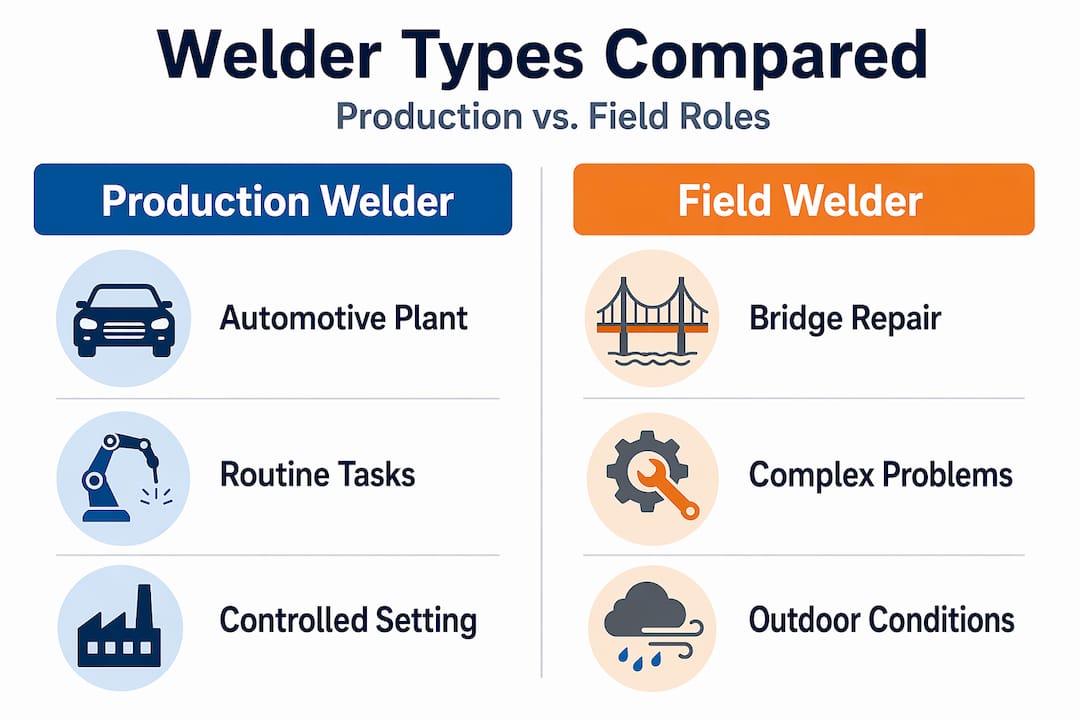
The difference between a production welder at an automotive plant and a field welder repairing a bridge is dramatic. One works in a controlled environment with fixturing; the other works in awkward positions under weather conditions with no room for error. Both carry the same fundamental professional welder duties, but the field role demands a broader, more adaptable skill set.
Pro Tip: If you are evaluating a welder for hire, ask them to walk you through how they read a welding symbol on a drawing. A skilled professional will explain it fluently. Someone lacking proper training will struggle with even basic symbology.
Understanding weld quality standards is not optional for anyone in this trade. It is the foundation every responsible professional welder builds on.
Why certification separates good welders from trusted ones
The welding industry runs on codes and standards, and the importance of certified welders cannot be overstated for businesses and project owners who care about liability, compliance, and long-term structural integrity.
The three most referenced certification bodies in the U.S. are the American Welding Society (AWS), the American Society of Mechanical Engineers (ASME), and the American Petroleum Institute (API). Each issues standards tied to specific industries and applications. AWS D1.1, ASME Section IX, and API 1104 are the codes most frequently required for structural steel, pressure vessels, and pipeline work respectively. A welder certified under one code is not automatically qualified under another. The qualifications differ per code and per position.
“The distinction between ‘welder’ and ‘certified welder’ is critical. Certifications prove the ability to pass quality inspections under varied conditions, not just ideal shop settings.” — Manufacturing Lead Generation, 2025
Here is a direct comparison of what certified versus uncertified welders bring to a project:
| Factor | Certified welder | Uncertified welder |
|---|---|---|
| Code compliance | Meets AWS, ASME, or API requirements | Cannot legally perform code work |
| Traceable quality | Documented WPS and qualification records | No verification trail |
| Failure risk | Significantly lower due to tested processes | Higher; no baseline quality standard |
| Pay rate | $40–$100+ per hour depending on specialty | $18–$28 per hour typical range |
| Employability | Qualifies for regulated industries | Limited to non-code fabrication |
Certified welding services reduce risk of expensive failures because they enforce repeatable, traceable processes. Weld failures often show up months or even years after a project is completed. By then, the cost of repair, replacement, or litigation dwarfs what the certification would have cost upfront.
One position that often surprises people: the Certified Welding Inspector (CWI). These professionals earn $70,000–$120,000 annually by examining and verifying weld quality rather than performing welds themselves. It is a natural career advancement for experienced welders who want less physical strain and more responsibility.
Pro Tip: For businesses contracting welding work, always request the welder’s current qualification record (WQR) and verify it matches the applicable code for your project. Expired certifications are more common than you would expect.
One nuance worth knowing: passing a 6G pipe certification under AWS D1.1 does not qualify welders for all pipe positions under every code. Additional qualification tests are often required when switching between code jurisdictions. That is not a bureaucratic technicality. It is how the industry protects project integrity.
Safety protocols every professional welder must follow
Welding is one of the more physically demanding and hazardous skilled trades, but the risks are manageable when protocols are followed rigorously. Safety is not a checkbox. It is an active, ongoing job function.
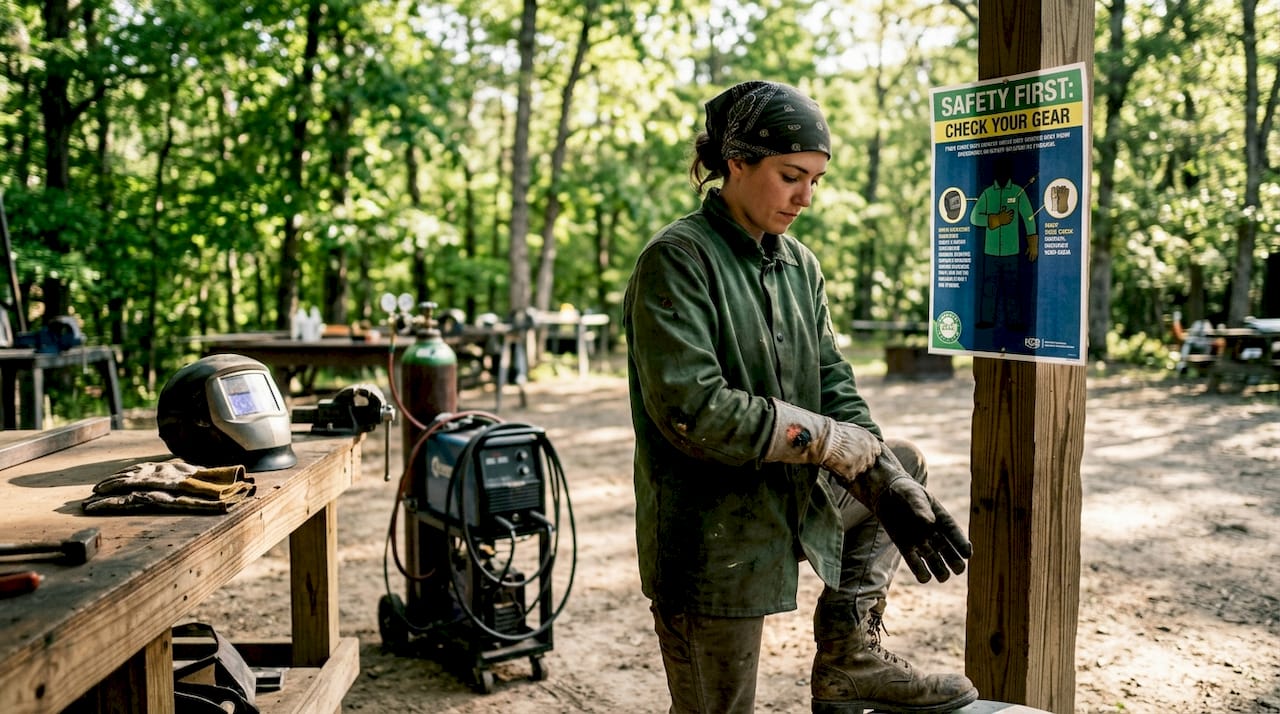
Sparks and slag can travel up to 35 feet from the point of the weld, which means any flammable material within that radius is a fire risk. Most job site fires tied to welding happen not from the weld itself, but from unnoticed smoldering in surrounding materials. That is why OSHA requires a fire watcher for 30 minutes after hot work under 29 CFR 1910.252. It is not optional, and ignoring it is a code violation with real consequences.
Beyond fire risk, welders face health hazards that accumulate over time:
- Fumes and gases from base metals, coatings, and filler materials can contain carcinogens and neurological hazards, making proper ventilation and respiratory protection non-negotiable
- UV and IR radiation from the arc causes arc eye (photokeratitis) and skin burns without proper eye protection and clothing
- Electrical hazards from improper grounding or damaged equipment in wet conditions
- Noise exposure during grinding and cutting operations, often neglected compared to the more visible risks
- Heat stress during prolonged work in confined spaces or outdoor summer environments
The standard PPE load for a production welder includes a welding helmet with correct lens shade, fire-resistant jacket and gloves, steel-toed boots, and hearing protection during grinding. For pipeline welders working outdoors or in confined spaces, respiratory equipment and gas monitors become critical additions. The role of certified welders in maintaining safety culture extends beyond their own protection. A sloppy PPE habit from one welder on a crew raises risk for everyone nearby.
Career paths, wages, and industry demand
A career in welding offers more financial upside than most people outside the trade realize, and the employment outlook supports that optimism with data.
The median annual wage for welders sits at approximately $51,000 nationally. That number climbs significantly with specialization. Certified structural welders and pressure vessel welders earn $75,000 to $100,000. Pipeline welders and underwater welders regularly exceed $100,000 per year. The pay difference is not seniority. It is certification, skill level, and the willingness to work in demanding environments.
Here is how welding industry roles typically progress:
- Entry-level production welder at a manufacturing facility, learning one or two processes in a controlled environment
- Structural or pipe welder after gaining experience and passing position-specific certifications
- Lead welder or welding supervisor, responsible for crew quality and procedure compliance
- Certified Welding Inspector (CWI), verifying others’ work against code requirements
- Welding engineer or business owner, developing procedures, managing contracts, or running a fabrication operation
The demand side of this equation is compelling for anyone evaluating welding as a career. The engineering construction workforce for welders is projected to grow from 1,470 to over 2,150 by 2030. That is a 47% increase driven by infrastructure projects, energy transition work, and manufacturing reshoring. Training pipelines are not keeping up with that pace, which means qualified welders are in a strong negotiating position.
For businesses, this has a direct cost implication. Waiting to hire skilled welders on short timelines means paying premium rates or accepting less qualified candidates. Companies that invest in training and certification support for their workforce tend to retain talent and avoid costly rework cycles. Understanding the welding standards that govern the work you are contracting is the first step to making smarter hiring decisions.
My honest take on what the industry gets wrong about welders
I’ve spent years watching people underestimate this trade, and it genuinely costs them. The assumption that welding is repetitive manual labor that robots will eventually absorb entirely is one of the most persistent and damaging misconceptions in manufacturing today.
The reality is that robotic welding cannot replace human welders in complex, non-repetitive tasks. Field repair on a bridge, custom structural fabrication for an architectural project, or emergency maintenance on a refinery component all require situational judgment, adaptive technique, and real-time problem-solving that no automated system handles reliably. Automation handles volume on identical parts. Skilled welders handle everything else.
What I’ve found frustrating is the gap between how businesses talk about valuing skilled labor and how they actually budget for it. Hiring an uncertified welder to cut costs on a structural project is not a savings decision. It is a liability decision with delayed consequences. I’ve seen projects require full weld removal and redo because the original work was not code-compliant. The total cost, including downtime, material waste, and contractor fees, exceeded what a certified welder would have charged by a wide margin.
My advice to businesses: treat certification as a baseline requirement, not a premium upgrade. And to anyone considering a career in welding, understand that the skills required for welding at the professional level are genuinely demanding and genuinely rewarded. The welder who invests in AWS or API certification is not just checking a box. They are entering a tier of the trade where work is consistent, pay is strong, and the value they bring is difficult to replace.
— Taylor
Gear up for the job with Simpleweld
Professional welders perform at the highest level when they have tools and equipment that match their standards. Simpleweld supplies industrial-grade welding equipment built for fabrication shops, contractors, and serious professionals who cannot afford product failure mid-project. From welding machines for every process to complete personal protective equipment that meets OSHA requirements, the catalog covers what production welders and field welders actually need.
Preparing for AWS D1.1 certification? Simpleweld stocks a certification test plate kit designed specifically for limited-thickness qualification practice so welders can train under real test conditions. Browse the full range of welding tools and equipment at Simpleweld and equip your team with the gear the work demands.
FAQ
What does a professional welder do on a daily basis?
Professional welders read blueprints, prepare and fit base materials, perform welds using specified processes, inspect completed work, and document procedures. Their welding job responsibilities vary by industry, but quality control and safety compliance are consistent across all roles.
Why does AWS or API certification matter for hiring?
Certified welders have passed standardized qualification tests proving they can produce code-compliant welds. This protects businesses from structural failures, liability, and expensive rework that uncertified work often causes down the line.
How much do professional welders earn?
The national median wage sits around $51,000 per year, but certified structural and pipeline welders commonly earn $75,000 to over $100,000 annually depending on specialization and location.
Can robots replace professional welders?
Robotic welding handles repetitive, high-volume tasks well in controlled environments like automotive assembly. Human welders remain irreplaceable for field repairs, custom fabrication, and complex positions that require real-time judgment and adaptive technique.
What safety equipment does a professional welder need?
Standard PPE includes an auto-darkening welding helmet, fire-resistant jacket and gloves, steel-toed boots, and hearing protection during grinding. Confined space and pipeline work adds respiratory equipment and gas monitoring to that list.