

Most contractors treat welding as a checkbox, not a strategy. That mindset quietly kills project timelines, inflates rework costs, and in the worst cases, puts lives at risk. The AWS D1.1/D1.1M standard governs welding procedures, welder qualifications, inspection, and fabrication for structural steel in buildings and bridges, setting a compliance floor that every project manager needs to understand. Advanced welding systems have been shown to push qualification rates to 98.9% while cutting energy use and accelerating production. This guide lays out exactly what you need to know about welding techniques, standards, and technology to run tighter, safer construction projects.
Table of Contents
- Why welding is fundamental to construction integrity
- Welding standards and compliance: What every project manager should know
- Advances in welding technology: Driving efficiency and quality
- Practical welding tips for stronger, safer structures
- Our take: Why smart contractors obsess over welding quality
- Find the right welding solutions for your construction needs
- Frequently asked questions
Key Takeaways
| Point | Details |
|---|---|
| Weld quality is critical | High-quality welding directly influences structural integrity and safety in construction. |
| Compliance drives results | Following standards like AWS D1.1 ensures both legal compliance and long-term durability. |
| Technology boosts productivity | Modern welding systems improve qualification rates and efficiency, lowering costs. |
| Practical habits prevent flaws | Routine inspections, preparation, and safety checks stop issues before they escalate. |
| Investment in training pays off | Training and documentation for welding teams increases success rates and reduces rework. |
Why welding is fundamental to construction integrity
Steel is the skeleton of modern industrial construction, and welding is how that skeleton holds together under real-world loads. When load-bearing beams, columns, and connections are welded correctly, the entire structure distributes stress the way engineers intended. When welds are substandard, stress concentrates at failure points, and those points eventually give way.
Think about a multi-story industrial facility or a bridge. Every joint that transfers load is either bolted or welded. Welded connections, when done right, actually outperform bolted joints in fatigue resistance because they create a continuous bond rather than a mechanical interface. But that advantage flips completely when weld quality is poor. Porosity (small gas pockets trapped in the weld), undercut (grooves along the weld bead), or incomplete fusion can reduce a connection’s load capacity by 30 to 50%, turning a safety-rated joint into a liability.
Key reasons why weld quality drives structural outcomes:
- Load transfer integrity: Properly fused welds carry tension, compression, and shear loads as designed. Poor welds create stress risers that initiate cracks under cyclic loading.
- Corrosion resistance: Sound welds have uniform surface profiles that resist moisture penetration. Pitted or rough welds trap water and corrode faster, accelerating material degradation.
- Seismic performance: Industrial facilities in seismic zones require welds that can absorb and dissipate energy without fracturing. Low-quality welds become brittle failure points under dynamic loading.
- Code compliance: Inspectors on public and commercial projects verify welds against strict visual and nondestructive examination criteria. Failed welds mean delays, costly repairs, and potential project shutdowns.
- Long-term maintenance costs: Structural repairs to substandard welds discovered years after construction are exponentially more expensive than getting the weld right the first time.
“Standards such as AWS D1.1/D1.1M govern welding procedures, welder qualifications, inspection, and fabrication for structural steel in buildings and bridges to ensure compliance and quality.” — UFGS 05 05 23.16 (2025)
Understanding structural welding standards gives you a concrete framework for evaluating whether your welds are actually performing at the level your project demands, not just passing a surface-level visual check.
Welding standards and compliance: What every project manager should know
AWS D1.1 is the reference document for structural steel welding in the United States. It covers everything from the geometry of acceptable weld profiles to the qualifications a welder must hold before touching a structural joint on your site. Ignoring it is not just a quality risk. It is a liability risk that follows you long after the project closes out.
Here is a simplified comparison of common welding code requirements you will encounter on industrial and commercial construction projects:
| Standard | Scope | Key focus areas |
|---|---|---|
| AWS D1.1 | Structural steel, buildings, bridges | Procedures, welder quals, inspection, fabrication |
| AWS D1.2 | Structural aluminum | Similar framework adapted for aluminum alloys |
| AWS D1.6 | Stainless steel structures | Corrosion-sensitive environments, food/chemical plants |
| ASME Section IX | Pressure vessels and piping | High-pressure environments, heavy industrial |
| API 1104 | Pipelines | Oil and gas, field welding conditions |
Each standard applies to a specific material and application type. On most commercial and industrial building projects, AWS D1.1 is your primary reference. But if your project includes stainless process piping or pressure vessels, your welding subcontractors need qualifications under those additional codes too.
Here is a practical, stepwise process for maintaining compliance on your job site:
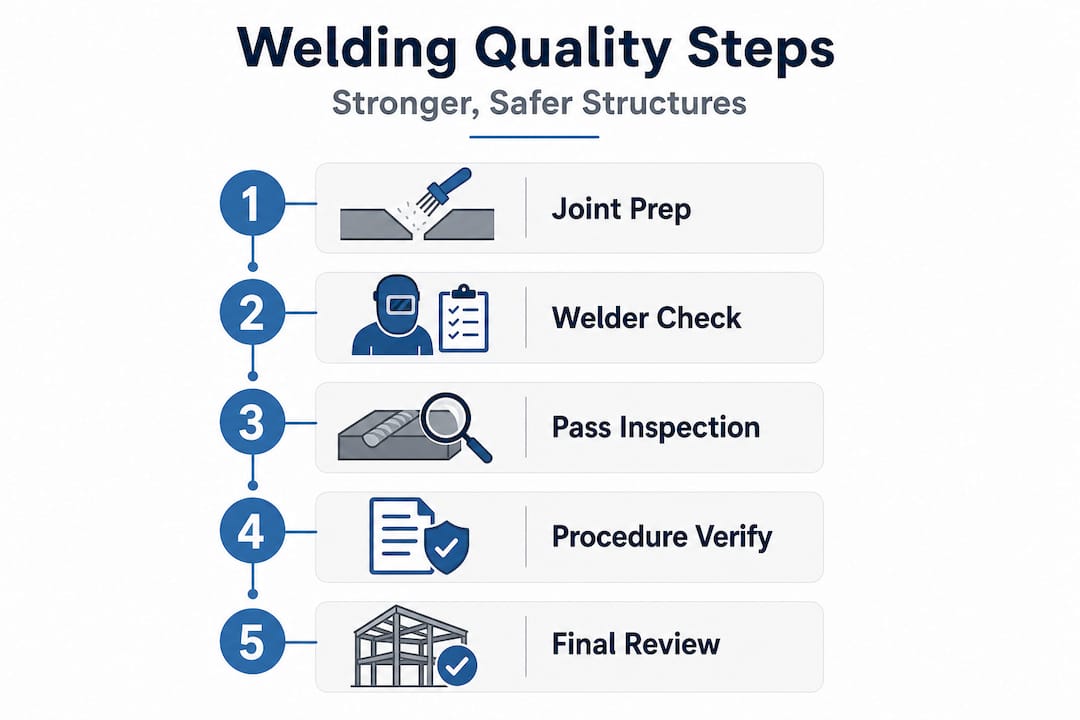
- Verify welder certifications before work begins. AWS D1.1 requires welders to pass a qualification test for each process (SMAW, GMAW, FCAW, etc.) and position (flat, horizontal, vertical, overhead) they will use. Check certificates and confirm they are current.
- Review and approve Welding Procedure Specifications (WPS). A WPS documents the exact parameters for a given weld, including preheat temperature, amperage range, travel speed, and filler metal classification. Every structural weld needs a supporting WPS.
- Conduct Procedure Qualification Records (PQR) verification. The PQR is the test data that proves the WPS actually produces acceptable welds. Require copies for every procedure being used on your project.
- Establish an inspection schedule. Visual inspection is the minimum. For critical connections, add nondestructive examination methods such as ultrasonic testing (UT) or magnetic particle inspection (MT).
- Document everything. Failed inspections, corrective actions, re-inspections, and final acceptance records all need to be captured. This documentation protects you during owner audits and in any future dispute.
Pro Tip: Build a simple compliance tracker spreadsheet that logs welder names, certification numbers, expiration dates, and the WPS they are qualified to use. Cross-reference this against your daily work logs. This one habit eliminates the most common source of code violations on industrial sites.
Understanding weld quality and standards in depth makes compliance feel less like paperwork and more like a practical quality management system. You can also review a thorough breakdown of welding codes and compliance to understand how these frameworks apply across different project types.
Advances in welding technology: Driving efficiency and quality
Technology is changing what is possible on a construction site, and the data backs it up. Empirical benchmarks show that advanced systems improve qualification rates to 98.9%, reduce energy consumption by 8.6%, and boost production by 22.7%. Those are not marginal gains. A 22.7% production increase on a large fabrication scope can translate directly into schedule compression and cost savings that matter to your bottom line.
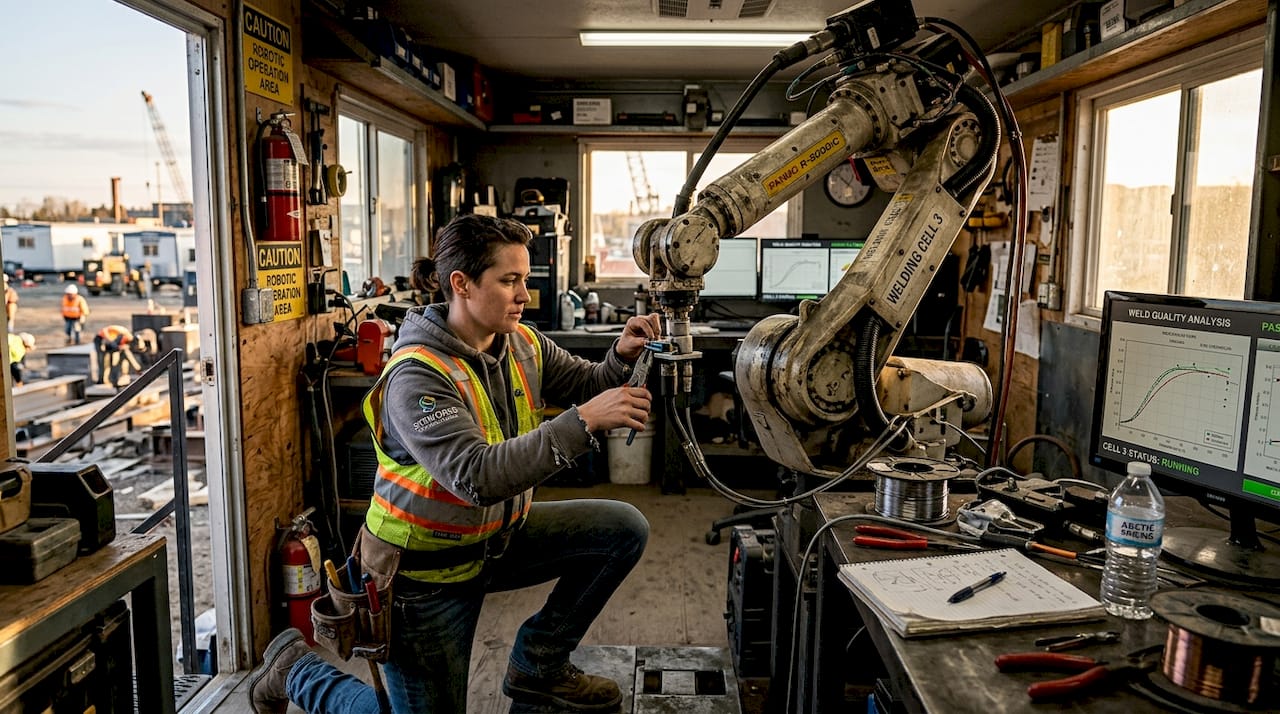
Here is how those numbers break down in practical terms:
| Performance metric | Conventional systems | Advanced systems | Improvement |
|---|---|---|---|
| Welder qualification rate | ~85 to 90% | 98.9% | +10 to 13% |
| Energy consumption | Baseline | 8.6% reduction | Significant cost savings |
| Production throughput | Baseline | 22.7% increase | Schedule acceleration |
| Defect detection accuracy | Manual/visual | Real-time QC | Fewer rework cycles |
The welding technologies driving these improvements include several innovations that are now accessible for field and shop use:
- Automated and robotic welding systems: Robotic arms maintain consistent travel speed, arc length, and wire feed rate, eliminating the human variation that causes inconsistent penetration and bead geometry. These systems are particularly valuable for repetitive structural connections in fabrication shops feeding site-installed members.
- Remote and digital inspection tools: Phased array ultrasonic testing (PAUT) and digital radiography replace time-consuming film-based methods. Inspectors can review weld images in real time and share results instantly with project managers off-site.
- Real-time quality control (QC) monitoring: Modern welding power sources record every parameter for every pass. When a variable drifts outside the WPS range, the system flags it immediately. This eliminates the “we didn’t know it was out of spec” problem that generates expensive rework.
- Advanced shielding gas blends: Purpose-formulated gas mixtures for GMAW and FCAW processes improve arc stability, reduce spatter, and produce cleaner weld profiles with less post-weld cleanup time.
- Inverter-based power sources: These units are lighter, more energy-efficient, and maintain arc stability across a wider input voltage range than transformer-based machines, making them better suited for variable site power conditions.
Keeping up with welding technology trends is not optional for contractors who want to stay competitive. And for precision applications, understanding modern TIG welding advances can open new capabilities on projects requiring tight tolerances or specialty materials.
Statistic callout: Advanced welding systems achieve a 98.9% welder qualification rate, reduce energy by 8.6%, and boost production by 22.7% compared to conventional systems. Source: Nature Scientific Reports (2025)
Practical welding tips for stronger, safer structures
Good welds do not happen by accident. They result from disciplined preparation, consistent execution, and thorough inspection. Here is what you need to get right at every stage of the process.
Weld joint preparation checklist:
- Clean the base metal. Remove mill scale, rust, oil, paint, and moisture from at least one inch on each side of the joint. Contamination is the leading cause of porosity and inclusions.
- Verify joint geometry. Check root openings, groove angles, and bevel dimensions against the WPS. A root gap that is too wide or too narrow changes penetration and can cause incomplete fusion.
- Preheat when required. Thicker steel sections and higher carbon equivalent materials need preheat to prevent hydrogen cracking. The WPS specifies minimum preheat temperatures. Do not skip this step to save time.
- Tack weld properly. Tack welds are structural welds too. They must be made by qualified welders using the approved process and parameters. Undertacks that crack during fit-up create stress concentrations before the final weld is even started.
- Confirm welder qualification. Verify the welder’s cert matches the process and position being used before they strike the arc.
Critical inspection steps:
- Perform visual inspection immediately after each pass to catch crater cracks, excessive spatter, or undercut before the next layer is added.
- Use a weld gauge (a calibrated measuring tool) to verify bead width, convexity, and throat dimensions against acceptance criteria.
- Document acceptance or rejection for each weld with the welder’s identification, date, and location within the structure.
- Schedule nondestructive examination for all complete-joint-penetration (CJP) welds in primary load-bearing connections, as required by AWS D1.1 fabrication requirements.
Pro Tip: Routine inspections after each completed weld pass cost almost nothing compared to the expense of grinding out and repairing a rejected weld after the entire joint is complete. Train your welders to call the inspector before moving on, not after.
Understanding weld joint preparation in detail gives your crew a concrete reference for getting that critical first step right every time. For projects with high linear footage of structural welds, the speed and deposition rate advantages covered in benefits of MIG welding can help you select the most efficient process for each application.
Safety gear essentials on welding sites:
Every welder needs an auto-darkening helmet rated for the arc intensity of the process being used, leather gloves, flame-resistant clothing, steel-toed boots, and proper respiratory protection when working in confined spaces or with flux-cored wire that generates significant fume. Safety is not a compliance exercise. A welder who gets hurt or fatigued from inadequate protection produces worse welds. The two issues are directly connected.
Our take: Why smart contractors obsess over welding quality
Here is something most project management guides will not tell you: the majority of structural failures traced to welding issues were not caused by ignorance of the standards. They were caused by schedule pressure, budget pressure, and the quiet decision to “accept it and move on.”
Project managers who understand deeper insights on weld quality know that every corner cut during fabrication or erection creates a future liability. The problem is that substandard welds rarely fail immediately. They pass visual inspection, they survive the initial loading, and they sit quietly in the structure for years, accumulating fatigue damage under cyclic loads until something triggers a rapid propagation event.
The contractors who consistently deliver quality outcomes treat welding the same way they treat scheduling and cost control. They invest in qualified personnel, approved procedures, and real-time inspection systems before the first arc is struck. They know that rejecting a bad weld early costs $50 to $200 in labor and consumables to repair. Discovering that same defect during final inspection or after the structure is in service costs 10 to 100 times more when you factor in access scaffolding, NDT mobilization, engineer review, and potential owner claims.
Technology makes this easier and more cost-effective than it has ever been. When advanced systems can push qualification rates to 98.9% and production throughput by 22.7%, the ROI on upgrading equipment and processes is not a question of whether it makes financial sense. It clearly does. The question is whether project managers are going to act on that information or keep running the same conventional approach and hoping for better results.
The contractors who win consistently are the ones who have internalized that welding quality is not a technical detail. It is a project management discipline.
Find the right welding solutions for your construction needs
Pairing the knowledge from this guide with the right tools is where theory becomes results on your job site.
At Simpleweld, we supply industrial-grade construction welders for sale that are built to handle the demands of structural fabrication and field erection. Whether your crew runs SMAW, GMAW, or FCAW processes, you will find power sources and accessories that match your WPS requirements. We also carry a full range of essential welding safety gear including auto-darkening helmets, gloves, and FR (flame-resistant) apparel to keep your team protected and productive. For projects requiring certified filler metals, our catalog of structural welding rods covers the classifications most commonly specified under AWS D1.1. Browse by process, classification, or application to find exactly what your next project calls for.
Frequently asked questions
What is the AWS D1.1 welding standard and why is it important?
The AWS D1.1 standard sets the protocols for welding structural steel, covering procedures, qualifications, and inspection to ensure construction projects meet required safety and quality levels. It is the baseline compliance reference for virtually every commercial and industrial steel structure in the United States.
How do advanced welding technologies impact construction productivity?
Advanced welding systems can push qualification rates to 98.9%, cut energy consumption by 8.6%, and increase production throughput by 22.7%, all of which translate into measurable schedule and cost improvements on large structural projects.
What are the key steps for ensuring quality welding onsite?
Proper weld joint preparation, thorough pass-by-pass inspection, verified welder qualifications, and approved welding procedure specifications are the core elements that consistently deliver quality results on construction sites.
Why should contractors prioritize weld quality in construction?
Substandard welds accumulate fatigue damage over time and can trigger structural failures years after construction. Prioritizing weld quality from day one reduces rework costs, eliminates compliance risk, prevents structural failures, and protects your project against costly owner claims down the line.