

Choosing between the many types of welding processes is one of the first real decisions any welder or fabricator faces. Get it wrong and you waste time, burn through consumables, and end up with welds that won’t pass inspection. The right call depends on your base material, joint design, environment, skill level, and whether you’re working to a code like AWS D1.1 or ASME Section IX. This guide breaks down every major welding method, from the most common arc processes to specialized industrial techniques, and gives you the direct comparisons you need to make a confident decision.
Table of Contents
- Key takeaways
- 1. MIG welding (GMAW)
- 2. TIG welding (GTAW)
- 3. Stick welding (SMAW)
- 4. Flux-cored arc welding (FCAW)
- 5. Resistance welding
- 6. Submerged arc welding (SAW)
- 7. Laser beam welding
- 8. Oxyfuel welding
- 9. How the processes compare
- 10. How to choose the right welding process
- My take on process selection after years in the field
- Get the right equipment for the process you’re running
- FAQ
Key takeaways
| Point | Details |
|---|---|
| Match process to conditions | Your working environment, material condition, and access to shielding gas narrow your options faster than anything else. |
| Four processes cover most work | MIG, TIG, Stick, and FCAW handle the vast majority of manufacturing and construction applications. |
| Settings matter as much as process | Transfer mode selection in MIG welding changes heat input and weld quality just as significantly as the process choice itself. |
| Standards drive industrial decisions | In structural and pressure work, codes like AWS D1.1 and ASME Section IX often determine which processes are even allowed. |
| Multiprocess machines add flexibility | For shops or hobbyists working across projects, a single multiprocess welder covers MIG, TIG, and Stick without the overhead of multiple machines. |
1. MIG welding (GMAW)
MIG welding, formally known as Gas Metal Arc Welding, is the most widely used welding process in fabrication shops for good reason. It feeds a continuous consumable wire electrode through the gun while a shielding gas, typically argon or a CO2 blend, protects the weld pool from atmospheric contamination. The result is a fast, relatively clean weld that requires less post-weld cleanup than stick or flux-cored.
What most beginners miss is that MIG is not a single process. MIG uses four distinct transfer modes, including short circuit, spray, globular, and pulse spray, each changing the arc behavior, heat input, and penetration profile. Short circuit is good for thin sheet metal and out-of-position work. Spray transfer puts down clean, high-penetration beads on thicker material but requires higher voltage and works only in flat or horizontal positions. Pulse spray gives you the benefits of spray with better out-of-position control.
The tradeoff is that MIG needs a stable shielding gas environment. Wind disrupts the gas coverage and creates porosity. That makes it primarily an indoor or sheltered-environment process.
Pro Tip: If you’re getting porosity in your MIG welds and you’ve ruled out contamination, check your shielding gas flow rate and look for drafts. Even a nearby HVAC vent can knock out your coverage.
You can read more about MIG welding best practices if you want to go deeper on transfer modes and setup parameters.
2. TIG welding (GTAW)
Gas Tungsten Arc Welding uses a non-consumable tungsten electrode to create the arc, and filler metal is added manually by hand. The shielding gas is almost always pure argon. The process is slower than MIG, but it produces the cleanest, most precise welds available in the arc welding category.
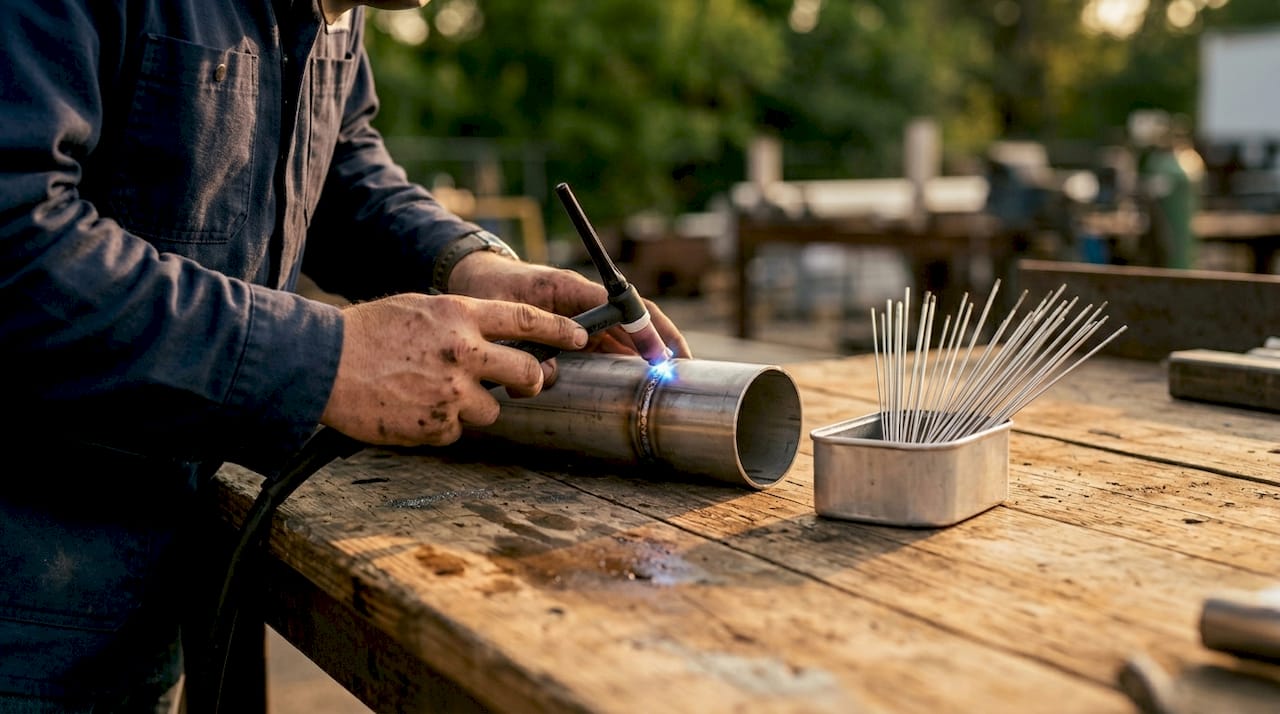
TIG is the go-to process for stainless steel, aluminum, titanium, and exotic alloys where appearance and metallurgical integrity are non-negotiable. You see it in aerospace components, food-grade stainless piping, and custom fabrication where every bead is visible. MIG is chosen for productivity, TIG for precision and appearance, and that distinction drives most process decisions in job shops.
The learning curve is steeper. You’re coordinating arc length, filler addition, and torch angle simultaneously with both hands, plus foot pedal amperage control on most machines. It takes time to build the muscle memory, but the weld quality ceiling is the highest of any arc process.
For a thorough breakdown of technique and modern TIG advances, check out TIG welding technique and precision from the Simpleweld blog.
3. Stick welding (SMAW)
Shielded Metal Arc Welding is the oldest and most portable of the major arc processes. The electrode is a flux-coated rod that both carries the arc and provides its own shielding through the burning flux. No external shielding gas is required.
That’s the entire reason stick welding dominates outdoor and field repair work. Wind doesn’t kill it. Rust, mill scale, and paint create problems for MIG and TIG, but stick tolerates dirty base metal far better. You can weld structural steel in a field, on a scaffold, or in weather conditions that would compromise every gas-shielded process. Field ironworkers and pipeline repair crews rely on it for this reason.
The downsides are real. You get slag to chip after every pass, and spatter cleanup takes time. Deposition rates are lower than MIG or FCAW. But where portability and environmental tolerance matter most, stick is still the right answer for a lot of work.
4. Flux-cored arc welding (FCAW)
Flux-cored welding looks like MIG from the operator’s perspective. You’re still feeding wire through a gun. The difference is the wire itself contains flux inside its hollow core, which generates shielding either on its own (self-shielded FCAW) or in combination with an external shielding gas (gas-shielded FCAW).
FCAW is the standard process for heavy structural work, including bridges and large structural fabrications, because it tolerates mill scale and rust while delivering higher deposition rates than standard MIG. Self-shielded FCAW wire eliminates the shielding gas bottle, making it viable outdoors in windy conditions similar to stick. Gas-shielded FCAW gives better bead appearance and mechanical properties for shop work on heavier plate.
The tradeoff compared to solid wire MIG is more slag to remove and higher wire cost. But on thick structural steel, the deposition efficiency makes it faster and more economical overall.
5. Resistance welding
Resistance welding generates heat by passing high electrical current through two pieces of metal pressed between copper electrodes. The resistance at the contact points produces enough heat to fuse the metal without any filler material. Spot welding and seam welding are the most common forms.
This process is nearly exclusive to manufacturing environments. Automotive plants use it to weld car body panels at scale. The process is fixture-driven and cycle-time optimized for high repeatability, which is exactly what high-volume production lines need. You won’t see it in field construction or small fab shops because it requires significant capital equipment and is not portable.
6. Submerged arc welding (SAW)
Submerged arc welding buries the arc under a layer of granular flux. The wire electrode feeds continuously into the joint, and the flux covers the arc completely during welding. You never actually see the arc. The flux melts and forms a slag blanket that protects the weld and then solidifies on top.
SAW delivers extremely high deposition rates, often ten times that of manual stick welding, making it ideal for long, straight welds on thick plate in a flat position. You’ll find it in pressure vessel fabrication, ship hull construction, and structural beam production. The limitation is that it’s only practical in the flat position and requires automated or semi-automated setups. It’s not for general-purpose or out-of-position work.
7. Laser beam welding
Laser beam welding uses a focused, high-intensity light beam to melt and fuse metal at a precise point. It offers beam-splitting capability, allowing multiple welds simultaneously, and is energy-efficient because the heat input is extremely concentrated.
Automotive manufacturers use laser welding for high-volume, precision joints where the heat-affected zone needs to stay minimal. It’s also used in electronics and medical device manufacturing. The equipment cost is high and the process requires tight fit-up tolerances. For most fabricators, this is a specialized industrial tool rather than a general-purpose option.
8. Oxyfuel welding
Oxyfuel welding mixes oxygen with a fuel gas, typically acetylene, to produce a flame hot enough to melt and fuse metal. It was once one of the most common welding methods before arc processes took over.
Today, oxyfuel sees limited use for welding but remains widespread for cutting and heating applications. Plumbers still use it for copper pipe work. Metal artists use it for fine work on thin sections and for brazing. The advantage is portability and low equipment cost. The disadvantage is slower travel speed, lower penetration control, and higher heat input compared to arc processes, which creates more distortion.
9. How the processes compare
Here’s a structured look at how these different welding methods stack up across the criteria that matter for real project decisions.
| Process | Best for | Material compatibility | Environment | Skill level | Deposition rate |
|---|---|---|---|---|---|
| MIG (GMAW) | General fabrication, sheet metal | Carbon steel, aluminum, stainless | Indoor / sheltered | Beginner to intermediate | High |
| TIG (GTAW) | Precision, thin material, exotics | All metals including titanium | Indoor | Intermediate to advanced | Low |
| Stick (SMAW) | Field repair, structural | Carbon steel, low alloy, cast iron | Outdoor / any | Beginner to intermediate | Medium |
| FCAW | Heavy structural, shipbuilding | Carbon steel, low alloy | Indoor and outdoor | Intermediate | Very high |
| Resistance | High-volume manufacturing | Steel sheet, aluminum | Industrial only | Automated | Very high |
| SAW | Thick plate, pressure vessels | Carbon steel, stainless | Flat / automated | Automated | Extremely high |
| Laser | Precision manufacturing | Most metals | Industrial only | Automated | Medium |
| Oxyfuel | Thin material, copper, brazing | Steel, copper, bronze | Portable | Intermediate | Low |
Pro Tip: When working outdoors or in a windy environment, your shielding gas choices go from the top of the list straight to Stick or self-shielded FCAW. No amount of increased flow rate will fully compensate for wind disruption in gas-shielded processes.
10. How to choose the right welding process
Getting the process selection right comes down to asking specific questions before you pick up a rod or gun.
Start with the base material. Stainless steel, aluminum, and titanium almost always point you toward TIG for quality work, or MIG with the right wire and gas mix for higher-volume production. Carbon steel opens up every process on the list.
Then look at the work environment. If you’re welding structural steel in the field, outdoor conditions eliminate gas-shielded processes unless you can provide reliable wind protection. Stick and self-shielded FCAW are your practical options there.
Consider code requirements next. Welding standards like AWS D1.1 and ASME Section IX don’t just recommend processes; they control which procedures are qualified for specific joints and service conditions. In industrial work, the contract documents often dictate this before the fabricator makes any choice. Reading the applicable standard before you write a welding procedure specification saves significant rework later.
Here’s a quick scenario guide:
- Structural steel fabrication in a shop: Start with FCAW or MIG for flat and horizontal, add stick or TIG for positional work as needed.
- Outdoor construction or repair: Stick welding or self-shielded FCAW. Both tolerate wind and imperfect base metal.
- Sheet metal, automotive bodywork, or stainless fabrication: MIG for speed, TIG for finish quality.
- Personal hobby projects on a budget: A basic MIG welder covers most work. Add a stick function for outdoor repairs.
- Aerospace, food-grade piping, or visible structural welds: TIG is the standard.
For more guidance on selecting welding equipment for specific project types, Simpleweld has a detailed professional guide worth reviewing before you invest in new machinery.
My take on process selection after years in the field
I’ve watched fabricators overthink process selection more times than I can count. The reality is that conditions usually make the decision for you. You don’t choose stick welding in the field because it’s theoretically superior. You choose it because your shielding gas gets blown out the moment the wind picks up, and the job needs to get done.
The thing that surprises most people moving from basic certification into real production work is how much MIG transfer mode selection changes the weld. It’s not just a setting. Switching from short circuit to spray on the same machine, same material, with only a voltage and wire speed change, gives you a fundamentally different weld profile and heat-affected zone. I’ve seen welders qualify procedures in spray transfer and then default to short circuit in production without thinking about it, and the mechanical properties diverge in ways that matter in structural applications. That’s not a machine problem. That’s a knowledge problem.
Stick welding also gets underestimated by people who learned to weld in a clean indoor environment. Its flux and slag shielding mechanism does something gas shielding cannot: it works regardless of what’s blowing around the arc. If your work takes you to difficult field conditions, knowing stick well is not optional. It’s a baseline competency.
The last thing I’d tell anyone selecting a process is to read the applicable welding code before writing a procedure. Welding standards tell you not just what is allowed, but what your qualification path looks like for each process. That shapes your equipment investment and training plan more than any process comparison chart.
— Taylor
Get the right equipment for the process you’re running
Understanding every welding process on paper is one thing. Having the right machine and consumables in your hands is another. Whether you’re setting up for MIG production work, TIG precision fabrication, or outdoor stick repairs, the equipment you run directly affects your weld quality and efficiency.
Simpleweld stocks a full range of welding machines and equipment covering every major process, from entry-level MIG setups to advanced multiprocess units. For fabricators who move between MIG, TIG, and Stick regularly, the Miller Multimatic 215 delivers all three processes in one machine without compromise. Pair that with quality welding rods and consumables and proper safety gear, and you have a complete setup built for real work. Browse the full catalog at Simpleweld to find equipment matched to your specific process requirements.
FAQ
What are the four most common welding processes?
The four most common welding processes are MIG (GMAW), TIG (GTAW), Stick (SMAW), and Flux-Cored Arc Welding (FCAW), and together they cover most manufacturing and construction applications.
Which welding process is best for outdoor work?
Stick welding and self-shielded FCAW are the best options for outdoor work because they don’t rely on external shielding gas, which wind disrupts. Both tolerate dirty base metal and varying field conditions.
How does MIG welding differ from TIG welding?
MIG uses a continuously fed consumable wire and is faster, making it better for production work. TIG uses a non-consumable tungsten electrode for greater precision and cleaner welds, particularly on thin or exotic metals.
Do welding codes dictate which process I can use?
Yes. In structural and pressure applications, codes like AWS D1.1 and ASME Section IX control which processes are qualified for specific joints, and contract documents often specify requirements before the fabricator has any input.
What is the easiest welding process for beginners?
MIG welding is generally considered the most accessible starting point because the wire feeds automatically and the arc is easier to maintain. Stick welding is a close second and is worth learning early if any outdoor or field work is anticipated.